
LED Display Power Supply
Mean Well 5V range, verified against the datasheets · 12 models from 150W to 500W · real wattage, PFC, cooling and input range
Seven of the twelve Mean Well 5V supplies sold for LED displays deliver less than their model number suggests — the LRS-350-5 gives 300W, not 350W. This page documents the whole 5V range model by model, so you size the supply against the real figure. Supplied by Excelled Display, LED display manufacturer and component supplier for B2B integrators worldwide.
LED Display Power Supply: The Short Answer
What is it? An LED display power supply converts mains AC into the regulated low-voltage DC that LED modules and receiving cards run on. In most indoor and outdoor LED cabinets that means 5V DC at high current — 40A to 100A per unit — because a cabinet packed with modules draws hundreds of watts at a voltage low enough to keep driver heat and copper losses manageable inside the module.
Which one should you buy? Mean Well’s 5V range splits into four families: LRS (lowest cost, no PFC), RSP (active PFC, full-range input), UHP (fanless slim, highest efficiency) and NEL (400W exactly, but 230V-only). Pick the family first, then the wattage.
What is the trap? The model number is the series wattage, not the 5V wattage. Only five of the twelve models deliver the wattage in their name at 5V. The other seven are limited by a shared current ceiling and deliver 50W to 100W less. Sizing on the model number is the single most common specification error on these parts.
How do I size it? Add up the maximum power of every module and receiving card in the cabinet, then keep that load at or below roughly 80% of the supply’s real 5V rating — the headroom covers inrush, derating in a hot cabinet and the fact that supplies age.
What an LED Display Power Supply Has to Do in a 5V System
A power supply in an LED cabinet does a harder job than its wattage suggests, because everything downstream of it is current-hungry. A 200W module string at 5V pulls 40A through the cabinet’s distribution. At 48V the same 200W would pull a little over 4A. That ten-to-one difference in current is why LED display supplies look the way they do: heavy output terminals, thick copper, and a metal case that has to move real heat.
Three consequences follow from that, and they shape every model on this page.
- Current, not wattage, sets the ceiling. Mean Well builds a series around one current limit per output voltage group. At 5V that limit caps the output well below the series number. This is the mechanism behind the whole name-versus-wattage problem.
- Efficiency falls as voltage drops. Every family here is most efficient at 24V, 36V or 48V and least efficient at 3.3V and 5V. The RSP-320-5 runs at 83% while the 48V model in the same series reaches 90%. The difference is waste heat inside a sealed metal box.
- Tolerance and ripple matter more than they look. LED driver ICs tolerate a range of input voltage, but ripple on the 5V rail shows up as brightness variation on low-grey content. The models on this page specify ripple between 150mVp-p and 200mVp-p, and the tighter figures belong to the RSP and UHP families.
For the rest of the cabinet, the supply is only one component. The control side — sending cards, receiving cards and the video processor that feeds them — is covered in the LED control system collection, and it is worth reading alongside this page because a supply that browns out under load will look exactly like a control fault.
Why Mean Well 5V Model Numbers Overstate the Wattage
Mean Well names a series after the highest wattage any model in it can reach. That figure is normally achieved by the highest-voltage output, where the current needed for the same power is lowest. The 5V model shares the family’s current ceiling, so it lands short. The pattern repeats across all four families, which is why it is a rule and not an accident of one part number.
Here is the complete 5V range, with the series number beside the output the datasheet actually specifies at 5V.
| Model | Series number | Actual 5V output | 5V current | Shortfall |
|---|---|---|---|---|
| LRS-200-5 | 200 | 200W | 40A | Exact |
| LRS-350-5 | 350 | 300W | 60A | 50W short |
| LRS-450-5 | 450 | 375W | 75A | 75W short |
| LRS-600-5 | 600 | 500W | 100A | 100W short |
| RSP-150-5 | 150 | 150W | 30A | Exact |
| RSP-200-5 | 200 | 200W | 40A | Exact |
| RSP-320-5 | 320 | 300W | 60A | 20W short |
| RSP-500-5 | 500 | 450W | 90A | 50W short |
| UHP-200-5 | 200 | 200W | 40A | Exact |
| UHP-350-5 | 350 | 300W | 60A | 50W short |
| UHP-500-5 | 500 | 400W | 80A | 100W short |
| NEL-400-5 | 400 | 400W | 80A | Exact |
Seven of twelve fall short. Five are exact. The exact ones are not a coincidence either: LRS-200-5, RSP-150-5, RSP-200-5 and UHP-200-5 all sit at the bottom of their families where the current ceiling and the series wattage happen to meet, and NEL-400-5 is a single-model series named after its own output.
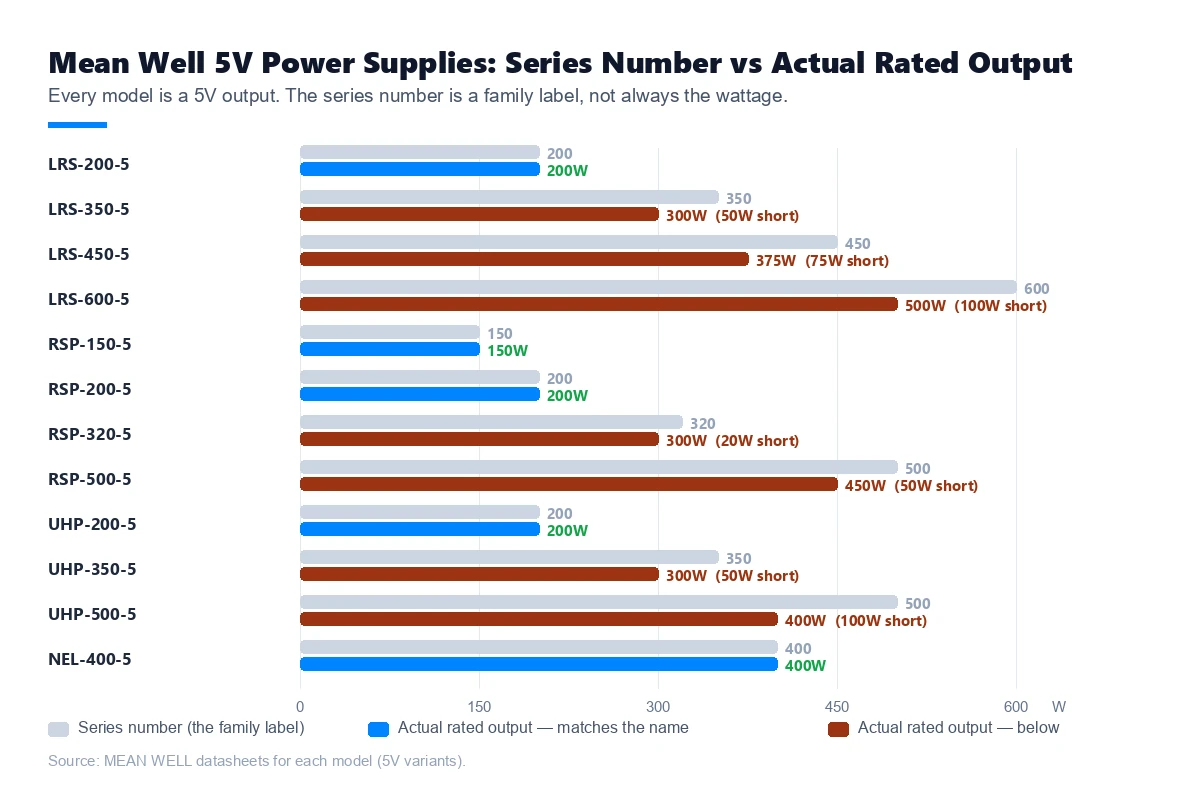
Grey bars are the series number, blue bars are models whose real 5V output matches the name, and dark red bars are models that deliver less.
The practical consequence: a cabinet sized at 350W on the assumption that an LRS-350-5 provides 350W is running that supply at 117% of its rating before any derating is applied. The supply will not fail immediately. It will run hot, age faster, and shut down on over-temperature in a warm ambient — usually after the installation has been signed off.
How to Size an LED Display Power Supply in Four Steps
Sizing is arithmetic, but the order matters, because the first two gates eliminate whole families before you compare a single wattage figure.
- Confirm the mains voltage at the destination. A supply with a selector switch or a narrow input window will not run on both 110V and 230V without being reconfigured. NEL-400-5 is 180–264VAC only and cannot be used in North America or Japan at all.
- Check whether the project requires power factor correction. If the tender, the market or the local grid code calls for EN61000-3-2 compliance, every LRS model and NEL-400-5 is disqualified, because neither family has a PFC stage. That leaves RSP and UHP.
- Add up the real load, then add headroom. Multiply each module’s maximum power by the module count, add the receiving cards, and divide by 0.8. That gives the minimum real 5V rating you need — check it against the actual output column, never the model number.
- Check the derating curve for the real cabinet ambient. Every model on this page loses output as ambient rises, and a sealed outdoor cabinet in direct sun is a very different thermal environment from a bench test at 25°C.
The five gates below compress the same logic into the questions that eliminate models fastest. Work down them in order.
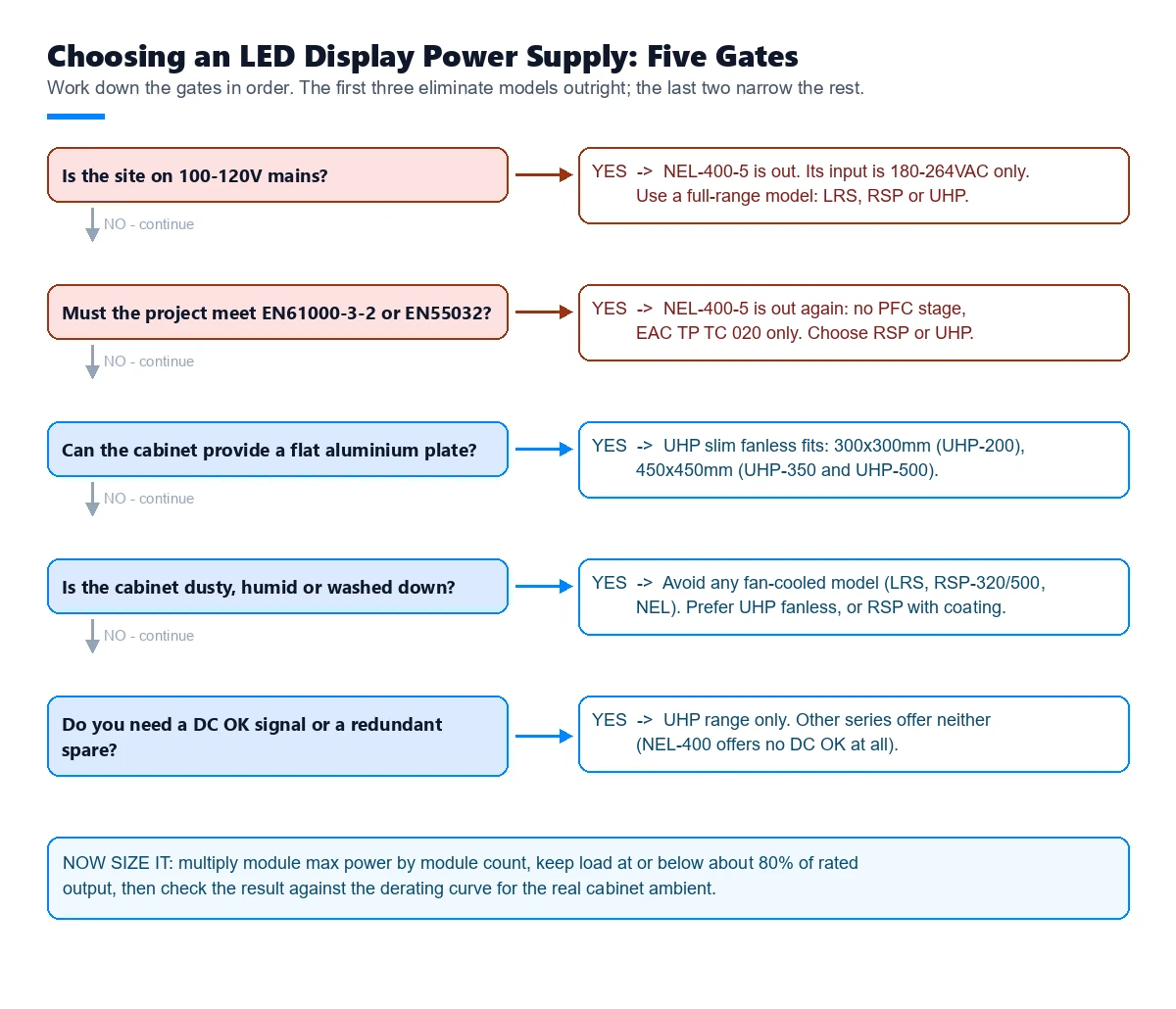
The first two gates eliminate models outright; the last three narrow what remains.
All 12 Mean Well 5V Power Supplies Compared
Every figure below is taken from the MEAN WELL datasheet for that specific 5V model — not from the series datasheet, because series headlines quote the best model in the family and that is the number buyers are usually misled by.
| Model | 5V output | PFC | Cooling | Efficiency | Case (mm) |
|---|---|---|---|---|---|
| LRS-200-5 | 200W / 40A | No | Fanless | 87% | 215 × 115 × 30 |
| LRS-350-5 | 300W / 60A | No | Fan | 83.5% | 215 × 115 × 30 |
| LRS-450-5 | 375W / 75A | No | Fan, 50°C on/off | 87% | 225 × 124 × 35 |
| LRS-600-5 | 500W / 100A | No | Fan, 50°C on/off | 86% | 225 × 124 × 41 |
| RSP-150-5 | 150W / 30A | Yes | Fanless | 87% | 199 × 99 × 30 |
| RSP-200-5 | 200W / 40A | Yes | Fanless | 87% | 215 × 115 × 30 |
| RSP-320-5 | 300W / 60A | Yes | Fan, speed control | 83% | 215 × 115 × 30 |
| RSP-500-5 | 450W / 90A | Yes | Fan | 84% | 230 × 127 × 40.5 |
| UHP-200-5 | 200W / 40A | Yes | Fanless + plate | 91% | 194 × 55 × 26 |
| UHP-350-5 | 300W / 60A | Yes | Fanless + plate | 90% | 220 × 62 × 31 |
| UHP-500-5 | 400W / 80A | Yes | Fanless + plate | 90% | 232 × 81 × 31 |
| NEL-400-5 | 400W / 80A | No | Fan | 84% | 215 × 115 × 30 |
Two patterns stand out once the table is side by side. Efficiency and cooling move together. The three fanless UHP models top the list at 90–91%, and the models that need forced air sit at 83–87%. Efficiency is not a green credential here; it is the number that decides whether a fanless case is physically possible. PFC is a family decision, not a model decision. Every RSP and UHP model has an active PFC stage and no LRS or NEL model does.
Does Your LED Display Power Supply Need Power Factor Correction?
Power factor is the ratio between the power a supply actually uses and the power it appears to draw from the mains. A supply without correction draws current in short, sharp pulses, and those pulses carry harmonic content that the grid has to absorb without doing useful work.
The reason this becomes a purchasing decision rather than an engineering curiosity is that harmonics are regulated. EN61000-3-2 in the European Union and equivalent harmonics limits elsewhere apply to equipment above a rated input power threshold, and a 300W to 500W LED display supply sits above it. A supply with no PFC stage cannot demonstrate compliance with a limit it does not attempt to meet.
- RSP series — built-in active PFC, with power factor above 0.93 to 0.98 depending on model and load. This is the series the letter P in the name refers to.
- UHP series — active PFC as well, and the highest efficiency of the four families. Passive or active PFC is included across the range.
- LRS series — no power factor correction stage. MEAN WELL’s own catalogue treats PFC as the feature that separates LRS from RSP.
- NEL-400-5 — no PFC, confirmed three ways on the datasheet: no PFC block in the block diagram, no power factor row in the specification table, and no EN61000-3-2 entry in the EMC list. Its EMC approvals are EAC TP TC 020 only.
Worth knowing before you sign: some reseller listings describe the LRS-350-5 as having “built-in active PFC, PF > 0.95”. That specification belongs to the RSP series. If your tender requires PFC, an LRS supply will not satisfy it regardless of what the listing says, and the discrepancy is usually discovered at commissioning.
Fanless or Fan-Cooled LED Display Power Supply: Which Survives Your Cabinet?
This decision is less about the supply than about the cabinet it goes into, and it is the one buyers most often get backwards. A fanless supply is not automatically the more reliable choice — it is the more reliable choice in the right enclosure.
When fanless is the correct answer
The UHP family is fanless and needs no air path through the case. That makes it the right choice for dusty, humid or wash-down environments, for acoustic-sensitive rooms such as studios and boardrooms, and for any installation where the supply is sealed inside a cabinet with no filtration. Nothing rotates, so there is no bearing to wear and no fan to draw contaminants across the boards. The trade-off is a mounting rule: the UHP models must be installed onto a flat aluminium plate or a cabinet acting as one, with a suggested plate of 300 × 300mm for the UHP-200-5 and 450 × 450mm for the UHP-350-5 and UHP-500-5, mounted centrally on an even surface. At 90% efficiency and 400W output the UHP-500-5 still has roughly 40W of heat to move through that plate.
When fanless is a mistake
A fanless supply in a sealed, unventilated box is worse off than a fan-cooled one, because convection needs somewhere for the heat to go. If the enclosure cannot reject heat, the fanless unit simply soaks. Two LRS models are fanless — the LRS-200-5 and the RSP-150-5 and RSP-200-5 in the RSP family — and each of them carries a derating curve that assumes free air around the case.
What a fan actually costs you
In a fan-cooled supply the fan is typically the first component to fail, and at 5V it runs continuously because the output stage is always hot. On the LRS-450-5, LRS-600-5 and the RSP models, the fan is switched by an internal sensor at around 50°C, which softens the duty cycle indoors but does nothing in a warm cabinet where the sensor never drops back below the threshold. If the cabinet is accessible for maintenance and the air is clean, a fan-cooled supply is the cheaper way to reach high current. If it is not accessible, specify fanless and design the thermal path instead.
110V or 230V: Which LED Display Power Supply Works on Your Mains?
Mean Well splits its 5V range into supplies with a full-range input and supplies with a selector switch, and getting this wrong is the failure that cannot be fixed on site.
| Input type | Models | Works on 110V | Works on 230V |
|---|---|---|---|
| Full range, no switch | RSP-150-5 (85–264VAC), RSP-200-5 (88–264VAC), RSP-320-5 (88–264VAC), RSP-500-5 (85–264VAC), all UHP models | Yes | Yes |
| Selector switch | LRS-200-5, LRS-350-5, LRS-450-5, LRS-600-5 (90–132VAC / 180–264VAC) | Yes, switch set to 115V | Yes, switch set to 230V |
| 230V only | NEL-400-5 (180–264VAC, 254–370VDC) | No | Yes |
The NEL-400-5 is the model to watch. Its input window is 180–264VAC, which rules out the United States, Canada, Japan, Taiwan and Mexico entirely — not as a preference but as a physical impossibility. It also means the datasheet’s set-up time, hold-up time and inrush figures are quoted at 230VAC only, so there is no 115V performance data to fall back on.
The LRS switch is a real risk, not a formality. Four LRS models carry a 115/230V selector. If a unit ships configured for 230V and is energised on a 110V supply — or worse, the reverse — the result is a dead supply, and on a multi-cabinet job it is the kind of error that takes out a batch of units at first power-up. Where the destination is uncertain, a full-range RSP or UHP model removes the failure mode entirely, and that is worth more than the price difference.
One further input detail that affects specification: the LRS-600-5 derates its output current to 90A on inputs below 110VAC, so its real capacity at 5V is 450W rather than 500W in North America. That is the same figure the RSP-500-5 delivers with PFC and lower ripple, which makes the RSP worth comparing directly before defaulting to the LRS on price.
LRS vs RSP vs UHP vs NEL: Which Mean Well Series Fits Your Project
The four families are not a ladder from cheap to expensive. They are four different answers to the same question, and the right one depends on which constraint binds hardest on your project.
| Series | Choose it when | Do not choose it when |
|---|---|---|
| LRS | Budget drives the decision, the market does not regulate harmonics, and the installation is a standard ventilated cabinet. Four models from 200W to 500W, and the LRS-200-5 is fanless. | The tender requires PFC, the destination is dust-prone, or you need remote on/off or a monitoring signal. No LRS model has a PFC stage. |
| RSP | Power factor correction is required, the destination mains is uncertain, or the cabinet needs a fanless supply at 150W to 200W. Full-range input across the family. | Cabinet depth is tight. The RSP-500-5 needs 40.5mm and 230mm of length, well beyond the 30mm profile of the smaller models. |
| UHP | The cabinet is sealed, dusty, humid or noise-sensitive; efficiency matters; or you need a DC OK signal or a redundant pair. Highest efficiency of the four families at 90–91%. | You cannot provide a flat aluminium mounting plate of the specified size. The UHP models are not free-standing; they are plate-mounted by design. |
| NEL | You are on 230V, need exactly 400W at 80A, and PFC is not required. A single-model family whose name matches its output. | The destination is 110V — it will not run at all. Also avoid where PFC is required, where efficiency matters (84%, the lowest here) or where you need a DC OK signal. |
Two of these comparisons come up often enough to state plainly. RSP-500-5 against LRS-600-5: the RSP delivers 90A against the LRS’s 100A, but it adds PFC, specifies lower ripple and noise, and on 110V mains the LRS is derated to 90A and 450W anyway — so outside 230V markets the two are closer than their names suggest. UHP-500-5 against RSP-500-5: the UHP gives 400W fanless against the RSP’s 450W with a fan. You are trading 50W for the removal of the only moving part, and in a sealed outdoor cabinet that trade is usually correct.
Full Specifications for Each Mean Well 5V Supply
Each page below covers one model against its own datasheet: complete electrical specifications, the mechanical drawing and terminal assignment, the derating curve, the specific traps in that part number, and the cases where it is the wrong choice. Start with the family that fits, then open the model you are considering.
LRS-200-5 · 200W
5V 40A, fanless free-air convection in a 215 × 115 × 30mm case. The bottom of the LRS range and one of the five models whose 5V output matches its name.
LRS-350-5 · 300W
5V 60A — the industry-standard 300W supply for LED cabinets, and the widest-documented model in the range. Fan-cooled with thermal on/off control.
LRS-450-5 · 375W
5V 75A in a taller 225 × 124 × 35mm case, with 87% efficiency. The efficiency sweet spot of the high-current LRS trio.
LRS-600-5 · 500W
5V 100A, derated to 90A below 110VAC input. The highest current in the range, and the 41mm case height that comes with it.
RSP-150-5 · 150W
5V 30A, fanless, active PFC and full-range 85–264VAC input with remote on/off. The smallest PFC supply in the range.
RSP-200-5 · 200W
5V 40A, fanless in a 1U 30mm case with active PFC above 0.95 and a conformal coating option for humid or coastal sites.
RSP-320-5 · 300W
5V 60A, and the point in the RSP range where cooling changes from fanless to a speed-controlled fan. Rated for operation at 5000m altitude.
RSP-500-5 · 450W
5V 90A with active PFC, remote on/off and remote sense, plus an 18ms hold-up time for graceful shutdown on brownout.
UHP-200-5 · 200W
5V 40A at 91% efficiency — the highest of any 5V model here — in a fanless 26mm-tall case, with DC OK and redundant options.
UHP-350-5 · 300W
5V 60A, 90% efficient and fanless in a 31mm case. Needs a 450 × 450mm aluminium mounting plate to hold its rating.
UHP-500-5 · 400W
5V 80A fanless at 90% efficiency, with a redundant-function variant for parallel N+1 pairs. About 40W of heat still leaves through the plate.
NEL-400-5 · 400W
5V 80A where the name finally matches the output, but 180–264VAC input only, no PFC, 84% efficiency and a 20ms hold-up time.
Certifications to Check Before You Specify a Power Supply
The four families do not carry the same approvals, and the differences are large enough to decide a project. The distinctions below are the ones that actually appear in tenders.
- Safety approval is the baseline. The LRS, RSP and UHP models on this page are certified to UL 62368-1, the current standard for audio/video and IT equipment. NEL-400-5 carries UL 62368-1 and EAC TP TC 004 only — there is no European safety approval on its datasheet.
- EMC is where the families diverge most. RSP and UHP models list EN55032 emissions and EN61000-4 immunity series approvals. NEL-400-5 lists EAC TP TC 020 for both emission and immunity, which is a Eurasian customs-union approval and not a European one.
- Harmonics compliance follows PFC. If a project references EN61000-3-2, only the RSP and UHP families can meet it, because only they have a PFC stage to begin with.
- Read the ratings that are easy to miss. The RSP-320-5 is rated for operation at up to 5000m altitude, which matters for highland installations. RSP-200-5 offers an optional conformal coating, which is the correct answer for coastal or humid sites where a fanless supply alone is not enough protection.
One genuine ambiguity worth knowing about, because it will come up if you compare datasheets: the UHP-200-5 sheet and the UHP-350/500 sheets do not present the EN61558 reference in identical terms — one frames it as an approval, the others as a design reference. If EN61558 is a hard requirement in your tender, confirm the specific model and batch documentation with the supplier rather than relying on the series headline. This page states the discrepancy instead of resolving it, because resolving it would require documentation we do not have.
Documentation practice matters as much as the certificate list. For any of these models, ask for the batch’s own documentation from the manufacturer’s website rather than trusting a listing photograph — the serial and date-code check is the only reliable way to confirm provenance.
When a Mean Well LED Display Power Supply Is the Wrong Choice
Every model on this page is the wrong choice for somebody, and it is more useful to say which than to pretend otherwise.
- Your cabinet has no thermal path at all. A fanless UHP needs a flat aluminium plate of the specified size; a fan-cooled unit needs air it can move. A fully sealed box with no plate and no ventilation will overheat any supply on this page, regardless of brand.
- You need 5V at more than 100A from one unit. The LRS-600-5 tops the range at 100A. Above that you are into parallel configurations, and only the UHP redundant variants are designed for paralleling. Distributing across several supplies is usually the better answer anyway, because it keeps cabinet wiring short.
- The destination is 110V and you have chosen NEL-400-5. It will not run. This is not a marginal risk; it is a non-starter.
- The tender requires PFC, EN61000-3-2 or European EMC approvals. That eliminates all four LRS models and NEL-400-5, leaving the RSP and UHP families.
- You need current monitoring, remote on/off or a redundant pair. Only the RSP and UHP families offer these functions, and DC OK in particular is a UHP feature. NEL-400-5 offers neither DC OK nor a redundant function.
- The load is genuinely small. Below roughly 150W at 5V, a DIN-rail or open-frame industrial supply is usually cheaper, smaller and easier to mount than an enclosed LED display supply, and the enclosed format buys you nothing.
Saying this plainly is part of the reason these pages are worth reading: a supplier who tells you when not to buy a part is easier to trust on the specifications where you cannot check the answer yourself.
LED Display Power Supply Troubleshooting: Five Failures
Most power-supply faults in an LED display present as something else first, which is why they get misdiagnosed as control problems. These five cover the large majority of field failures on the models in this range.
The display dims or flickers on high-brightness content
This is usually an undersized supply rather than a control fault. Full-white content draws maximum current, the 5V rail sags, and the driver ICs respond by losing brightness uniformity. Measure the 5V rail at the far end of the cabinet under a full-white test pattern rather than at the supply terminals; voltage drop across the cabinet distribution is the usual culprit, and if the rail itself is low at the supply, the unit was sized on the model number instead of the real output.
The supply shuts down after an hour or two, then recovers
Over-temperature protection, almost always caused by a cabinet whose real ambient is far above the bench figure the derating curve was read at. A fan-cooled unit in a dusty cabinet makes this worse, because the fan is moving less air than it did when new. Check for blocked or clogged fans and confirm the installation ambient against the curve.
Nothing starts, but the supply is new
On the four LRS models, check the 115/230V selector switch before anything else. A correctly built cabinet with the switch in the wrong position behaves exactly like a dead supply. This failure is common enough on multi-unit jobs that the switch position is worth photographing at commissioning.
The supply powers up repeatedly in a hiccup cycle
Hiccup mode is the intended response to overload or short circuit, not a defect. It means the load is drawing more than the supply will deliver, or there is a short on the 5V distribution. Disconnect the load in sections to isolate it. Worth noting for specification: some models recover from over-voltage protection automatically, while others require the input to be cycled, so a fault that clears itself on one model may need a manual re-power on another.
The supply runs hot with a load well inside its rating
Check efficiency and ambient together. At 84% efficiency a 450W output produces roughly 86W of heat inside the case — the arithmetic follows directly from the datasheet efficiency figure, and it is why the lower-efficiency models in this range need forced air. If the load is genuinely modest and the cabinet is still hot, the supply is the wrong family for the enclosure rather than the wrong wattage.
If the supply checks out and the fault remains, the next place to look is the signal chain rather than the power chain. Sending cards, receiving cards and the processor can produce symptoms that look identical to a power fault, and the LED control system collection covers that side of the cabinet.
Mean Well LED Display Power Supply: Frequently Asked Questions
QWhat size power supply do I need for an LED display?
Add up the maximum power of every module and receiving card in the cabinet, then divide by 0.8 so the supply runs at about 80% of its rating. Compare that figure against the supply’s real 5V output, not its model number. A cabinet calculating to 240W needs a supply rated at 300W or more at 5V, which is the LRS-350-5, RSP-320-5 or UHP-350-5 rather than a 250W part.
QWhy does a Mean Well 5V power supply deliver less than its model number?
Because Mean Well names a series after the highest wattage any model in that family can reach, and the highest figure normally belongs to the highest-voltage output. The 5V model shares the family current ceiling, so it lands short. Seven of the twelve 5V models work this way: the LRS-350-5 gives 300W at 60A, the RSP-500-5 gives 450W at 90A, and the UHP-500-5 gives 400W at 80A.
QIs 5V a good choice for an LED display power supply?
It is the standard for the modules themselves, because it keeps driver heat and voltage drop inside the module manageable. The cost is high current: 200W at 5V is 40A, so cabinet distribution, terminals and cable cross-sections all have to be sized for that current rather than for the wattage. Where a cabinet can use 24V or 48V modules instead, the same power moves at a fraction of the current.
QHow much power does an LED screen need?
It scales with module count and content, not with screen area alone. The figure that matters for sizing is the maximum power of the modules at full white, which is typically quoted per module or per square metre on the module datasheet. Sum the maximum, not the average, because full-white content is what determines peak current draw and it is the case that trips an undersized supply.
QDo I need a power supply with PFC for an LED display?
It depends on the market and the tender. If the project references EN61000-3-2 or an equivalent harmonics limit, you need a supply with a PFC stage, which means the RSP or UHP family. Neither the LRS series nor the NEL-400-5 has a PFC stage, so neither can demonstrate that compliance. Where no such requirement applies, an LRS supply is the cheaper route to the same current.
QCan I run an LED display power supply on 110V?
On most of them, yes. The RSP and UHP families have full-range inputs covering roughly 85 to 264VAC with no selector switch. The four LRS models cover 90 to 132VAC and 180 to 264VAC through a selector switch that must be set correctly. The NEL-400-5 is the exception: its input is 180 to 264VAC only, so it cannot be used in North America, Japan, Taiwan or Mexico at all.
QWhich Mean Well series is best for LED displays?
There is no single best, because the families solve different constraints. RSP is the general-purpose choice when PFC and full-range input are needed. UHP is best for sealed, dusty or noise-sensitive cabinets because it is fanless and the most efficient. LRS is the budget option where harmonics are not regulated. NEL is a 230V-only single-model family for exactly 400W.
QDo LED display power supplies need a fan?
Not always, but the models above roughly 200W at 5V generally use one because low-voltage high-current conversion produces more waste heat. Two LRS models and two RSP models are fanless. The three UHP models are fanless at every wattage up to 400W, but they must be mounted on a flat aluminium plate of a specified size so the case itself becomes the heatsink.
QWhat is the difference between LRS and RSP power supplies?
Power factor correction and input range, mainly. The RSP series has a built-in active PFC stage with power factor above 0.95 and a full-range input with no selector switch. The LRS series has no PFC stage and uses a 115/230V selector switch. RSP also adds functions such as remote on/off, and at the same output the RSP model usually specifies tighter ripple and noise.
QHow do I install an LED display power supply?
Mount it on a flat surface with the specified screw size, keep the ventilation clear on fan-cooled models, and size the output cabling for the full current rather than the wattage. Fanless UHP models must be fixed to an aluminium plate or a cabinet acting as one, mounted centrally, with an even surface or thermal grease at the interface. Set the LRS voltage selector to match the mains before first power-up.
QWhat happens if the power supply is undersized?
In the short term, brightness instability on high-load content as the 5V rail sags. In the medium term, elevated case temperature, faster ageing of the output capacitors and over-temperature shutdowns in warm cabinets. The supply usually does not fail outright, which is why an undersized installation is often signed off and then returns as an intermittent fault months later.
QHow long do Mean Well LED display power supplies last?
Datasheet MTBF figures for this range run into the millions of hours on a Telcordia or MIL calculation, and the LRS models with published figures quote 1.5M to 3.35M hours. Those numbers assume the rated ambient and a load inside the rating. Real service life is dominated by case temperature, so the two things that shorten it most are running the supply above 80% of its real 5V output and installing it in a cabinet that is hotter than the derating curve assumed.