
1890x560mm LED Poster Display
560 × 1,890 mm · P1.75–P2.5 · 27 kg on wheels · Spliceable
The 1890x560mm LED poster display is a 1.06 m² freestanding screen on a wheeled base that one person can move — supplied by EXCEL LED, a trusted LED display manufacturer for global B2B system integrators.
Quick Answer
What it is: the 1890x560mm LED poster display is a freestanding direct-view screen with a 560 × 1,890 mm display area — 1.06 m². Pitches: P1.75, P2.0 and P2.5 mm indoor, or P2.5 mm outdoor. Weight: 27 kg on a wheeled base. Panels: 33 mm thin. Service: rear access, magnetic modules. From EXCEL LED: factory-direct supply with the control system pre-configured.
What Is a 1890x560mm LED Poster Display?
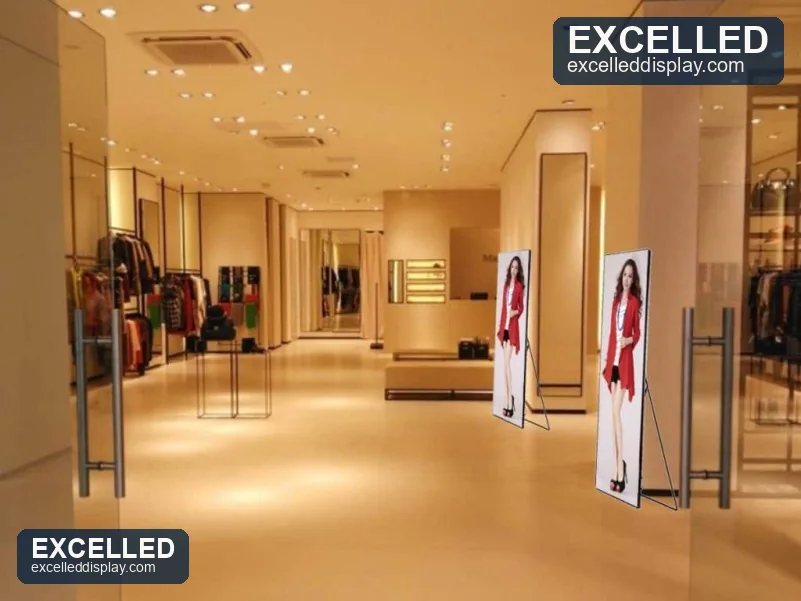
The 1890x560mm LED poster display is the most widely sold poster-format LED screen on the market, and the size itself is the reason. Its 560 × 1,890 mm display area gives 1.06 m² of canvas in a footprint under 600 mm wide — tall enough to read from across a concourse, narrow enough to stand against a pillar or a shop window without blocking the aisle.
The 1890x560mm LED poster display is a complete unit, not a cabinet that needs building. The frame, the modules, the receiving card, the media player and the wheeled base all ship assembled. Setup is a matter of standing it up, switching it on and loading content. Nothing is bolted together on site.
The format is also sold as a floor-standing LED poster display, an LED poster screen, a 560×1890 LED poster, a portable LED poster display, and by suppliers who market it as 3-in-1 digital signage because the same cabinet can be floor-standing, wall-mounted or hung. You will also see it written as 1890*560mm with an asterisk; it is the same cabinet and the same dimensions.
What separates one supplier’s 1890x560mm LED poster display from another’s is almost entirely invisible in a product photo: which module is fitted, which driver IC, how the cabinet handles heat, and whether the receiving card is a genuine branded part or a clone. Those are the differences that decide whether the screen still looks uniform after two years. This page gives the full parameter set for the cabinet so you can compare builds line by line rather than by photograph.
1890x560mm LED Poster Display Cabinet, Module and Frame Data
The physical layer of the 1890x560mm LED poster display is where the practical differences live. The numbers below are what determine whether the unit fits your doorway, whether one person can move it, and what happens when a module fails.
| Item | Value |
|---|---|
| Display Area | 560 × 1,890 mm — 1.06 m² |
| Cabinet Outer Frame | 570 × 1,920 mm |
| Panel Thickness | 33 mm (screen panel only) |
| Base Depth | 330 mm including wheel base |
| Module Size | 210 × 280 mm, layout 9 × 2 (typical) |
| Net Weight | 27 kg per unit (typical) |
| Mobility | Built-in wheels on indoor models |
| Installation | Floor-standing / wall-mount / hanging |
| Service Access | Rear service, magnetic modules |
| Splicing | Spliceable side by side into a larger video wall with no visible seam between cabinets |

1890x560mm LED Poster Display Module Layout and Cabinet Construction
The 9 × 2 module layout is the detail that makes this cabinet serviceable. Eighteen 210 × 280 mm modules tile the face, and each one is held magnetically. A failed module is released from the rear with a service tool and replaced without dismantling the screen, without touching the neighbouring modules, and without recalibrating the whole canvas.
At 33 mm the 1890x560mm LED poster display is thin enough to sit almost flush against a wall while still leaving room behind it for the receiving card, the power supply and the cabling. That internal volume is also what allows rear service — a screen built this thin but sealed at the back would have to come off the wall for every repair.
The base is a separate assembly: a 330 mm deep foot on castors that the panel slots into. It is what lets the same cabinet be a floor-standing unit in one installation and a wall-mounted panel in the next, which is the practical meaning behind the 3-in-1 description suppliers use.
1890x560mm LED Poster Display Specifications by Pitch
The table below covers the complete 1890x560mm LED poster display platform in all four standard configurations. Indoor units use SMD 3-in-1 modules; the outdoor unit adds a sealed front face and a much higher brightness class. Brightness is quoted throughout as a published minimum — ≥600 nits indoors and ≥4,000 nits on the sealed outdoor build. Suppliers publish typical indoor output of 800–1,100 nits at coarser pitches, which sits above the minimum rather than contradicting it. Running the screen at 70–80% is standard practice indoors and extends LED life. To work from the manufacturer figures directly, download the datasheet for your build before comparing suppliers.
| Parameter | Indoor P1.75 | Indoor P2.0 | Indoor P2.5 | Outdoor P2.5 |
|---|---|---|---|---|
| Pixel Pitch | 1.75 mm | 2.0 mm | 2.5 mm | 2.5 mm |
| LED Type | SMD1415 | SMD1515 | SMD2121 | SMD1921 |
| Brightness | ≥600 nits (published minimum) | ≥600 nits (published minimum) | ≥600 nits (published minimum) | ≥4,000 nits (published minimum) |
| Refresh Rate | ≥1920 Hz (3840 Hz option) | ≥1920 Hz | ≥1920 Hz | ≥1920 Hz |
| Resolution per Unit | 326 × 1097 | 288 × 960 | 228 × 760 | 240 × 640 / 240 × 800 |
| Viewing Angle (H/V) | 160° / 160° | 160° / 160° | 160° / 160° | 140° / 120° |
| Contrast Ratio | 4000:1 (typical) | 4000:1 (typical) | 4000:1 (typical) | 4000:1 (typical) |
| Grey Scale | 16 bit, >281 trillion colours (typical) | 16 bit, >281 trillion colours (typical) | 16 bit, >281 trillion colours (typical) | 16 bit, >281 trillion colours (typical) |
| Frame Rate | 60 fps (typical) | 60 fps (typical) | 60 fps (typical) | 60 fps (typical) |
| Protection Level | IP30 (typical) | IP30 (typical) | IP30 (typical) | IP65 front / IP54 rear |
| Lifetime | 80,000 h to 50% brightness (typical) | 80,000 h to 50% brightness (typical) | 80,000 h to 50% brightness (typical) | 80,000 h to 50% brightness (typical) |
| Power Input | 100–240 V AC, 50/60 Hz | 100–240 V AC, 50/60 Hz | 100–240 V AC, 50/60 Hz | 100–240 V AC, 50/60 Hz |
| Operating Temperature | −10 °C to +40 °C (typical) | −10 °C to +40 °C (typical) | −10 °C to +40 °C (typical) | −20 °C to +50 °C (typical) |
| Operating Humidity | 10%–90% RH, non-condensing | 10%–90% RH, non-condensing | 10%–90% RH, non-condensing | 10%–90% RH |
| Control Mode | WiFi / USB / App / Cloud | WiFi / USB / App / Cloud | WiFi / USB / App / Cloud | WiFi / USB / App / Cloud |
| Service Access | Rear service, magnetic modules | Rear service, magnetic modules | Rear service, magnetic modules | Rear service |
Configuration Notes for the 1890x560mm LED Poster Display
Choosing the Pixel Pitch for a 1890x560mm LED Poster Display
Pitch is the single decision that moves cost the most, and on this cabinet the choice is unusually clean: three indoor options spread across a 1.06 m² face, so the trade-off is purely between viewing distance and budget.
| Pitch | Resolution | Comfortable From | Sits Where |
|---|---|---|---|
| P2.5 mm | 228 × 760 px | 2.5 m and beyond | Aisles, concourses and entrance halls where nobody stops close |
| P2.0 mm | 288 × 960 px | Around 2 m | Retail floors and reception desks with passing traffic |
| P1.75 mm | 326 × 1097 px | From about 1.5 m | Shop windows, product walls and any screen customers read up close |

The rule of thumb that works in practice is one metre of viewing distance per millimetre of pitch. A P2.5 unit is clean from 2.5 m, a P1.75 unit from 1.5 m. That is a working figure for video and photographic content, not a hard limit — text is less forgiving than images, so if the screen will carry menus, prices or schedules, read the specification one step finer than the video content suggests.
Two practical notes on specifying a 1890x560mm LED poster display. First, resolution matters more than pitch on this cabinet. A P1.75 unit renders 326 × 1097 px, which is enough to run a portrait 1080p asset with room to spare; a P2.5 unit at 228 × 760 px will visibly soften fine text. Second, splicing changes the arithmetic. Four P2.5 units side by side produce a 2,240 × 1,890 mm canvas at roughly 912 × 760 px — a wide, low-resolution band. If the plan is to splice, either accept the lower pixel density or budget for the finer pitch from the start.
Indoor and Outdoor 1890x560mm LED Poster Display Builds
The same product family covers both environments, but the two builds are engineered differently and priced differently. Choosing between them is a question of where the screen lives, not of how much protection you can afford.
| Attribute | Indoor ★ | Outdoor |
|---|---|---|
| Brightness | ≥600 nits (published minimum) | ≥4,000 nits (published minimum) |
| Protection | IP30 (typical) | IP65 front / IP54 rear |
| Display area | 560 × 1,890 mm | 600 × 1,600 or 600 × 2,000 mm |
| Viewing angle | 160° / 160° | 140° / 120° |
| Operating range | −10 °C to +40 °C | −20 °C to +50 °C |
| Wheels | Built in as standard | Optional |
| Choose when | The screen is under a roof | Rain, dust or direct sun reach it |
On a 1890x560mm LED poster display used indoors, ≥600 nits is the right answer and buying brighter wastes money. A shopping mall, an airport concourse or a shop window with no direct sun needs a screen that is comfortable to look at, not one that out-punches daylight. Running an indoor unit at 70–80% of maximum also extends LED life measurably, which is why the brightness ceiling matters less than the uniformity across the face.
Outdoors, the calculation reverses. ≥4,000 nits is not marketing headroom; it is the minimum needed to stay readable with the sun on the face. The sealed front face that delivers IP65 is the same structure that narrows the viewing angle and lifts the cost, and the wider operating range of −20 °C to +50 °C comes from a build that tolerates more thermal cycling.
Three Ways to Install a Floor-Standing LED Poster Display
The cabinet is described as 3-in-1 because the same panel serves three mounting methods without modification. Which one you use is decided by the site, and it is worth settling before the order rather than after delivery.
- Floor-standing on the wheeled base. The default. The panel slots into the 330 mm deep base and the unit stands free at 1,920 mm overall height. Because the base carries castors, the screen can be repositioned for a promotion, a seasonal layout or a cleaning schedule without any tools. This is the configuration for retail floors, hotel lobbies and exhibition stands.
- Wall-mounted. The base comes off and the panel fixes flat to a wall through the same frame. At 33 mm thick it sits close to the surface, and rear service access is preserved as long as a service gap is left behind it. Use this where floor space is contested or where the screen should read as part of the architecture rather than as a freestanding object.
- Hanging. Suspended from a ceiling or truss using the frame’s mounting points, the panel becomes signage that no one can walk behind or knock over. This is the configuration for atriums, transport hubs and anywhere the floor below must stay clear.
Whichever method is chosen, the same three site conditions decide whether a 1890x560mm LED poster display installation goes smoothly: a level surface, a power outlet within reach of the standard cable, and enough clearance for a person to reach the rear of the panel for service. A 27 kg unit is light enough for two people to lift, but nothing about the design expects it to be carried — the wheels exist so that it does not have to be.
Splicing Poster Units Into a Larger Video Wall
A single 1890x560mm LED poster display is a poster. Several units butted together become a video wall, and this is where a 560 mm wide cabinet becomes more useful than a wider one: the narrow module lets you build a canvas in increments instead of committing to one large panel.
The cabinets align side by side with no visible seam between them, and because every unit in the family is calibrated to the same reference, a row of units drives as one continuous image rather than as a row of separate screens. That is the difference between a video wall and a shelf of posters.
How Many 1890x560mm LED Poster Display Units to Splice
| Units in a row | Canvas size | Resolution at P2.0 | Typical use |
|---|---|---|---|
| 2 units | 1,120 × 1,890 mm | 576 × 960 px | Double-width window display |
| 3 units | 1,680 × 1,890 mm | 864 × 960 px | Feature wall behind a reception desk |
| 4 units | 2,240 × 1,890 mm | 1,152 × 960 px | Concourse or exhibition backdrop |
| 6 units | 3,360 × 1,890 mm | 1,728 × 960 px | Full stage or atrium wall |
Three rules keep a spliced row looking like one screen. Keep the pitch identical across every unit — mixing a P1.75 unit into a row of P2.5 units shows immediately as a change in pixel density, because the module boundaries no longer line up. Keep the batch identical — LEDs are binned by brightness and colour at the factory, and two production batches side by side will differ visibly even at the same nominal specification. And keep the content designed for the finished canvas, not for a single unit; a 16:9 asset stretched across a 2,240 × 1,890 mm row will be cropped, not fitted.
For deployments that run alongside fixed screens, these units sit on the same control ecosystem, so an operator can drive a row of 1890x560mm LED poster display units and the venue’s permanent indoor LED screens from one place.
Content Control on a 1890x560mm LED Poster Display
The 1890x560mm LED poster display is built to be operated by shop or marketing staff, not by a technician. Four delivery routes cover almost every deployment, and all four are available on the same cabinet.
Publish over WiFi
Send content to the screen from a laptop or phone on the same network, with no cable and no visit to the unit.
Load from a USB drive
The fallback that always works. Plug in a drive with the content and a schedule file; no network needed on site.
Schedule from a phone
Playlists, on/off times and brightness schedules are set from the supplier’s app by whoever runs the site.
Publish remotely
Where no local network exists, a 4G module lets a head office push content to units in different cities.
Both synchronous and asynchronous playback are supported. Synchronous mode drives the screen live from a player or a computer, which is what a live event or a synchronised multi-screen wall needs. Asynchronous mode stores the playlist inside the unit and runs unattended, which is what a shop window needs. A single 1890x560mm LED poster display can be switched between the two.
For larger estates the units use the same control ecosystem as fixed installations. Controllers such as NovaStar and Colorlight are widely supported, so a venue can manage a row of 1890x560mm LED poster display units alongside its permanent outdoor LED display without training staff on a second system. The control system is pre-configured at the factory, which means a PC and its configuration tools — NovaLCT and equivalents — are needed only for a one-off firmware update or a calibration change, not for daily operation.
For a deeper look at receiving cards, sending cards and processors, see the LED control system collection.
1890x560mm LED Poster Display or the Folding Format?
Two poster platforms are in production side by side, and the numbers must not be mixed between them. The distinction is simple: this page covers the 560 × 1,890 mm cabinet, the most widely sold poster size, which stays assembled and moves on wheels. The other platform folds.
| Attribute | 1890x560mm ★ | Folding format |
|---|---|---|
| Display area | 560 × 1,890 mm (1.06 m²) | 640 × 1,920 mm (1.23 m²) |
| Transport | Stays assembled, moves on castors | Folds to 1,090 × 646 × 90 mm |
| Weight | 27 kg (typical) | 43 kg, aviation aluminium |
| Pixel pitch range | P1.75 – P2.5 mm | P1.25 – P2.5 mm |
| Surface technology | SMD face | GOB encapsulated |
| Built-in audio | Not standard | Two speakers as standard |
| Choose when | It stays in one place | It has to be packed and moved |
For a screen that will spend its life in one building, the 1890x560mm LED poster display is the cheaper and simpler answer. It is lighter, it needs no folding mechanism to maintain, and it lifts onto a van when it has to move. For a rental fleet, a touring activation or a shop that stores its screens between campaigns, the folding format earns its premium.
The full specification for the folding platform is on the tri-fold LED poster display page. Both formats are catalogued under poster LED display types, alongside the general guidance on siting, control and maintenance that applies to either.
What a 1890x560mm LED Poster Display Costs
No manufacturer publishes a list price for this platform, because it is configured rather than catalogued. Any figure you see quoted as a single number for a 1890x560mm LED poster display is either a specific configuration or an outdated one. What can be done honestly is to name the factors that move the price of a 1890x560mm LED poster display and the order of magnitude they move it by.
What Drives the Price of a 1890x560mm LED Poster Display
- Pixel pitch. The largest single factor. Going from P2.5 to P1.75 roughly doubles the number of LEDs and driver channels on the same 1.06 m² face, and the finer modules cost more per unit area as well. On this cabinet the spread between the cheapest and the most expensive indoor build is wider than the spread between any two suppliers selling the same pitch.
- Indoor or outdoor. The sealed front face, the brighter module and the wider temperature range all add cost, and the outdoor cabinet is a different size, so it is not a direct comparison on price per square metre.
- Refresh rate option. The 3840 Hz option on the P1.75 build adds a modest premium. It is worth taking if the screen will appear on camera and worth declining if it will not.
- Branded or cloned control parts. A genuine branded receiving card costs more than a clone and behaves differently over five years. This is the most common place where two quotations for an apparently identical screen diverge.
- Quantity and shipping. Units ship assembled, so freight is volumetric rather than weight-based; the wheeled base in particular consumes container space. Ordering several units together reduces the per-unit freight share.
Price Bands for a 1890x560mm LED Poster Display
Public dealer and retail listings for this format typically sit in a band from roughly USD 900 to USD 2,500 per unit depending on pitch and build. Those figures come from published dealer and retail listings, not from factory quotations, and they carry the reseller’s margin as well as their own shipping and duty. A factory-direct quotation for a comparable build is normally below that band, which is why the band is more useful as a sanity check on a reseller’s price than as a budget figure.
Maintenance and Spare Parts for a Floor-Standing Poster Display
Maintenance on the 1890x560mm LED poster display happens at module level. Nothing in the design expects a unit to be returned to the factory, and nothing expects the screen to be taken off the wall to replace a single failed part.
| Interval | Task | Why It Matters |
|---|---|---|
| Weekly | Wipe the face with a dry microfibre cloth | Dust dulls the image and traps heat on the module surface |
| Monthly | Check for dead pixels and reseat any lifted module | A single dead pixel is cheap to fix early and obvious to viewers |
| Monthly | Verify brightness uniformity across the canvas | Detects driver degradation before it shows as visible banding |
| Quarterly | Inspect the wheel base, castors and the panel joint | The base carries every repositioning and takes the wear |
| Quarterly | Check the power supply, cabling and connectors | Loose connectors are the most common cause of an intermittent dark panel |
| Annually | Full calibration check against a reference colour target | Restores colour consistency, especially across spliced units |
Spare Parts to Hold for a 1890x560mm LED Poster Display
Because the modules on a 1890x560mm LED poster display are magnetic and serviced from the rear, a failed module is a fifteen-minute job with the screen left in place. The parts worth holding in stock are the ones with lead times: spare modules in the pitch you ordered, a spare receiving card, a spare power supply, and a set of castors. Modules are the item most likely to be needed and the item most likely to be out of stock years later, because LED bins change between production runs. Ordering two or three spare modules with the original order is the cheapest insurance in the whole project.
Where a 1890x560mm LED Poster Display Works Best
The 1.06 m² portrait format of the 1890x560mm LED poster display suits anywhere a printed poster would go but the message needs to move. Four settings account for most of the units that leave the factory.

- Retail floors and shop windows. The format replaces a printed poster at the same size and can be changed in minutes rather than days. Two or three units spread around a store let a campaign run consistently without printing anything.
- Hotel and corporate lobbies. Wayfinding, event schedules and brand content on the same screen. The wheeled base means the layout can move for an event and move back afterwards without a facilities team.
- Exhibitions and trade stands. A stand needs to change between shows, and shipping printed graphics to each venue is slower and more expensive than pushing new content. Two units make a backdrop; four make a wall.
- Transport hubs and public concourses. Where the message is directional or informational rather than promotional, the fine-pitch options keep text legible at the distances people actually stop and read.
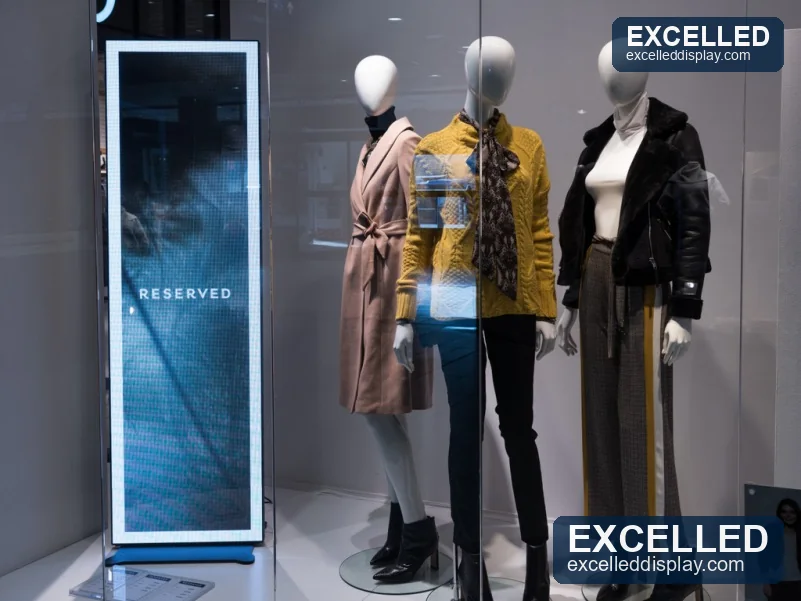
The same cabinet appears in completed projects across several sectors; a selection is catalogued in the installed LED display projects gallery. Where the requirement is finer pitch than P1.75, the indoor fine pitch LED display range covers the next step down, and the P2.5 LED display page covers the same pitch in fixed-installation cabinet formats.
How to Choose a 1890x560mm LED Poster Display
Five decisions settle almost every 1890x560mm LED poster display project. Taking them in order avoids the common mistake of choosing a pitch first and discovering the constraints afterwards.
- 1. Where will it stand, and for how long? A screen that stays in one building does not need a folding chassis, an outdoor rating or a battery. A screen that tours needs all three considered. Settle this before anything else, because it rules whole configurations in or out.
- 2. How close will people get? Measure the distance from the screen to the nearest point a person is likely to stand, not the average distance across the room. One metre per millimetre of pitch is the working rule. Reading text up close pushes the specification one step finer.
- 3. Will it be photographed or filmed? If the screen will appear in anyone’s video, take the 3840 Hz option. If it will not, decline it and put the money into pitch instead.
- 4. One screen or a wall? Decide the finished canvas before choosing the pitch. Splicing four units doubles the width but leaves the pixel density where it was, and a wall that is meant to look like one screen has to be bought as one batch.
- 5. Who will run it day to day? If the answer is shop staff rather than an AV team, the app and USB routes matter more than the controller brand, and factory pre-configuration saves a site visit.
1890x560mm LED Poster Display: Frequently Asked Questions
Q1 What is a 1890x560mm LED poster display?
It is a freestanding direct-view LED screen with a display area of 560 × 1,890 mm, which is 1.06 m². The cabinet is 570 × 1,920 mm overall and 33 mm thick, and it stands on a wheeled base at 1,920 mm tall. It ships assembled and is available in three indoor pitches and one outdoor build.
Q2 How much does a 1890x560mm LED poster display cost?
There is no published list price, because the platform is configured rather than catalogued. Public dealer and retail listings generally fall between roughly USD 900 and USD 2,500 per unit depending on pitch and build, and those figures include a reseller’s margin. A factory-direct quotation for a comparable build is normally lower. Pitch is the largest single factor.
Q3 Is there a datasheet or manual download for this model?
Yes. Every order ships with an operation manual covering setup, content publishing, splicing and the maintenance schedule, and a datasheet is issued against the specific configuration you order rather than as a generic document. Firmware and configuration files for the control system are supplied as downloads, so a unit in the field can be updated on site instead of being returned.
Q4 How many units do I need to build a video wall?
That depends on the canvas you want. Two units give 1,120 × 1,890 mm, three give 1,680 × 1,890 mm, and four give 2,240 × 1,890 mm at roughly 1,152 × 960 px in P2.0. Decide the finished size first, then choose the pitch, because splicing does not increase pixel density.
Q5 How do I configure content without a computer on site?
Content can be published over WiFi, loaded from a USB drive, scheduled from a phone app, or pushed remotely over 4G where no local network exists. Both synchronous and asynchronous playback are supported, so a stored playlist can run unattended or the screen can be driven live. The control system is pre-configured at the factory before dispatch.
Q6 What is the difference between this and the folding LED poster?
Size, weight and transport. This 1890x560mm LED poster display has a 560 × 1,890 mm display area and weighs around 27 kg, and it stays assembled on castors. The folding platform has a 640 × 1,920 mm display area, weighs 43 kg, carries a GOB face and built-in speakers, and folds to a 90 mm package for transport. They are two products, so their numbers are not interchangeable.
Q7 Does a 1890x560mm LED poster display work outdoors?
An outdoor build exists in the same family, rated IP65 front and IP54 rear with brightness of at least 4,000 nits and an operating range of −20 °C to +50 °C. It is a different cabinet, though: its display area is 600 × 1,600 mm or 600 × 2,000 mm, and its viewing angle is narrower. The indoor unit should not be used outdoors.
Q8 Which pixel pitch should I choose for a 1890x560mm LED poster display?
Work from the closest distance a viewer will stand, allowing about one metre per millimetre of pitch. P2.5 suits 2.5 m and beyond, P2.0 suits around 2 m, and P1.75 is comfortable from about 1.5 m. If the screen carries menus, prices or schedules rather than video, choose one step finer than the video content suggests.
Q9 Is the control system compatible with NovaStar and Colorlight?
Controllers such as NovaStar and Colorlight are widely supported on this platform, so the units can be managed alongside a venue’s existing fixed screens without training staff on a second ecosystem. Both synchronous and asynchronous playback are supported. Confirm the receiving card brand on the quotation if you need to match an installed system exactly.
Q10 Does it come with wheels?
Indoor models ship with a built-in wheeled base as standard, on a foot that is 330 mm deep. The castors let one person reposition the unit without lifting it. Outdoor models list wheels as optional. The base detaches, so the same panel can be wall-mounted or hung instead if the site changes.
Q11 Can it be wall-mounted or hung from a ceiling?
Yes. The cabinet is described as 3-in-1 because the same panel is designed for floor-standing, wall-mount and hanging installations. At 33 mm thick it sits close to a wall, and rear service access is preserved as long as a service gap is left behind the panel. Hanging uses the frame’s own mounting points.
Q12 What warranty and support come with it?
Standard warranty is two years covering LED dead pixels, driver IC failure and power supply faults, with an extended term available on request. Because service is at module level from the rear, support is normally resolved by shipping a replacement module rather than returning a unit. Full terms are confirmed against your order specification before production begins.
1890x560mm LED Poster Display Supplied Factory-Direct
The 1890x560mm LED poster display is the format to choose when a printed poster is the right size but the wrong medium. Its 1.06 m² canvas is large enough to be seen across a room, its 33 mm panel is thin enough to sit against a wall, and its 27 kg wheeled base is light enough for one person to move. Three indoor pitches cover distances from 1.5 m to beyond 2.5 m, and the cabinets splice into a wall without a visible seam between units.
Related reading: poster LED display buying guide · tri-fold LED poster display · fold up and down folding LED screen · LED display solutions