
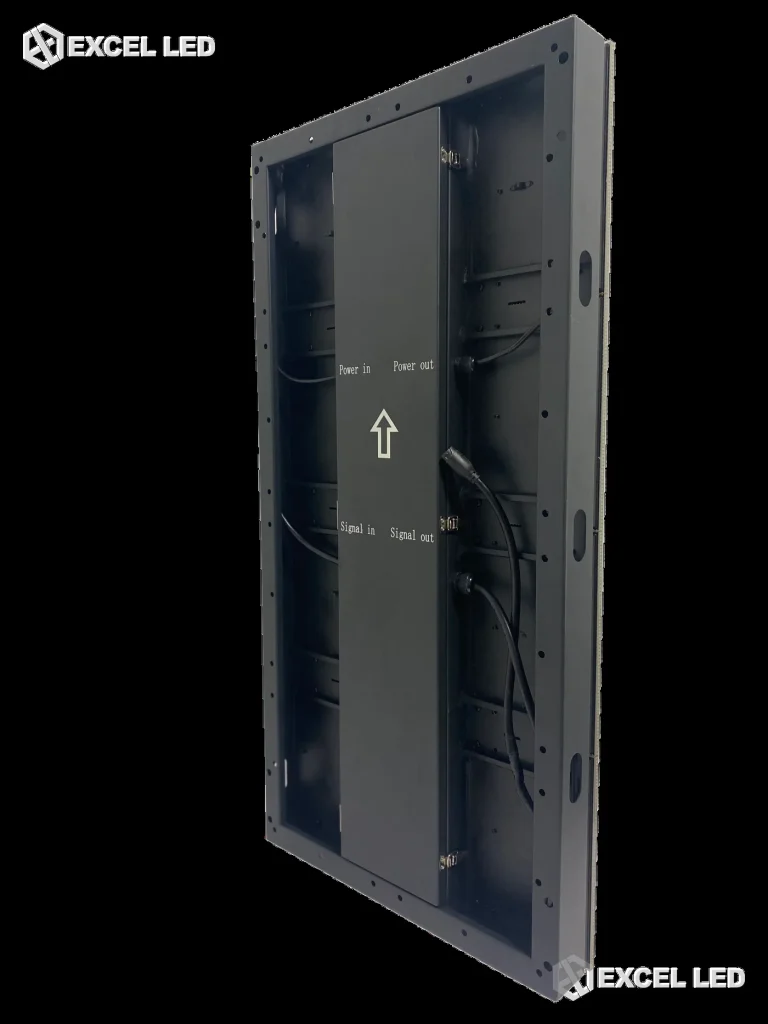
500x1000mm Interactive LED Floor Screen
Iron Cabinet Series · P2.97–P6.25 · 2,000 kg/m² Load · Front Maintenance
A walkable interactive LED floor screen built for permanent installations — steel 500×1000 mm cabinets, 2,000 kg/m² load rating, contactless sensing and full front maintenance — supplied by Excel LED, a trusted LED display manufacturer for global B2B system integrators.

Interactive LED Floor Screen: The Essentials
What is it? A walkable LED floor built from 500×1000×77 mm steel cabinets (22.5 kg each) that displays video content and reacts to footsteps through a contactless opto-magnetic sensor built into each module’s PCB — no cameras, no pressure pads.
How much weight can it take? 1.5–2.0 t/m² (about 2,000 kg/m²). The load path runs through the mask support columns into the cabinet frame, so the display components themselves carry no weight (confirmed).
Which pixel pitches? P2.97, P3.91, P5.2 and P6.25 — the iron cabinet platform starts at P2.97; finer pitches (P1.5–P2.6) live on the aluminum-base COD series.
Best used for? Permanent installations on a budget: nightclubs and bars, shopping-mall atriums, fixed stage floors and exhibition plazas where the floor stays put for years.
How is it maintained? Fully from the front — modules and cabinets are serviced from above, so the floor never needs to be dismantled to swap a module.
Why Venues Choose the Iron Cabinet Interactive LED Floor Screen
Every venue operator knows the failure modes of a cheap dance floor: dead pixels after the first month of heels and trolleys, modules that can only be reached by tearing the whole floor apart, and interaction that triggers randomly or not at all. Those failures are not bad luck — they come from floors where the display components carry the load and where sensing was bolted on as an afterthought.
The Iron Cabinet Series takes the opposite approach. Force is routed through the mask support columns into the bottom shell and then into the cabinet frame, so the LEDs and driver ICs never bear weight. The interactive function is not an add-on: an opto-magnetic wireless sensing chip is built into the module PCB itself, triggering content the moment a person steps on the tile — contactless, with nothing protruding from the walking surface.
Within Excel LED’s interactive floor line-up, this series is the cost-efficient permanent-install option. If your project needs fine pitch at close viewing distance, the interactive LED floor tiles in the aluminum-base COD series go down to P1.5. If it needs to be packed into a flight case every week, the rental LED dance floor screen in the die-cast series is the better tool. For fixed floors in clubs, malls and stages, iron is where the budget math works.
2,000 kg/m² Load
Rated 1.5–2.0 t/m² with a patented load path that keeps weight off the display components (confirmed).
500×1000 mm Format
Two cabinets per square metre — fewer joints, fewer connections and faster installation than small-tile floors.
Front IP54 / Back IP53
Handles cleaning water and spilled drinks from above; sealed rear keeps dust out (confirmed, P2.97–P6.25).
Pitch Range P2.97–P6.25
Four pitch options cover 2–10 m viewing distances, from mall atriums to stage floors (confirmed).
2,000 kg/m² Load-Bearing Interactive LED Floor Screen Structure
A dance floor is furniture first and a display second — it gets stood on, danced on, rolled over by trolleys and occasionally driven over. The engineering question that decides whether a floor LED screen survives is simple: where does the force go?
In common designs the load passes through the mask into the LED board, and dead pixels start appearing wherever the solder joints fatigue. This series uses a different force path: the mask support columns transfer weight into the bottom shell, and the bottom shell into the cabinet frame — the PCB and LEDs carry no structural load. The design is covered by granted Chinese utility-model patents for load-bearing floor-screen structures.

The render above illustrates the principle: a vehicle parked on the floor with the display still running. Based on Excel LED’s project experience, the practical check is not the published rating but the retest after repeated loading — a floor that still shows a flawless image after a full event season is the figure that matters most.
How the Contactless Interactive LED Floor Screen Senses Footsteps
The interactive function uses opto-magnetic wireless sensing: the sensor chip is built into the module PCB, and a step near the surface triggers the content change — no contact required, nothing to wear out on the walking surface (confirmed across the series specification sheets).
Two sensing approaches dominate the low end of the market, and both have structural weaknesses. Capacitive designs need a mask only 0.8–1.0 mm thick to sense through, which leaves the surface too weak for real foot traffic and prone to false triggers. Infrared designs are sensitive to ambient light — strong sunlight and stage lighting cause misfires, and dark objects (black shoes, black rubber soles) reflect too little IR to register. For a nightclub or a mall atrium, both failure modes show up within weeks.
An optical-magnetic design avoids the trade-off: sensing does not depend on the object’s colour or reflectivity, and it is not confused by stage lighting. Content effects — ripples, footprints, colour bursts, games — are rendered synchronously with the main display through the same control system.
Interactive LED Floor Screen Front Maintenance: Fix the Floor Without Lifting It
On floors without front access, a single dead module means cordoning off the area, lifting neighbouring tiles and working underneath — hours of venue downtime for a 15-minute swap. This series is fully front-maintainable: modules are secured for tool-free removal from above, and cabinets themselves can also be serviced from the front.
- Locate — the control system reports the faulty module’s coordinates, so you know exactly which tile to open.
- Remove — take the module out from the walking surface; no dismantling of surrounding tiles.
- Replace — swap in the spare module from your on-site kit and return it to service.
- Verify — run a full-white and full-colour test pattern to confirm the fix before reopening the area.
For permanent installations, we recommend planning 2–4 spare modules per 100 m² as a common planning rule for preliminary sizing — final sparing should be verified against your venue’s usage intensity and maintenance response time.

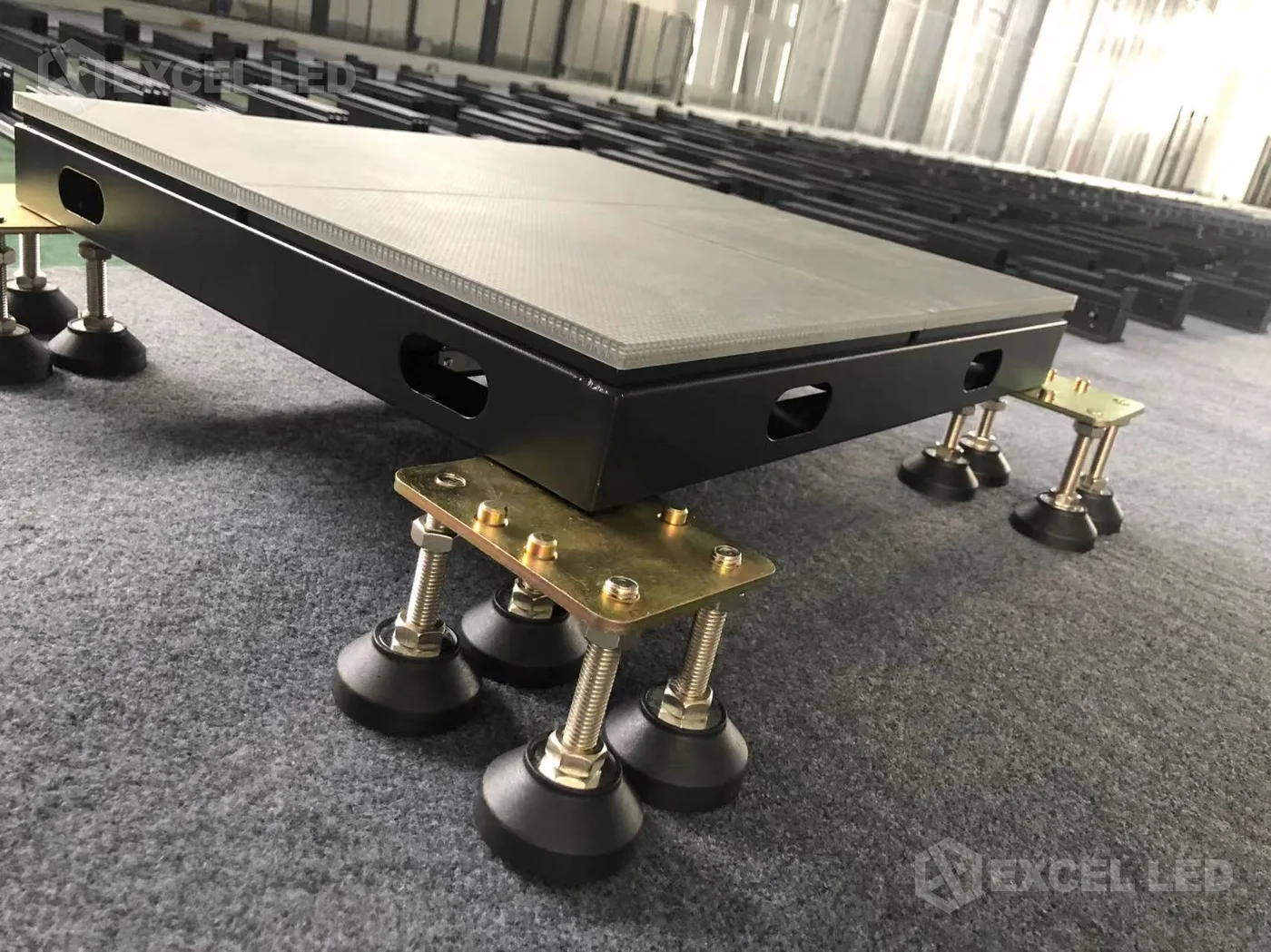
Iron Cabinet Interactive LED Floor Screen Specifications (P2.97–P6.25)
All values below are from the series specification sheet; where two independent documents agreed, the value is marked (confirmed). Values that only appear in marketing materials are not listed.
| Parameter | P2.97 | P3.91 | P5.2 | P6.25 |
|---|---|---|---|---|
| Pixel Pitch | 2.97 mm | 3.91 mm | 5.2 mm | 6.25 mm |
| LED Configuration | SMD1415 | SMD1921 | SMD1921 | SMD1921/2727 |
| Pixel Density | 112,896 dot/m² | 65,536 dot/m² | 36,864 dot/m² | 25,600 dot/m² |
| Module Size / Resolution | 250×250 mm, 84×84 dot | 250×250 mm, 64×64 dot | 250×250 mm, 48×48 dot | 250×250 mm, 40×40 dot |
| Scan Mode | 1/28 | 1/16 | 1/12 | 1/10 |
| Cabinet Size | 500×1000×77 mm (confirmed) | |||
| Cabinet Resolution | 168×336 dot | 128×256 dot | 96×192 dot | 80×160 dot |
| Cabinet Weight | 22.5 kg (confirmed) | |||
| Cabinet Material | Steel (sheet-metal) cabinet | |||
| IP Rating (front / back) | IP54 / IP53 (confirmed) | |||
| Load Bearing | 1.5–2.0 t/m² (confirmed) | |||
| Brightness | 1,000–4,000 cd/m² (confirmed) | |||
| Refresh Rate | 1,920 / 3,840 Hz (confirmed) | |||
| Gray Scale | ≥14 bit (confirmed) | |||
| Viewing Angle (H/V) | 120° / 120° (confirmed) | |||
| Max / Avg Power Consumption | 800 W/m² / 270 W/m² (confirmed) | |||
| Interactive Function | Opto-magnetic wireless sensing, contactless; Interactive / Non-Interactive optional (confirmed) | |||
| Control Mode | Synchronous display with control PC (DVI) (confirmed) | |||
| Input Signals | Composite, S-Video, Component, VGA, DVI, HDMI, HD-SDI (confirmed) | |||
| Operating Environment | 0–40 °C work / −20–60 °C storage; 35–85% RH work / 10–90% RH storage (confirmed) | |||
| Operating Life | ≥100,000 hours (confirmed) | |||
| Installation | Rail installation / adjustable foot installation (confirmed) | |||
| Packaging | Flight case (confirmed) | |||
| Certification | CE / FCC / RoHS / CCC certified models | |||
How to Install a Permanent Interactive LED Floor Screen
The iron cabinet supports two installation methods: rail installation for large continuous floors and adjustable foot installation for floors that need precise height matching to the surrounding surface. Both put the walking surface flush with the finished floor level.
A typical recessed installation workflow runs as follows — the figures below are the manufacturer’s installation-plan data (pit depth 300–650 mm, structure-to-floor clearance 130–170 mm, structure spacing 500/1,000 mm):
- Build the steel structure in the pit — typical pit depth 300–650 mm; verify flatness and fix the structure firmly. Reserve 130–170 mm between the structure’s support surface and the finished floor, with structure spacing at 500 mm or 1,000 mm.
- Place the base supports on the structure at the same 500/1,000 mm spacing.
- Set the first cabinet — start from a corner, engage the cabinet’s locating holes with the support pins, and adjust the support height until the surface sits flush with the floor.
- Lay row by row — after each row, check gaps and level with a spirit level, adjusting any cabinet that sits proud or sunken.
- Finish the edges — add trim strips where required for a clean transition to the surrounding floor.
For load planning: at 22.5 kg per 0.5 m² cabinet, the cabinet layer adds roughly 45 kg/m² before the steel structure — your structural engineer sizes the pit framing from the total dead load plus the 2,000 kg/m² live load rating. Cabling and power run beneath the cabinet layer; a synchronous system connects the control PC to the floor over DVI/HDMI through a sending controller.


Where a 500x1000mm Interactive LED Floor Screen Pays Off
Nightclubs, Bars and Entertainment Venues
A dance floor that reacts to every step is the visual centrepiece of the venue — and the hardest-working surface in the building. For typical nightclub viewing distances of 2–8 m, P3.91 and P5.2 deliver a clean image at a sensible budget; go P2.97 only where guests stand directly over the floor. The 2,000 kg/m² rating and IP54 front take heels, spilled drinks and cleaning crews in stride.
Shopping Mall Atriums and Retail Floors
Mall floors run 12+ hours a day and must survive trolleys and strollers. The aluminum-base series handles premium retail floors at close range, but for large atrium areas where visitors view from a few metres away, the iron cabinet’s lower cost per square metre wins. Recommended pitch: P2.97–P3.91 for atriums viewed from escalators and walkways.
Fixed Stage Floors and TV Studios
For permanent stage floors and studio sets, the iron cabinet provides broadcast-grade refresh (up to 3,840 Hz) for camera work at P3.91–P6.25, depending on how close the cameras get. The front-maintenance design matters here: stage floors get re-cabled and re-configured constantly, and modules must be swappable between shows.

Who Buys the Iron Cabinet Interactive LED Floor Screen
Based on Excel LED’s floor project experience, four buyer groups dominate iron cabinet interactive LED floor screen orders — each reads the same specification sheet with different eyes:
Nightclub and Venue Owners
Owners and facilities managers buying a floor the venue will run for years. Their checklist: the 2,000 kg/m² rating for dancing crowds, the IP54 front against spilled drinks, and module swaps that never close the dance floor.
Mall and Property Operators
Marketing and facilities teams running atrium floors 12+ hours a day. They buy on operating life (≥100,000 hours), average power draw and how easily the content team refreshes scenes — not on the finest pitch.
Fixed-Install AV Contractors
AV and system integrators building permanent stage and studio floors. They need the pit, rail and cable-routing data confirmed in writing, and a supplier who reviews drawings before cabinets ship.
LED Distributors and Dealers
Trade buyers adding a floor line to their catalog. One platform spanning P2.97–P6.25 serves club, mall and stage jobs from a single SKU family, backed by datasheets and a 2-year warranty they can resell behind.
Where these buyers are: the interactive LED floor screen case below is a 90 m² electronics-brand mall installation in Indonesia. Excel LED’s floor references also include a ~300 m² sportswear flagship store in Shanghai and a 36 m² corporate showroom in Guangzhou on the fine-pitch COD platform, plus a 110 m² TV-studio rental in Japan and a custom-shaped event floor in Thailand on the die-cast rental platform.
Interactive LED Floor Screen Case: 90 m² for an Electronics Brand Mall, Indonesia
An international electronics brand’s mall installation in Indonesia used a 90 m² interactive LED floor as the centre-piece of its retail space — customers walking across the floor trigger content that complements the surrounding product displays.
The mall context drives three requirements: all-day operating hours (favouring the ≥100,000-hour operating life and moderate 270 W/m² average power), foot traffic with trolleys (the 2,000 kg/m² load path), and content that stays fresh (synchronous control lets the store’s media team update scenes without touching the hardware).

Based on Excel LED’s experience with mall installations, the decisions that matter most are made before ordering: pit depth and cable routing, spare-module planning, and choosing a pitch that matches the actual viewing lines of the space rather than the specification sheet’s finest option. Share your floor plan and we will mark these up before you commit to a configuration.
Why Every Interactive LED Floor Screen Ships After an Aging Test
Every floor project ships after a powered aging test — the complete floor is assembled in the factory and run at working brightness to flush out early-life failures (weak LEDs, marginal driver ICs, power-supply faults) before the goods leave the plant.

For walkable floors this step carries more weight than for wall screens: a module that fails in a wall is swapped from a lift; a module that fails inside an installed floor costs venue downtime. Based on Excel LED’s engineering practice, we treat the aging report — with photos of your actual floor running — as a standard deliverable, not an optional extra.
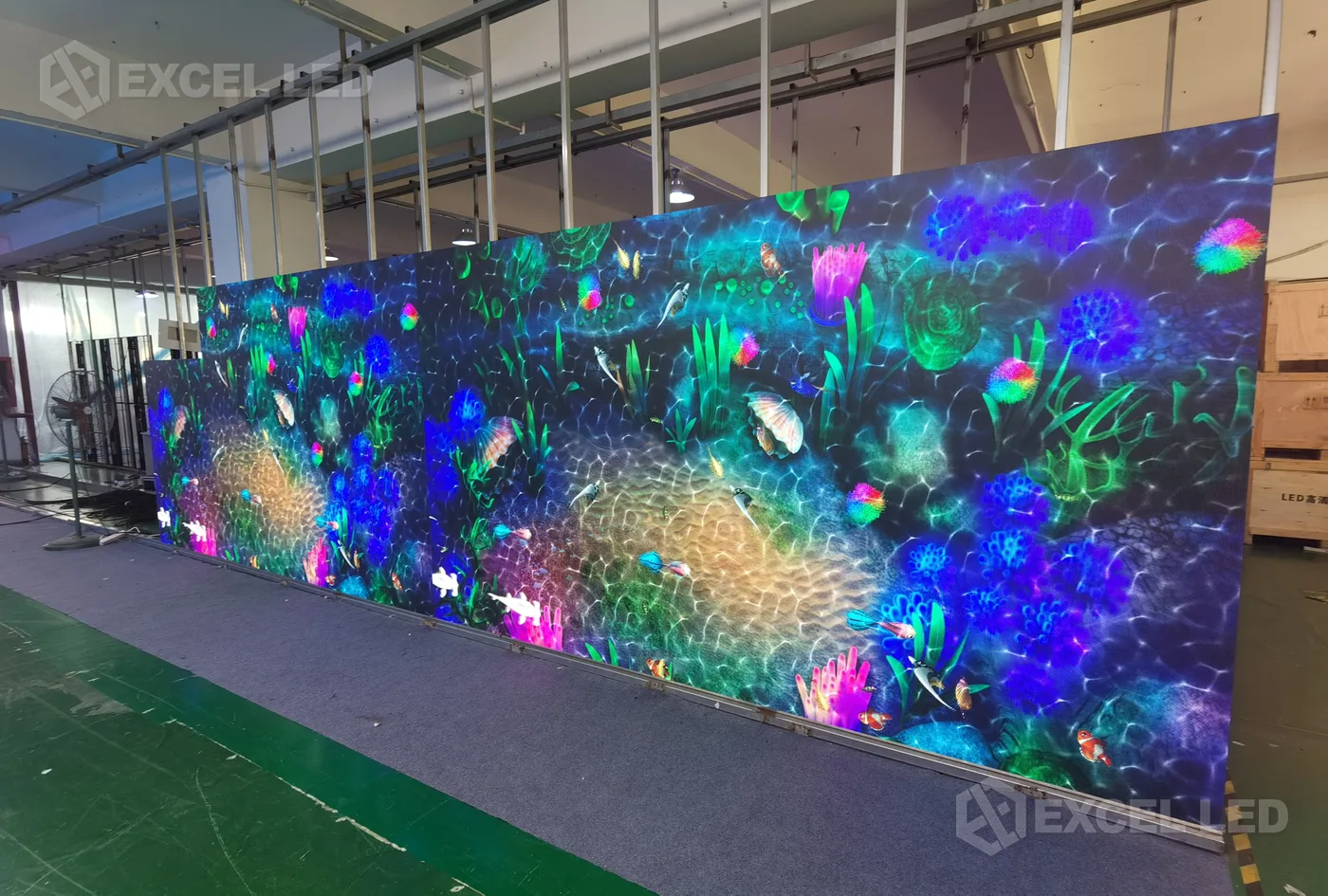
Interactive LED Floor Screen Series Compared: Iron Cabinet vs COD vs Die-Cast Rental
Excel LED’s interactive floor line divides into three cabinet platforms. The right question is not “which is best” but “which matches your installation”:
| Item | Iron Cabinet ★ | Aluminum-Base COD | Die-Cast Rental |
|---|---|---|---|
| Cabinet | Steel 500×1000×77 mm | Aluminum base + die-cast cover 500×500×73 mm | Die-cast aluminum 500×500×82 mm |
| Weight | 22.5 kg (0.5 m²) | 11 kg (0.25 m²) | 11 kg (0.25 m²) |
| Pitch range | P2.97–P6.25 | P1.5–P2.6 (COD) | P1.5–P6.25 (no P5.2) |
| IP rating (front/back) | IP54 / IP53 | IP31 / IP31 | IP65 / IP54 (manufacturer-stated) |
| Positioning | Cost-efficient permanent install | Fine-pitch premium (flagship, XR, museum) | Touring, rental, fast deployment |
| Best for | Clubs, mall atriums, fixed stages | Close-view retail floors, showrooms | Event companies, rental stock |
Who should not: projects needing P1.5–P2.6 close-range resolution (choose the aluminum-base COD series), and rental/touring applications that pack and repack weekly (choose the die-cast rental series).
For the underlying cabinet engineering — how die-cast and sheet-metal designs differ in stiffness, weight and cost — the die-cast aluminum LED cabinet guide and the LED display cabinet collection cover the wider context.
Choosing the Right Interactive LED Floor Screen: Five Decisions Before You Buy
Based on Excel LED’s quotation experience, most floor-screen mistakes are made before the PO is signed. Five decisions decide the outcome:
- Viewing distance first, pitch second. Standing on the floor? You need P1.5–P2.6 (aluminum COD). Viewing from 2–8 m? P2.97–P3.91. Stage-height viewing only? P3.91–P6.25. Buying finer pitch than the space needs is the most common budget waste.
- Interactive or non-interactive. The sensing function is optional per module configuration — a non-interactive floor costs less and suits pure advertising surfaces. Decide per zone, not per project: entrance zones interactive, perimeter non-interactive is a common split.
- Load reality check. Count the worst case honestly — dancing crowds, restocking trolleys, vehicles in the show. 2,000 kg/m² covers most venues; vehicle displays should be confirmed case by case with the factory.
- Structure and pit. A recessed floor needs 300–650 mm of pit depth with a level steel structure. Surface-mounted installations on adjustable feet need a ramp or threshold detail instead. Confirm this with your contractor before the cabinets ship.
- Content and control. The floor is a synchronous display driven from a control PC — plan who runs the content, and budget the media server or playback machine into the project, not just the screen.
What Drives the Price of an Interactive LED Floor Screen
Four factors dominate the quotation: pixel pitch (finer = more LEDs = higher cost per m²), interactive configuration (sensing adds cost per module versus a non-interactive floor), structure work (pit, steel, trim — often comparable to the screen itself), and control/content scope. A useful budgeting habit: price the project per square metre including structure and control, not just the bare cabinets — comparing bare-cabinet prices between suppliers hides the real differences. For typical market ranges, the LED floor display buying guide breaks down rental versus purchase economics in detail.
Download the Full Datasheet (PDF)
The complete interactive floor series datasheet — per-pitch electrical detail, cabinet configurations, COD surface test data and installation facts — is ready to download for your project file. For a per-project configuration review and factory-direct pricing, send your basics through the quote form and it comes back with a real quotation response.
Download the Datasheet (PDF) →
Interactive LED Floor Screen FAQ
Q1How much weight can an interactive LED floor screen hold?
The iron cabinet series is rated for 1.5–2.0 t/m² (about 2,000 kg/m²) — dancing crowds, trolleys and restocking traffic are all within rating. The load path runs through the mask support columns into the cabinet frame, so the display components carry no weight. Vehicle loads should be confirmed with the factory case by case, as point loads differ from distributed loads.
Q2Can a car drive on an LED floor screen?
The 2,000 kg/m² rating is a distributed load. A parked car can be within it, but tyre contact points create high point loads, and turning wheels add lateral stress. If your show includes vehicles on the floor, tell us the vehicle weight and tyre layout during design — we will confirm the configuration rather than guess. The load-bearing render on this page illustrates the design principle.
Q3How does the interactive LED floor detect footsteps?
Each module’s PCB carries a built-in opto-magnetic wireless sensing chip. A step near the surface triggers the corresponding content effect — contactless, with no pressure pads or protruding parts on the walking surface. Unlike infrared sensing, it is not confused by stage lighting or dark shoes; unlike capacitive designs, it does not require an ultra-thin fragile mask.
Q4Can you turn the interactivity off?
Yes. Interactive and non-interactive configurations are optional per project, and zones can be mixed — for example an interactive centre dance floor with non-interactive perimeter advertising areas. A non-interactive floor reduces cost per square metre where reaction to footsteps has no value.
Q5How do you repair a module in an installed floor?
From the front. Modules are removable from the walking surface without dismantling neighbouring tiles, and the control system reports the faulty module’s coordinates so you open exactly one tile. We recommend keeping 2–4 spare modules per 100 m² on site as a preliminary planning rule — final sparing depends on usage intensity.
Q6Is the floor waterproof? Can it handle spilled drinks?
The iron cabinet series carries an IP54 front / IP53 rear rating — spilled drinks and cleaning water from above are within design intent. It is not a rain-exposed outdoor product; permanent outdoor use requires a confirmed outdoor-rated configuration. Avoid standing pools of liquid and pressure-washing the seams.
Q7Which pixel pitch should I choose for a nightclub or mall?
Match pitch to the closest meaningful viewing line. Guests standing on or beside the floor: P2.97. Mall atriums viewed from a few metres: P2.97–P3.91. Stage floors viewed from stage distance: P3.91–P6.25. In our quotation experience, most venues over-specify pitch — the budget saved buys the interactive content that guests actually remember.
Q8How deep does the floor pit need to be?
A typical recessed installation needs 300–650 mm of pit depth: steel structure, cabling and the cabinet layer with its adjustable supports. The structure surface sits 130–170 mm below finished floor level. Surface-mounted installations with adjustable feet avoid the pit but need a ramp or threshold detail. Confirm both with your contractor before ordering.
Q9How long does an interactive LED floor last?
The series is rated for ≥100,000 hours of operating life at specification conditions — over a decade of all-day mall schedules. Brightness degrades gradually rather than failing suddenly; periodic calibration keeps the floor uniform. The practical service life depends more on maintenance quality and load discipline than on the LED rating itself.
Q10What is included in the warranty?
Excel LED provides a 2-year warranty as standard on floor screen projects, covering LEDs, driver ICs and power supplies. Spare modules, front-maintenance access and the factory aging report are part of standard delivery. Extended warranty terms can be discussed for permanent installations — ask for the detail with your quotation.
Q11LED floor screen or interactive projection — which is better?
They solve different problems. Projection is cheaper per square metre but fails in ambient light, needs mounting height, and shows no image underfoot brightness. An interactive LED floor screen delivers full brightness under stage lighting, carries real foot traffic, and runs 24/7. For permanent venue floors in lit environments, LED wins; projection suits dark rooms with light foot traffic and tight budgets.
Q12How is the floor packed and shipped?
Cabinets ship in flight cases, with modules, power and data cabling packed to survive international freight. Permanent-install projects typically ship in one coordinated batch matched to your site schedule. Ask for the packing list with your quotation so your freight forwarder can plan the receiving side.
500x1000mm Interactive LED Floor Screen — Built for Venues That Stay Open
A permanent floor lives or dies on the decisions made before installation: the load path, the pitch matched to real viewing lines, the pit detail, the spare-module plan. The Iron Cabinet Series packages those decisions into a cost-efficient 500×1000 mm platform with a 2,000 kg/m² rating, contactless opto-magnetic interaction and full front maintenance — a floor your operations team can actually live with.
Related reading: LED floor screen collection · LED floor display buying guide · LED display cabinet collection