
Folding LED Screen
Fold Up and Down Style LED Display · 2,180 × 646 × 450 mm · P1.25–P2.5 · Folds to 1,090 mm
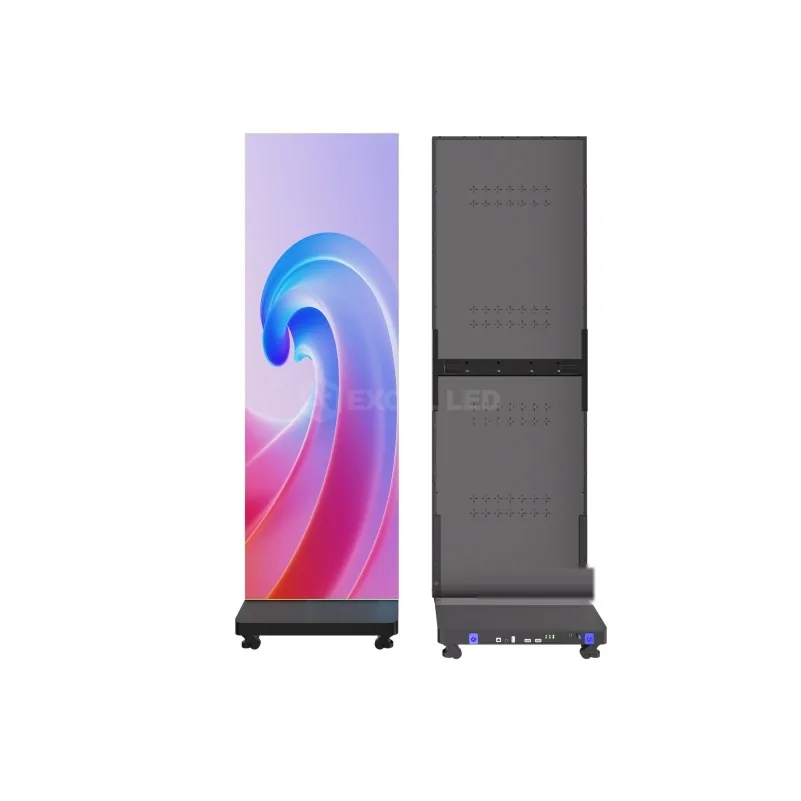
A 2,180 mm freestanding screen that folds in half at mid-height and rolls where the campaign goes — folding LED screens supplied by EXCEL LED, a trusted LED display manufacturer for global B2B system integrators.

Quick Answer
What it is: a folding LED screen that folds up and down — the upper section hinges back over the lower section, halving the standing height. Size: about 2,180 × 646 × 450 mm unfolded, folding to roughly 1,090 mm high and 90 mm thick (typical, confirmed per order). Pitches: P1.25 to P2.5. Protection: GOB face. Operation: app, USB and HDMI, no PC on site. From EXCEL LED: factory-direct supply with pre-configured control.
What Is a Folding LED Screen That Folds Up and Down?
A folding LED screen in the fold up and down style is a freestanding direct-view LED display poster built on a chassis that hinges at mid-height: the top half folds back and down over the bottom half, so a screen that stands about 2,180 mm tall becomes a package roughly 1,090 mm high and 90 mm thick (typical). One person lifts the folded stack, stands it up, unfolds it, and the screen is ready — no cabinet assembly, no wall bracket, no separate media player.
The fold direction is the difference buyers ask about. Where a tri-fold LED poster display folds a 1,920 mm face into three Z-folded sections, this style folds a taller canvas in two, which keeps one hinge instead of two, one fewer failure point on rental fleets, and a wider 646 mm face. Both formats ship from the same production system; the choice is about face height, fold count and how the package travels.
Because suppliers name the format differently, the same hardware appears in listings as a fold up and down LED poster, a two fold folding poster screen, or loosely as a folding LED display. Everything on this page describes the fold-up-and-down chassis shown in the images; only the pitch and configuration change between orders.
How the Fold Up and Down LED Display Mechanism Works: 2,180 mm to 1,090 mm
The chassis splits at mid-height. Fold it and the upper section swings down on a reinforced hinge until it rests flat over the lower section; the folded stack measures about 1,090 × 646 × 90 mm (typical). Unfolding is the reverse: lift, swing up until the latch engages, and the back plate closes flush.
One Hinge
A single mid-height hinge instead of two means fewer alignments and fewer wear points over a rental life.
Slim Folded Pack
The folded depth of about 90 mm lets two or three units ride flat in a van beside the booth kit.
Tool-Free Cycle
Fold, carry and unfold without tools; the wheeled base moves the standing unit between spots in seconds.
Face Protected Inward
The LED face faces inward in transit, with GOB encapsulation guarding the modules it rides against.

Why GOB Encapsulation Matters on a Folding LED Screen
The modules on this chassis carry GOB (glue-on-board) encapsulation, a transparent resin layer poured over the LED face. On a screen that folds, hinges and travels, GOB does two jobs: it cushions the solder joints against the flex that folding introduces, and it resists the knocks, spills and cleaning that a floor-standing screen meets in retail traffic.
The payoff shows up as fewer dead pixels per year on rental fleets rather than as a spec-sheet number. For buyers comparing formats, our GOB LED screen line explains the encapsulation process in depth, and the module close-ups below show the two most ordered pitches on this chassis.


Folding LED Screen Specifications
Values below describe the fold-up-and-down chassis as configured on our platform. Items marked (typical) are platform-level values finalized per order — the confirmed datasheet ships with every quotation.
| Parameter | Specification |
|---|---|
| Unfolded size (with base) | about 2,180 × 646 × 450 mm (typical) |
| Folded size | about 1,090 mm high × 646 mm wide × 90 mm thick (typical) |
| Fold style | Fold up and down — single mid-height hinge, upper section folds over the lower (confirmed) |
| Pixel pitch options | P1.25 / P1.53 / P1.86 / P2.5 (typical) |
| LED package | GOB encapsulation, floor-tile grade (confirmed) |
| Base | Wheeled chassis with universal casters; base height about 140 mm (typical) |
| Splicing | Multi-unit synchronous splicing into a larger canvas (confirmed) |
| Split screen | Free split-screen layouts — image above, video below, or zones per campaign (confirmed) |
| Control | Mobile app one-click publishing; Wi-Fi / USB / HDMI inputs; sync or async (confirmed) |
| Brightness | Indoor-grade; final value confirmed on the order datasheet (to be confirmed) |
| Certification scope | CE / FCC / RoHS on the product platform (typical) |
Brightness, weight and battery options are quoted per configuration rather than published as one number, because they change with pitch and build. The maximum splicing count and loading configuration are also confirmed per build. That keeps this page honest: every exact figure you buy against comes from your order datasheet, which you can download with the quotation, and our engineers confirm the configuration before production. For control-system planning across a larger install, see the LED control system collection.
Pixel Pitch on This Folding Chassis: P2.5 vs P1.86 vs P1.25
Pitch sets both clarity and price, and on a tall close-viewing face it matters more than on a distant billboard. The rule of thumb: minimum comfortable viewing distance in meters roughly equals the pitch number in millimeters.
| Item | P2.5 (Recommended) | P1.86 | P1.25 |
|---|---|---|---|
| Best viewing distance | 2.5 m+ | 1.9 m+ | 1.3 m+ |
| Typical use | Retail floors & events | Mall close-up ads | Premium close-range |
| Relative cost | Lowest | Medium | Highest |
If the project mixes formats, keep one pitch family across the kit so matched content looks consistent — the P2.5 indoor LED display page covers the most ordered pitch in depth, and our P1.25 fine pitch LED display page covers the premium end.
Splicing Folding Posters Into a Larger Canvas
Multiple units lock side by side and sync over Ethernet into one continuous screen — a faster, tool-free way to build a temporary wall than racking cabinets. Because each folding poster folds flat, a four-unit wall travels as four slim stacks and builds in minutes before the doors open.
- Position the units side by side and level them on their casters.
- Link the Ethernet between units and set the splice layout in the app.
- Assign each unit its slice of the master image; frames sync across the row.
- Split zones if the campaign needs them — brand above, product video below.
Content control stays the same as our other poster lines: publish from the phone app over Wi-Fi, load a USB stick, or feed a live HDMI source. Day-to-day operation needs no PC on site, and scheduled playlists change content automatically at opening hours.
Where the Fold Up and Down LED Display Works Best
Folding LED Screen for Rental Fleets and Event Staging
The fold-up-and-down chassis exists for this duty: it rides in a van beside the booth kit, builds before the aisles open, and moves between city stops without a crane hour. Splicing turns two or four units into a stage backdrop for the same trip.
Folding LED Screen for Retail Floors and Brand Counters
One staff member rolls the unit to a new spot and republishes content the same day a promotion changes. Front-facing service keeps maintenance simple when the unit sits against glass.
Folding LED Screen for Showrooms, Exhibitions and Weddings
High-impact motion content in spaces where nothing can be drilled — the screen stands where the event needs it, then folds into the car. For fixed-install alternatives, compare the formats in our indoor LED screen range.
Fold Up and Down vs Tri-Fold LED Display: Which Fold Style Fits?
Both formats fold flat for transport; they differ in face height, fold count and package shape. The honest comparison:
| Item | Fold Up and Down (Recommended) | Tri-Fold |
|---|---|---|
| Fold count | One hinge (two sections) | Two hinges (three sections) |
| Face canvas | ~2,180 mm tall class | 640 × 1,920 mm |
| Folded package | ~1,090 × 646 × 90 mm | 1,090 × 646 × 90 mm |
| Best for | Taller canvas, fewer hinges, simple fold cycle | Standardized 640×1920 content, three-section load spread |
| Full spec page | This page | tri-fold LED poster display |
Buyers comparing the flat format that never folds should read the 1890x560mm LED poster display page — it is the lowest-cost poster in the family and the right call when the unit stays put.
Setup, Maintenance and Spare Parts for the Folding LED Display Chassis
Setup is a two-minute cycle: unfold on the floor, stand the unit on its base, power it on, and publish from the app. No tools, no crane, no install crew — the same plug-and-play logic as the rest of our poster family.
- Unfold and latch. Swing the upper section up until the mid-height latch engages.
- Power on. A standard outlet starts the built-in player with the last playlist.
- Publish. App over Wi-Fi, USB stick, or HDMI input; scheduled playlists run unattended.
- Front service. Modules, power supplies and the receiving card are accessible from the front.
Spare modules ship with every order, and remote diagnostics resolve most issues before a part is dispatched. Our LED screen manufacturing overview shows the production and burn-in process behind this folding poster display. Deployments from our factory floor are collected in the LED display case library.
What a Folding LED Screen Costs
Quotes move mainly with pitch, package and configuration — a P2.5 unit and a P1.25 unit on the same chassis can differ several-fold, and battery builds add a power option that mains-only units do not carry. We deliberately publish configuration drivers instead of a stale list price:
| Cost Driver | How It Moves the Price |
|---|---|
| Pixel pitch | The largest single factor — P1.25 carries roughly four times the LED count of P2.5 per square meter. |
| Fold chassis | The hinge, latch and reinforced back plate add cost over a fixed cabinet; they are the point of the format. |
| Power build | Mains-only is standard; battery builds add cells, charging and weight — quote per configuration. |
| Order quantity | Fleet orders of 5–10+ units price differently from single samples; spares ratio affects the package. |
Decide the pitch from viewing distance first, the fold style from how often the unit travels, then compare quotations on equal configurations. For a formal number, use the quote form below — our engineers confirm availability and the exact configuration for your market before pricing.
Folding LED Screen: Frequently Asked Questions
Q1What is a folding LED screen in the fold up and down style?
It is a freestanding LED poster whose upper section hinges back and down over the lower half. A screen standing about 2,180 mm tall folds to roughly 1,090 mm high and 90 mm thick, so one person can carry it, and it unfolds without tools wherever the campaign needs it.
Q2How is it different from a tri-fold LED poster display?
The tri-fold folds its 640 × 1,920 mm face into three Z-folded sections on two hinges; this style folds a taller canvas in two on one hinge. Fewer hinges mean fewer alignment and wear points, while the taller face suits venues that want more vertical impact from a single unit.
Q3Which pixel pitch should I choose?
Match pitch to the closest viewing distance. Retail floors watched from 3 m or more suit P2.5; mall close-up positions around 2 m suit P1.86; premium counters within about 1.3 m justify P1.25. Finer pitch than the distance requires only adds cost with no visible gain.
Q4How many units can be spliced into one large screen?
Units connect over Ethernet and sync as a row or grid; how many you can configure depends on the controller of the build you order. Because each unit folds flat, a multi-unit wall travels as several slim stacks and assembles in minutes — faster than racking traditional cabinets for a temporary event.
Q5Does the folding hinge wear out?
The hinge is a reinforced, rated mechanism designed for repeated rental cycles, and GOB encapsulation cushions the module flex that folding introduces. As with any moving part, follow the fold cycle correctly — unlatch before folding, never force it — and inspect the latch during routine service.
Q6How do I configure and publish content to the screen?
Three ways: the mobile app over Wi-Fi for one-click publishing, a USB stick for direct import, or HDMI for live sources. Scheduled playlists change content automatically at set times, and split-screen layouts let you run brand content above and product video below on the same face.
Q7Can it run on battery power?
Battery builds are available as a configuration option on the poster platform — they add cells, charging and weight, and suit short outdoor-free events where no outlet is convenient. Availability and runtime are confirmed per order; mains power remains the standard build.
Q8What is the delivery time?
Standard configurations ship in roughly 15–25 working days depending on order size; rush builds can complete in about 10 working days when module stock allows. Sea freight adds 25–35 days to most destinations, air freight 7–12 days. Your quotation confirms the current schedule.
Q9What warranty covers a folding LED screen?
Standard warranty is 2 years covering LED modules, driver ICs and power supplies, with extended terms available for fleet buyers. Spare modules ship with orders, and the front-service design means a failed module is swapped from the front in minutes without moving the unit.
Q10Is the screen suitable for outdoor use?
The standard chassis is an indoor unit. Covered positions — under awnings, arcades or in window bays — suit higher-brightness grades. For fully exposed outdoor walls, a weatherproof fixed screen from our outdoor lines is the correct tool; folding poster screens are not rated for direct rain.
Q11How heavy is it, and can one person move it?
The chassis is engineered for single-person handling: the folded stack lifts like a case, the standing unit rolls on its base casters, and the fold cycle needs no second person. Exact weight is confirmed on your order datasheet because it changes with pitch and power build.
Q12Do you support cloud fleet management?
Yes. Cloud platforms monitor every unit online, push scheduled playlists across a fleet, and raise alerts if a unit goes offline — useful for mall deployments running dozens of units. Single-unit phone publishing remains available for smaller setups that skip the platform layer.
Q13How much does the fold up and down poster cost?
Public dealer listings for comparable foldable posters run from about $1,400 at the category’s entry level to roughly $5,400–$7,500 for name-brand foldable units. Pricing is configuration-driven — pitch, power build and quantity — so factory-direct pricing is usually lower. Request a quote for your exact configuration.
Q14Is there an operation manual and datasheet download?
Yes. Every order ships with a confirmed datasheet and an operation manual covering the fold cycle, app publishing, splicing setup and front-service procedures. Documentation downloads are provided with the order, and our support team walks new crews through the first setup remotely.
Folding LED Screen Supplied Factory-Direct by EXCEL LED
The fold up and down style is the tallest poster in our family that still folds into a van: one hinge, a GOB face, splicing and app control on a wheeled chassis. Pick the pitch from your real viewing distance, confirm the configuration with our engineers, and the screen ships with spare modules and a confirmed datasheet. Fixed-install comparisons live in our indoor LED screen lines, and the full poster family is mapped in the poster LED display guide.
Related reading: Tri-Fold LED Poster Display · 1890x560mm LED Poster Display · Poster LED Display Guide · LED Control System Collection · LED Display Case Library