
Mean Well LRS-350-5 Power Supply
5V 60A · 300W rated · fan cooled · 215 × 115 × 30mm · UL 62368-1 · 3.35M hour MTBF
The enclosed 5V switching supply that most LED display cabinets are built around — 60A at 5V, 300W rated, a 9-pin screw terminal block and a 30mm low-profile case that fits inside a standard 1U cabinet — supplied by Excelled Display, LED display manufacturer and component supplier for global B2B integrators.

Mean Well LRS-350-5 Power Supply at a Glance
What is it? The LRS-350-5 is the 5V model in the MEAN WELL LRS-350 series of enclosed single-output switching power supplies. It converts 90–132VAC or 180–264VAC mains into a regulated 5V DC output at up to 60A, in a 215 × 115 × 30mm metal case with a built-in fan and a covered 9-pin screw terminal block.
How much power does it actually deliver? 300W rated, not 350W. The “350” in LRS-350 is the series name; 5V × 60A = 300W. Only the higher-voltage models in the same series reach the full 350W figure. This single point is misstated on a large share of reseller listings, so it is worth confirming against the official LRS-350-5 datasheet before you size a cabinet.
What does it take in? 90–132VAC / 180–264VAC selectable by a switch on the unit, or 240–370VDC with the switch set to 230VAC, at 47–63Hz. Typical AC current draw is 6.8A at 115VAC and 3.4A at 230VAC, with a cold-start inrush current of 60A.
What protections are built in? Overload (110–140% of rated output power, hiccup mode with automatic recovery), over-voltage (5.75–6.75V on the 5V model, hiccup mode) and over-temperature shutdown, plus short-circuit protection. All three recover automatically once the fault clears.
How does it stay cool? A built-in DC fan with thermal on/off control: the datasheet specifies the fan switches on at 50°C or above and off at 40°C or below. Working temperature range is −25 to +70°C with derating, and the unit is rated for operation up to 5,000m altitude.
What is it used for? LED display modules and cabinets, LED strip and signage power, and industrial control panels. Configuration, MOQ and pricing from our sales team.


What the “350” in LRS-350-5 Actually Means: 5V 60A Is a 300W Supply
Most sourcing mistakes on this part happen before anyone opens a datasheet. The model number reads like a power rating, so a buyer assumes an LRS-350-5 is a 350W power supply, orders it for a screen that needs 340W, and finds out at commissioning that the supply is rated 300W. The confusion is baked into the naming: LRS-350 is the series, and the number after the dash is the output voltage, not the wattage.
The rated power of every model in the series, straight from the MEAN WELL specification table, shows why the “350” only holds at the top of the voltage range:
| Model | Output voltage | Rated current | Rated power |
|---|---|---|---|
| LRS-350-3.3 | 3.3V | 60A | 198W |
| LRS-350-4.2 | 4.2V | 60A | 252W |
| LRS-350-5 | 5V | 60A | 300W |
| LRS-350-12 | 12V | 29A | 348W |
| LRS-350-24 | 24V | 14.6A | 350.4W |
| LRS-350-48 | 48V | 7.3A | 350.4W |
Every model in the series shares one 60A current ceiling at the low-voltage end. Power is current multiplied by voltage, so the same 60A that produces 350W at 48V produces only 300W at 5V. Nothing is defective or derated — that is simply how a constant-current-limited supply behaves across a voltage range.

LRS-350-5 Specifications: The Datasheet Parameters That Matter on a Screen
The table below is transcribed from the MEAN WELL LRS-350 series specification sheet for the 5V model. Where a parameter is quoted, it carries the same conditions the manufacturer specifies — most readings are taken at 230VAC input, rated load and 25°C ambient, which is worth remembering when a measurement on site does not match the sheet.
| Parameter | LRS-350-5 specification |
|---|---|
| DC output voltage | 5V, adjustable 4.5 ∼ 5.5V via the ADJ. potentiometer |
| Rated current | 60A, current range 0 ∼ 60A |
| Rated power | 300W (series is named “350”; see the model table above) |
| Ripple & noise (max.) | 150mVp-p, measured at 20MHz bandwidth with a 12″ twisted pair terminated by a 0.1µF and 47µF parallel capacitor |
| Voltage tolerance | ±3.0% (includes set-up tolerance, line regulation and load regulation) |
| Line regulation | ±0.5% |
| Load regulation | ±2.0% from 0% to 100% rated load |
| Set-up / rise time | 1500ms, 50ms/230VAC at full load (measured at cold first start) |
| Hold-up time (typ.) | 16ms/230VAC, 12ms/115VAC at full load |
| Input voltage range | 90 ∼ 132VAC / 180 ∼ 264VAC selected by switch; 240 ∼ 370VDC with the switch on 230VAC |
| Input frequency | 47 ∼ 63Hz |
| Efficiency (typ.) | 83.5% at 5V (the series ranges from 79.5% at 3.3V to 89% at 48V) |
| AC current (typ.) | 6.8A/115VAC, 3.4A/230VAC |
| Inrush current (typ.) | 60A/115VAC, 60A/230VAC cold start |
| Leakage current | <2mA / 240VAC |
| Overload protection | 110 ∼ 140% rated output power; hiccup mode, recovers automatically after the fault is removed |
| Over-voltage protection | 5.75 ∼ 6.75V; hiccup mode, recovers automatically |
| Over-temperature protection | Shuts down output; recovers automatically once temperature falls |
| Cooling | Built-in DC fan with on/off control — fan on at RTH ≥50°C, off at ≤40°C |
| Working temperature | −25 ∼ +70°C with derating (curve specified for horizontal mounting) |
| Working humidity | 20 ∼ 90% RH, non-condensing |
| Storage | −40 ∼ +85°C, 10 ∼ 95% RH |
| Temperature coefficient | ±0.03%/°C (0 ∼ 50°C) |
| Vibration | 10 ∼ 500Hz, 5G, 10 min per cycle, 60 min each along X, Y and Z axes |
| Withstand voltage | I/P–O/P 3.75KVAC; I/P–FG 2KVAC; O/P–FG 0.5KVAC |
| Isolation resistance | 100MΩ / 500VDC at 25°C, 70% RH |
| Dimensions (L×W×H) | 215 × 115 × 30mm, Case No.207A |
| Weight / packing | 0.76kg per unit; 15pcs / 12.4kg / 0.67CUFT per carton |
| MTBF | 2099.9K hours min. (Telcordia SR-332); 328.6K hours min. (MIL-HDBK-217F at 25°C) |

A note on the AMBIGUITY you will meet elsewhere: reseller listings for this part quote withstand voltage as 1.5KVAC, inrush as 40A, working temperature as −10 to +40°C, and weight as 0.88kg. Every one of those figures contradicts the 2025 MEAN WELL specification sheet for this series. Where a listing and the datasheet disagree, the datasheet governs — and if a purchased batch does not match the sheet, that is a supplier conversation, not a datasheet error.
How Many LED Modules Can One LRS-350-5 Power?
There is no single correct answer to this, and any supplier who quotes one without asking about your module is guessing. The answer depends on three numbers: the maximum power rating of your LED module (from the module datasheet, not from a marketing page), the number of modules on the supply, and the headroom you choose to leave.
Sizing runs in four steps:
- Start from the supply’s real rating. 300W at 5V, which is 60A. Not 350W.
- Apply a load ceiling. A common planning rule in LED cabinet builds is to keep continuous load at or below about 80% of the supply’s rated output — roughly 240W, or 48A, on an LRS-350-5. This is an engineering convention rather than a requirement published by MEAN WELL, so treat it as a starting point and confirm it against your project’s own thermal and warranty conditions.
- Divide by the module’s maximum power. Use the maximum figure from the module datasheet, because a full-white test pattern is exactly the condition a screen is commissioned under.
- Check the current path, not just the total. 48A has to leave through the terminal block and reach the modules. Confirm the wire gauge, the terminal rating and the number of feeds, then confirm the total against the cabinet’s own power distribution design.
Worked as an Illustrative Example — substitute your own module figures, these numbers are for the arithmetic only:
| Step | Illustrative calculation |
|---|---|
| Supply rating | 300W / 60A at 5V |
| Usable at 80% planning ceiling | 240W / 48A |
| Module maximum power (illustrative) | 25W per module |
| Modules per supply (240 ÷ 25) | 9 modules, with 15W of the usable budget unspent |
| Modules if the same budget is pushed to 100% | 12 modules — no headroom, and the fan runs at full duty |
If the screen outgrows one supply, the usual approach is to split the cabinet into independently supplied sections rather than to parallel two LRS units — parallel operation is not a function this model provides. For the control and signal side of the same cabinet, the LED control system collection covers how sending cards, receiving cards and processors are powered and wired alongside the supplies.
LRS-350-5 Wiring: 9-Pin Terminal Assignment and AC Input Setup
The LRS-350-5 terminates in a covered 9-pin screw terminal block with a 9.5mm pitch. The pin assignment is fixed and printed on the unit, and getting it wrong is the fastest way to destroy a supply on first power-up:
| Pin | Assignment | Practical note |
|---|---|---|
| 1 | AC/L — live | Mains live input |
| 2 | AC/N — neutral | Mains neutral input |
| 3 | FG — frame ground | Bond to the cabinet earth; do not omit |
| 4 ∼ 6 | DC OUTPUT −V | Three terminals, shared negative rail |
| 7 ∼ 9 | DC OUTPUT +V | Three terminals, shared positive rail |
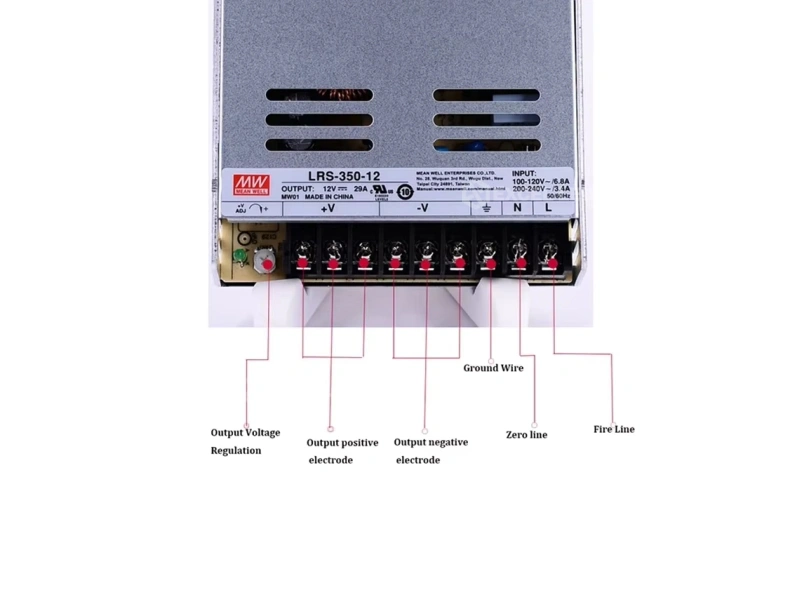
Set the input voltage switch before you connect mains
The unit carries a selector switch for 90–132VAC or 180–264VAC. It ships set for one range, and connecting 230V mains to a supply left on the 115V position will damage it immediately. Confirm the switch position against the actual site voltage as the first step of commissioning, not the last.
The output side has three +V and three −V terminals for a reason: at 60A, splitting the load across multiple terminals keeps contact resistance and local heating down. Use more than one terminal per rail on any load above roughly half rating, and keep the DC run to the first module as short as the cabinet allows.

Adjust the output before you load it
The ADJ. potentiometer sets output between 4.5V and 5.5V. LED modules are typically specified at 5V, and the voltage measured at the module input is lower than the voltage at the supply terminals once the cable run is under load. Measure at the far end of the run, not at the supply, then trim the potentiometer to bring the module input back to its specified voltage.
The same wiring discipline applies to the control hardware inside the cabinet. Our guides to the MCTRL660 LED display controller and the Colorlight X2 LED video processor cover the signal side, and the Huidu HD-A5 LED display player covers standalone playback for screens that run without a PC.
Fan Cooling, Derating and Why 70°C Is Not a Working Target
Unlike the fanless UHP series, the LRS-350-5 is force-cooled. The datasheet specifies a fan on/off control function that switches the fan on at a heatsink temperature of 50°C or above and off again at 40°C or below. That hysteresis is deliberate: it keeps the fan from cycling on and off every few seconds around a single threshold.
In a display cabinet, that behaviour has a practical consequence worth planning for. The fan only runs when the supply is genuinely hot, which means a lightly loaded LRS-350-5 in a ventilated cabinet may run its fan rarely or not at all — and a screen that is silent at low brightness may spin up audibly when it goes full white. On a screen mounted in a quiet interior space, that is a specification the buyer should know about before installation, not after.

Reading the derating curve correctly
The working temperature range is −25 to +70°C, but the range is not flat. The published derating curve reduces the allowable output load as ambient temperature rises, and the curve is specified for horizontal mounting. Three things follow from that:
- Read the curve at your worst case, not your average. A cabinet in direct summer sun can sit well above the ambient the rest of the year. Size the supply at the curve’s value for the hottest condition the screen will actually see.
- Mount it the way the curve assumes. A supply installed on its side has a different thermal path than the horizontal orientation the curve is drawn for; do not assume the curve transfers unchanged.
- Derate again for altitude. The datasheet requires an additional ambient derating of 5°C per 1,000m for operation above 2,000m.
LRS-350-5 vs LRS-350-12 vs RSP-500-5: Which One Fits Your Screen
Three questions decide this, and they are not interchangeable. First, what voltage do your modules need? Second, how much current? Third, is power factor correction required in your market? The third question is the one buyers miss, and it is the reason the RSP series exists alongside the LRS series.
| Parameter | LRS-350-5 | LRS-350-12 | RSP-500-5 |
|---|---|---|---|
| Output | 5V / 60A | 12V / 29A | 5V / 90A |
| Rated power | 300W | 348W | 450W |
| Built-in PFC | × | × | ✓ |
| AC input | 90–132 / 180–264VAC by switch | 90–132 / 180–264VAC by switch | 85–264VAC universal, no switch |
| Cooling | Built-in fan, on/off control | Built-in fan, on/off control | Built-in fan, speed control |
| Remote ON/OFF & sense | × | × | ✓ |
| Efficiency (typ.) | 83.5% | 85% | Series up to 90.5% |
| Height | 30mm | 30mm | 40.5mm |
| Best for | 5V LED modules, standard cabinets | 12V signage, fans, accessories | 5V screens in PFC-mandated markets |
Three differences a datasheet table hides
The rows above are not all equally obvious in practice, and three of them decide whether a swap is even physically possible:
- Height: 30mm versus 40.5mm. The LRS-350-5 is a 30mm low-profile unit. The RSP-500-5 is 40.5mm tall. If your cabinet was designed around a 30mm supply slot, an RSP-500-5 does not drop into it — that is a cabinet redesign, not a component swap. Check the slot before you assume the upgrade path exists.
- Input: a switch versus universal. The LRS-350-5 needs its 115/230VAC selector set correctly for the site. The RSP-500-5 accepts 85–264VAC universally with no selector to mis-set. On a product shipped to multiple markets, that removes one commissioning error entirely.
- Remote control and remote sense. The RSP-500-5 has both built in; the LRS-350-5 has neither. Remote sense compensates for voltage drop on long DC runs at the supply end — the same problem described in the wiring section above, solved in the supply rather than in the cable.
Who should choose which
- Choose the LRS-350-5 when your modules run on 5V and the cabinet’s total 5V load sits comfortably under 300W. It is the volume workhorse: cheap per amp, widely stocked, and a drop-in fit for the 30mm low-profile slot in a standard cabinet.
- Choose the LRS-350-12 when the load is 12V — signage, fans, sensors, accessory rails — or when a mixed 5V/12V cabinet needs a second supply rail. Note that it delivers more total watts from the same 60A ceiling because 12V × 29A is a bigger number than 5V × 60A.
- Choose an RSP-series supply such as the RSP-500-5 when the destination market requires power factor correction, or when the 5V load exceeds what a single LRS-350-5 can carry. The RSP series adds an active PFC stage; the LRS series does not have one, and no LRS model does.
When the LRS-350-5 Is the Wrong Power Supply
A page that cannot tell you when not to buy something is a catalogue entry, not advice. The LRS-350-5 is the right answer for a large share of 5V LED cabinet work, and clearly wrong in the following cases:
| Situation | Why the LRS-350-5 does not fit |
|---|---|
| 5V load above 300W per supply section | The 60A ceiling is the limit of the series. Split the cabinet into separately supplied sections, or move to a higher-current model. |
| PFC required by tender or market | The LRS series has no power factor correction stage. Specify an RSP-series supply instead. |
| Silent operation is a requirement | This is a fan-cooled unit. For noise-sensitive interior installations, a fanless design in the UHP series is the appropriate family. |
| Need 150% peak load capability | The datasheet’s 150% peak load capability, up to one second, applies to the 12V to 48V models only. It does not extend to the 5V model — do not size an LRS-350-5 assuming a 450W surge. |
| Operating in the European Union on public mains above 220VAC | See the compliance section below. The datasheet carries an explicit restriction on harmonic current requirements for this series. |
| Sealed, unventilated enclosure | Forced-air cooling needs somewhere for the heat to go. A sealed box turns a thermal design problem into an over-temperature shutdown. |
| Modules that require 4.2V or 3.3V | The 5V model adjusts only between 4.5V and 5.5V. Its siblings, LRS-350-4.2 and LRS-350-3.3, cover the lower rails. |
Where the power supply is the wrong component to be choosing at all, the constraint is usually elsewhere in the system — module efficiency, cabinet thermal design or control architecture. On the indoor product side, pages such as the Mini COB LED display and the P3.91 rental LED display set out the module-level specifications those decisions start from.
LRS-350-5 Compliance: UL 62368-1, EN61558 and the EN61000-3-2 Limit
The LRS-350 series is certified to IEC/UL 62368-1, BS EN/EN61558-1 and BS EN/EN61558-2-16, with additional approvals including EAC TP TC 004, BSMI CNS15598-1, GB 4943.1 and BIS IS13252 (Part 1). Withstand voltage between input and output is 3.75KVAC, and isolation resistance is specified at 100MΩ minimum. Note that some models in the series carry a KC marking only for the 12V and 24V variants, and the datasheet warns that some production may not carry the BIS logo — if a specific market certificate is a contractual requirement, confirm it with the supplier against the actual batch rather than assuming series-wide coverage.
There is one caveat in this datasheet that buyers in Europe need to read in full, because almost no reseller page mentions it. The manufacturer states that this power supply does not meet the harmonic current requirements of BS EN/EN61000-3-2, and sets out conditions under which it should not be used:
- The end device is used within the European Union, and
- The end device is connected to a public mains supply rated 220VAC or higher nominal, and
- The supply is installed in an end device with average or continuous input power greater than 75W, or forms part of a lighting system.
The same note lists exceptions, including professional equipment with a total rated input power greater than 1,000W. This is not a defect in the product — it is a scope limitation that the manufacturer publishes plainly, and it is the kind of detail that decides whether a part is usable on a given project. For EU tenders, or any project where harmonic compliance is written into the specification, treat this as a design input and confirm the compliant alternative before the bill of materials is frozen.
The component is also specified as a part to be installed into final equipment, not as a standalone appliance: the manufacturer notes that EMC testing was carried out with the unit mounted on a 360mm × 360mm metal plate of 1mm thickness, and that the final equipment must be re-confirmed as still meeting EMC directives. Cabinet builders should plan for that re-confirmation rather than assuming the supply’s approvals transfer automatically.
LRS-350-5 Troubleshooting: No Output, Hiccup Mode and Fan Faults
Because three of this supply’s protections are hiccup-mode with automatic recovery, the same visible symptom — the screen blanks and comes back — can have several unrelated causes. Work through them in the order below; each step separates one cause from the others.
No output at all, and the fan does not run
- Possible cause: no mains reaching the supply, or the input voltage selector set for the wrong range.
- How to check: measure AC voltage across pins 1 and 2 at the terminal block. Then confirm the 115/230V switch position against the site voltage.
- Fix: correct the switch position, restore mains, and check the input fuse feeding the cabinet. If mains is present at the terminals and the selector is correct, the unit has failed and should be replaced rather than repaired in the field.
Output shuts down and recovers on its own, repeatedly
- Possible cause: overload (110–140% of rated power), over-voltage, or over-temperature protection engaging. All three use hiccup mode with auto-recovery, so all three look identical from the outside.
- How to check: measure the actual DC current with the screen at full white. Feel or measure the supply case and cabinet ambient temperature. A clamp meter plus a thermometer usually identifies which protection is firing.
- Fix: if the current is above the planning ceiling, split the load across an additional supply. If the cabinet is hot, fix the airflow — the supply is doing what it was designed to do, and a bigger supply in the same sealed box will simply get hot later.
Screen brightness drops or pixels discolour at the far end of a run
- Possible cause: voltage drop along the DC path, not a supply fault. At 5V, cable resistance takes a proportionally large bite out of the delivered voltage.
- How to check: measure voltage at the supply terminals and again at the input of the last module on the run. The difference is the drop.
- Fix: shorten the run, increase the conductor cross-section, or split the feed. Then trim the ADJ. potentiometer so the module input reads its specified 5V under load — not so the supply terminal reads 5V.
Fan runs constantly, or is unexpectedly loud
- Possible cause: sustained high load or high cabinet ambient keeping the heatsink above the fan’s on-threshold.
- How to check: confirm the datasheet behaviour — the fan is specified to switch on at RTH ≥50°C and off at ≤40°C. A fan that never stops means the unit is never getting back below 40°C.
- Fix: treat it as a thermal signal. Improve cabinet ventilation and confirm the load is inside the derating curve for the real ambient. Do not disconnect the fan; the over-temperature protection will shut the screen down instead.
LRS-350-5 Datasheet, Manual and 3D Drawing
The documents below are the manufacturer’s own files, hosted by MEAN WELL. They are the reference we work from, and they are the correct place to verify any specification quoted on this page.
| Document | What it covers |
|---|---|
| LRS-350-5 datasheet (PDF) | Full specification table, derating curve, block diagram, mechanical drawing and terminal pin assignment |
| LRS-350 series product page | All voltage variants in the series with their individual model datasheets |
| Installation manual | Manufacturer installation guidance for the LRS and comparable enclosed series |
| 3D outline drawing (ZIP) | CAD model of the Case No.207A enclosure for cabinet layout work |


Every document link above was checked and resolves to a live file on the manufacturer’s own domain. We do not publish download buttons for documents we cannot point at.
Mean Well LRS-350-5: Frequently Asked Questions
QIs the Mean Well LRS-350-5 a 350W power supply?
No. The rated output power of the LRS-350-5 is 300W. The “350” is the series name and 350W is only reached by the higher-voltage models in the same series, such as the 24V and 48V versions. At 5V the output is 60A, and 5V multiplied by 60A gives 300W.
QHow many amps does the LRS-350-5 output?
60A at 5V, with a current range of 0 to 60A. The 60A ceiling is shared across the whole LRS-350 series, which is why the lower-voltage models produce less total wattage than the higher-voltage ones.
QDoes the LRS-350-5 have power factor correction?
No. The LRS series does not include a power factor correction stage. Power factor correction is a feature of the MEAN WELL RSP series. If a project specification requires PFC, an RSP-series supply is the correct family to specify instead.
QWhat is the difference between the LRS-350-5 and the LRS-350-12?
Output voltage and rated power. The LRS-350-5 delivers 5V at 60A for 300W; the LRS-350-12 delivers 12V at 29A for 348W. Both share the same case, terminal layout and fan cooling. Choose based on the voltage your LED modules and cabinet accessories require.
QCan the LRS-350-5 deliver 150% peak power?
Not for the 5V model. The datasheet specifies a 150% peak load capability for up to one second on the 12V to 48V models in the series. That capability does not extend to the 5V model, so an LRS-350-5 should be sized on its 300W continuous rating.
QIs the LRS-350-5 fan cooled or fanless?
It is fan cooled. The unit contains a built-in DC fan with thermal on/off control, specified to switch on at a heatsink temperature of 50 degrees Celsius or above and off at 40 degrees or below. For fanless operation, the MEAN WELL UHP series is the appropriate family.
QWhat is the efficiency of the LRS-350-5?
Typical efficiency is 83.5% at the 5V output, measured at 230VAC input and rated load. Within the same series, efficiency rises with output voltage, reaching 89% on the 48V model. Lower efficiency at 5V is inherent to the topology rather than a quality difference between models.
QWhat are the dimensions of the LRS-350-5?
215mm long by 115mm wide by 30mm high, in MEAN WELL Case No.207A, weighing 0.76kg. The 30mm height is the low-profile dimension that lets the unit fit inside a standard 1U LED display cabinet.
QHow do I wire the LRS-350-5 terminal block?
The 9-pin block assigns pin 1 to AC live, pin 2 to AC neutral and pin 3 to frame ground. Pins 4 to 6 are the DC negative output and pins 7 to 9 are the DC positive output. Use multiple terminals per rail at high current, and confirm the 115/230VAC selector switch position before applying mains.
QCan I use the LRS-350-5 in the European Union?
It depends on the application. The manufacturer states that this series does not meet the harmonic current requirements of BS EN/EN61000-3-2, and sets out conditions where it should not be used within the EU, including end devices with average or continuous input power above 75W connected to public mains at 220VAC or higher. Confirm harmonic compliance against the project specification before ordering.
QWhat is the working temperature range of the LRS-350-5?
Minus 25 to plus 70 degrees Celsius with derating, and the derating curve is specified for horizontal mounting. Above 2,000 metres altitude, an additional ambient derating of 5 degrees Celsius per 1,000 metres applies.
QHow many LED modules can one LRS-350-5 power?
It depends on the maximum power rating of your modules. Divide the usable load by the module maximum power to get the count. As an illustrative example, a 240W usable budget at an 80% planning ceiling divides into nine 25W modules. Always size from your own module datasheet and verify the DC distribution design.
Excelled Display supplies MEAN WELL power supplies alongside the modules, cabinets and control hardware they run with, so the power budget and the screen specification are confirmed together rather than in isolation. For the rest of the chain, see the LED control system collection, the outdoor LED display range and the LED display manufacturing process behind them.
Related reading: MCTRL600 LED display controller · Colorlight X4 LED video processor · Mooncell MVB4S Pro 2-in-1 processor · P2.97 rental LED screen · COB LED display CNI series