
Mean Well RSP-320-5 Power Supply
5V 60A · 300W rated, not 320W · active PFC PF>0.95 · fan-cooled with speed control · 5000m altitude · 215 × 115 × 30mm
The 60A 5V supply in the RSP family that needs a fan — the point in the range where current, heat and efficiency force a change of cooling strategy — supplied by Excelled Display, LED display manufacturer and component supplier for global B2B integrators.

Mean Well RSP-320-5 Power Supply at a Glance
What is it? The RSP-320-5 is the 5V model in the MEAN WELL RSP-320 series of enclosed single-output power supplies with active power factor correction. It accepts a full-range 88–264VAC input with no selector switch and delivers a regulated 5V DC output at up to 60A in a 215 × 115 × 30mm case.
How much power does it actually deliver? 300W — not 320W. 5V × 60A = 300W. The series number is 320 and the 5V model is 20W short of it, because the four lowest-voltage models all share the same 60A ceiling. At 5V that ceiling caps the output at 300W no matter what the series is named.
Does it have a fan? Yes — and this is the model where the RSP range changes character. The datasheet feature list states forced air cooling by a built-in DC fan with fan speed control, and the mechanical drawing marks the air flow direction and a fan PWM stage running at 100KHz. The RSP-150-5 and RSP-200-5 below it are both fanless; this is where the range stops being fanless.
Why does this one need a fan when the 200W model does not? Because of the heat, and the datasheet’s own efficiency figures show it. The RSP-320-5 is rated 83% efficient at 5V — the lowest of all twelve models in the series, which run up to 90%. Delivering 300W at 83% efficiency means roughly 61W dissipated as heat inside the case, against roughly 30W for the 200W fanless model at 87%. Doubling the heat loss is what makes convection insufficient.
What does it take in? A universal 88–264VAC input, or 124–370VDC, at 47–63Hz, with active inrush current limiting. Full-range input means no 115/230V selector switch. Typical draw is 4A at 115VAC and 2A at 230VAC.
What protections are built in? Overload at 105–135% of rated power using hiccup mode with automatic recovery, over-voltage shutdown at 5.75–6.75V requiring a re-power, over-temperature shutdown with automatic recovery, and short-circuit protection.
Anything unusual in its certifications? Two entries are specific to this model rather than the series: KN 32 is listed for the 5V model only, and the EN61558-1/2-16 approvals apply only to 12V or higher models — so the 5V variant does not carry them. Both are covered below.
What is it used for? LED display modules and cabinets on PFC-specified projects, factory control and automation apparatus, test and measurement instruments, laser-related machinery, burn-in facilities and RF applications. Configuration, MOQ and pricing from our sales team.
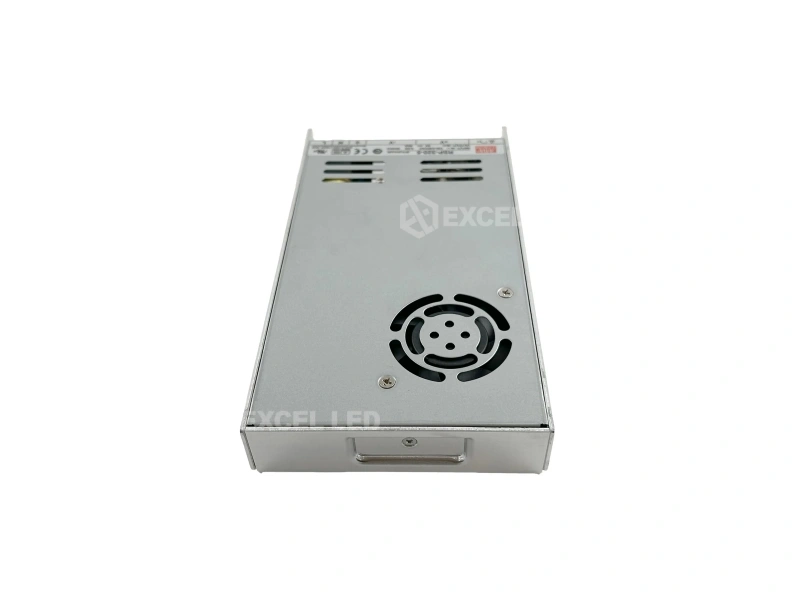

The RSP-320 Series: A 320W Name and Only One Model That Reaches It
The RSP-320 series spans twelve voltages from 2.5V to 48V. The four lowest-voltage models share a 60A current ceiling, and the highest-voltage models land near 321W. The 5V model sits in the 60A group, which is why it delivers 300W rather than the 320 the name suggests.
| Model | Output voltage | Rated current | Rated power | Efficiency (typ.) |
|---|---|---|---|---|
| RSP-320-2.5 | 2.5V | 60A | 150W | 75.5% |
| RSP-320-3.3 | 3.3V | 60A | 198W | 79.5% |
| RSP-320-4 | 4V | 60A | 240W | 81% |
| RSP-320-5 | 5V | 60A | 300W | 83% |
| RSP-320-7.5 | 7.5V | 40A | 300W | 88% |
| RSP-320-12 | 12V | 26.7A | 320.4W | 88% |
| RSP-320-13.5 | 13.5V | 23.8A | 321.3W | 88% |
| RSP-320-15 | 15V | 21.4A | 321W | 88.5% |
| RSP-320-24 | 24V | 13.4A | 321.6W | 89% |
| RSP-320-27 | 27V | 11.9A | 321.3W | 89% |
| RSP-320-36 | 36V | 8.9A | 320.4W | 89.5% |
| RSP-320-48 | 48V | 6.7A | 321.6W | 90% |
Two models in this series share the same 300W rating: the 5V at 60A and the 7.5V at 40A. If you are comparing quotations on wattage alone they look identical, but the 7.5V model is 88% efficient against the 5V model’s 83% — a five-point difference that shows up as heat inside the cabinet, not on the invoice.
RSP-320-5 Specifications: Datasheet Parameters for the 5V 60A Model
Transcribed from the MEAN WELL RSP-320 specification sheet (RSP-320-SPEC, revision dated 2025-01-10) for the 5V model. Unless stated otherwise, readings are taken at 230VAC input, rated load and 25°C ambient.
| Parameter | RSP-320-5 specification |
|---|---|
| DC output voltage | 5V, adjustable 4.5 ∼ 5.5V |
| Rated current | 60A, current range 0 ∼ 60A |
| Rated power | 300W |
| Ripple & noise (max.) | 150mVp-p at 20MHz bandwidth |
| Voltage tolerance | ±2.0% (includes set-up tolerance, line regulation and load regulation) |
| Line regulation | ±0.5% |
| Load regulation | ±1.0% from 0% to 100% rated load |
| Set-up / rise time | 1500ms, 50ms/230VAC; 3000ms, 50ms/115VAC at full load |
| Hold-up time (typ.) | 8ms at full load, 230VAC / 115VAC |
| Input voltage range | 88 ∼ 264VAC universal full range, no selector switch; 124 ∼ 370VDC |
| Input frequency | 47 ∼ 63Hz |
| Power factor (typ.) | PF > 0.95 / 230VAC, PF > 0.98 / 115VAC at full load |
| Efficiency (typ.) | 83% at 5V — the lowest of the series; other models reach 88–90% |
| AC current (typ.) | 4A/115VAC, 2A/230VAC |
| Inrush current (typ.) | 20A/115VAC, 40A/230VAC, with active inrush current limiting |
| Leakage current | <1mA / 240VAC |
| Overload protection | 105 ∼ 135% rated output power; hiccup mode, recovers automatically once the fault is removed |
| Over-voltage protection | 5.75 ∼ 6.75V; shuts down the output, re-power required to recover |
| Over-temperature protection | Shuts down output, recovers automatically once temperature falls |
| Cooling | Forced air cooling by built-in DC fan with fan speed control (fan PWM 100KHz) |
| Working temperature | −30 ∼ +70°C with derating (refer to the derating curve, horizontal mounting) |
| Working humidity | 20 ∼ 90% RH, non-condensing |
| Storage | −40 ∼ +85°C, 10 ∼ 95% RH |
| Temperature coefficient | ±0.03%/°C (0 ∼ 50°C) |
| Vibration | 10 ∼ 500Hz, 2G, 10 min per cycle, 60 min each along X, Y and Z axes |
| Operating altitude | Up to 5000 metres — a headline feature of this series (derate 5°C/1000m above 2000m on fan models) |
| Withstand voltage | I/P–O/P 3KVAC; I/P–FG 2KVAC; O/P–FG 0.5KVAC |
| Isolation resistance | 100MΩ / 500VDC at 25°C, 70% RH |
| Dimensions (L×W×H) | 215 × 115 × 30mm (Case No. 207A) |
| Weight / packing | 0.9kg per unit; 15pcs / 14.5kg / 0.67CUFT per carton |
| MTBF | 1826.4K hours min. (Telcordia SR-332); 192.9K hours min. (MIL-HDBK-217F at 25°C) |
| Warranty | 3 years (manufacturer’s stated warranty on the datasheet) |
Two figures here are worth more than they look. The 1826.4K-hour Telcordia MTBF is a genuine reliability figure for a fan-cooled supply — the comparable fanless RSP-200 quotes only 224.5K hours on the older MIL standard. And the 5000-metre altitude rating is unusual in this power class.
Why the RSP-320-5 Has a Fan and the RSP-200-5 Does Not
This is the most useful thing to understand about the RSP range, because it decides which models are appropriate for dusty, sealed or acoustic-sensitive cabinets. The transition from fanless to fan-cooled happens between 40A and 60A at 5V, and the datasheet efficiency figures explain why.
| RSP model at 5V | Output | Efficiency | Heat to dissipate | Cooling |
|---|---|---|---|---|
| RSP-150-5 | 30A / 150W | 87% | ≈22W | Fanless |
| RSP-200-5 | 40A / 200W | 87% | ≈30W | Fanless |
| RSP-320-5 | 60A / 300W | 83% | ≈61W | Built-in DC fan with speed control |
The heat column is arithmetic derived from the datasheet efficiency figures — output watts divided by efficiency gives input watts, and the difference is the loss. It is not a figure MEAN WELL prints on the datasheet. Shown here because it makes the cooling change legible: doubling the output power while efficiency drops four points more than doubles the heat the case has to shed.
What fan speed control actually does for you
- Noise tracks load, not the calendar. The fan runs at the speed the thermal load requires rather than at a fixed maximum. A screen idling at low brightness is quieter than the same screen at full white.
- Fan life is the maintenance item. A fan-cooled supply has a moving part with a finite service life that a fanless supply does not. On a screen expected to run for a decade, budget for the fan as a wear item.
- Airflow path matters more than the fan. The mechanical drawing marks the air flow direction. Mount the unit so air enters and exhausts freely; a fan pushing into a blocked duct is worse than no fan, because the supply still assumes forced airflow for its rating.
- Dust is now a factor. A fan draws cabinet air through the case. In a dusty installation that means planning filter or cleaning intervals, or specifying the optional conformal coating.
RSP-320-5 Certifications: KN 32, EN61558 and the 5V-Specific Entries
The RSP-320-5 carries the full modern safety set: UL62368-1, TUV BS EN/EN62368-1, EAC TP TC 004, CCC GB4943.1, BSMI CNS15598-1, AS/NZS 60950.1 and IS13252(Part1)/IEC60950-1. Two entries on the datasheet are qualified by voltage, and both qualifications land on the 5V model.
| Item | Detail from the RSP-320 datasheet | Applies to 5V? |
|---|---|---|
| Safety standards | UL62368-1, TUV BS EN/EN62368-1, EAC TP TC 004, CCC GB4943.1, BSMI CNS15598-1, AS/NZS 60950.1, IS13252(Part1)/IEC60950-1 (except for 2.5V, 48V) | Yes — 5V is not in the excluded list |
| EN/IEC 61558-1 and -2-16 | Dekra EN 61558-1/2-16, IEC 61558-1/2-16 approved | No — for 12V or higher models only. The 5V variant does not carry this approval |
| KN 32 | Listed under EMC emission alongside EN55032 Class B, EN61000-3-2,-3, EAC TP TC 020, CNS15936, GB9254 Class B, GB17625.1 | Yes — KN 32 is listed for the 5V model only |
| EMC immunity | BS EN/EN61000-4-2, 3, 4, 5, 6, 8, 11; BS EN/EN55035, light industry level | Yes |
| Withstand voltage | I/P–O/P 3KVAC; I/P–FG 2KVAC; O/P–FG 0.5KVAC | Yes |
| MTBF | 1826.4K hrs min. Telcordia SR-332; 192.9K hrs min. MIL-HDBK-217F (25°C) | Yes |
Why the EN61558 omission can matter commercially
EN 61558 covers safety of power transformers and switch-mode power supplies, and its part 2-16 addresses supplies used in situations where the output is treated as safety extra-low voltage for general equipment. A buyer writing a specification that names EN61558-1/2-16 will find the RSP-320-5 does not hold it — while the RSP-320-12 and every model above it does. If that approval is a hard requirement, the 5V model in this series cannot meet it regardless of price.
And the KN 32 listing runs the other way
KN 32 is the Korean EMC emission standard, and the datasheet lists it as applying to the 5V model specifically. A project destined for Korea that requires KN 32 is therefore better served by the 5V model than by other voltages in this series. Requirements cut both ways, which is why the datasheet entries need reading per model rather than per series.
RSP-320-5 at 5000 Metres: What the Altitude Rating Changes
The datasheet lists operating altitude up to 5000 metres as a headline feature, and it is one of the few specifications on this page that most competing listings omit entirely. It matters because altitude affects cooling in two separate ways.
- Air is thinner, so it carries less heat. Convective cooling depends on air mass flow, not air volume. At 5000m the same fan moves the same volume but a substantially lower mass of air, so the same fan speed removes less heat.
- The derating rule is stated on the datasheet. MEAN WELL applies an ambient temperature derating of 5°C per 1000m with fan models above 2000m. That is a hard, published number — not an estimate. Read it before quoting this supply into a high-altitude project.
- Apply it to the derating curve. Take the worst-case cabinet ambient, add 5°C for every 1000m above 2000m, and read the load limit at the resulting temperature. A site at 3000m effectively moves the whole curve 5°C to the left.
- High-altitude sites are usually also cold sites. Mountain and highland installations often have low ambient temperatures, which offsets part of the derating. Use the real measured ambient, not a summer design maximum carried over from a sea-level project.
| Site altitude | Effective ambient adder (fan models) | Practical meaning |
|---|---|---|
| Sea level to 2000m | No adder | Read the derating curve directly |
| 3000m | +5°C | Evaluate the curve 5°C hotter than measured |
| 4000m | +10°C | Evaluate the curve 10°C hotter than measured |
| 5000m | +15°C | The datasheet’s stated ceiling; evaluate the curve 15°C hotter |
The datasheet does not publish a separate derating curve per altitude — it publishes the 5°C/1000m rule and expects it to be applied to the standard curve. That is the method above. If a high-altitude project is load-critical, raise the site altitude at quotation and we will confirm the derated figures rather than leave the arithmetic to the installation stage.
RSP-320-5 vs RSP-200-5 vs RSP-150-5: Where Fanless Stops
Three 5V models, one range, one decision that matters more than the others: whether you need a fan. Everything else follows from the current you are drawing.
| Parameter | RSP-320-5 | RSP-200-5 | RSP-150-5 |
|---|---|---|---|
| Output | 5V / 60A | 5V / 40A | 5V / 30A |
| Rated power | 300W | 200W | 150W |
| Cooling | Built-in DC fan, speed control | Fanless | Fanless |
| Efficiency (typ.) | 83% | 87% | 87% |
| Active PFC | Yes, PF > 0.95 | Yes, PF > 0.95 | Yes, PF > 0.93 |
| Remote ON/OFF | Not provided | Not provided | Built in (CN1) |
| Input range | 88∼264VAC full range | 88∼264VAC full range | 85∼264VAC full range |
| Operating altitude | 5000m | Not listed as a feature | Not listed as a feature |
| I/P–O/P withstand | 3KVAC | 3KVAC | 4KVAC |
| Conformal coating option | Yes | Yes, -CC suffix | Not listed |
| Dimensions | 215×115×30mm | 215×115×30mm | 199×99×30mm |
| MTBF (Telcordia) | 1826.4K hrs | Not quoted on the revision held | 2253.9K hrs |
| Best for | 60A at 5V, PFC-mandated, ventilated cabinet | 40A at 5V, no moving parts | 30A at 5V with signal-line switching |
Three things the numbers alone will not tell you
- Higher output does not mean higher reliability here. The Telcordia MTBF figures are 1826.4K hours for the 320W model and 2253.9K hours for the 150W model, both under the modern standard. This looks counter-intuitive for a fan-cooled unit until you note that the 150W model runs cooler and the 320W model has a fan. Neither figure is a predicted service life; they are comparative failure-rate estimates under the stated model conditions.
- The most feature-rich model is the smallest one. The RSP-150-5 is the only one of the three with built-in remote ON/OFF and the only one with a 4KVAC withstand. If a control scheme switches supplies over a signal line, higher current is not the upgrade path.
- Conformal coating spans two of the three but not all. Both the RSP-320 and RSP-200 list optional conformal coating; the RSP-150 does not. For a coastal or condensation-prone project that narrows the choice irrespective of wattage.
How Many LED Modules Can One RSP-320-5 Power?
No supplier can answer this without knowing your module. The count depends on the maximum power rating of your LED module from its own datasheet, the number of modules on the supply, and the thermal headroom you leave — which on a fan-cooled unit is a real constraint, not a formality.
- Start from the real rating. 300W at 5V, which is 60A.
- Apply a load ceiling. A common planning rule in LED cabinet builds is to keep continuous load at or below about 80% of rated output — roughly 240W, or 48A, on an RSP-320-5. This is an engineering convention rather than a MEAN WELL figure; treat it as a starting point and confirm it against your project’s thermal and warranty conditions.
- Divide by the module’s maximum power, taken from the module datasheet rather than a marketing page — full white is exactly the condition a screen is commissioned under.
- Check the derating curve at real cabinet ambient, including the altitude adder if the site is above 2000m.
- Check the current path. 48A has to leave through the terminal block and reach the modules. Confirm wire gauge, terminal rating and the number of feeds.
- Check the capacitance on the 5V rail. The datasheet strongly recommends external output capacitance not exceeding 5000µF, and the 5V model is inside the list this applies to. If the cabinet carries a large capacitor bank, raise it at quotation.
Worked as an Illustrative Example — substitute your own module figures; these numbers are for the arithmetic only:
| Step | Illustrative calculation |
|---|---|
| Supply rating | 300W / 60A at 5V |
| Usable at 80% planning ceiling | 240W / 48A |
| Module maximum power (illustrative) | 25W per module |
| Modules per supply (240 ÷ 25) | 9 modules, with 15W of the usable budget unspent |
| Heat into the cabinet at that load | ≈49W at 83% efficiency — multiplied by the number of supplies in the cabinet |
Parallel operation is not a function this model provides. If the screen outgrows one supply, split the cabinet into independently supplied sections rather than paralleling two RSP units. For the control and signal side of the same cabinet, the LED control system collection covers how sending cards, receiving cards and processors are powered and wired alongside the supplies.
RSP-320-5 Wiring: 9-Pin Terminal Assignment and Airflow Clearance
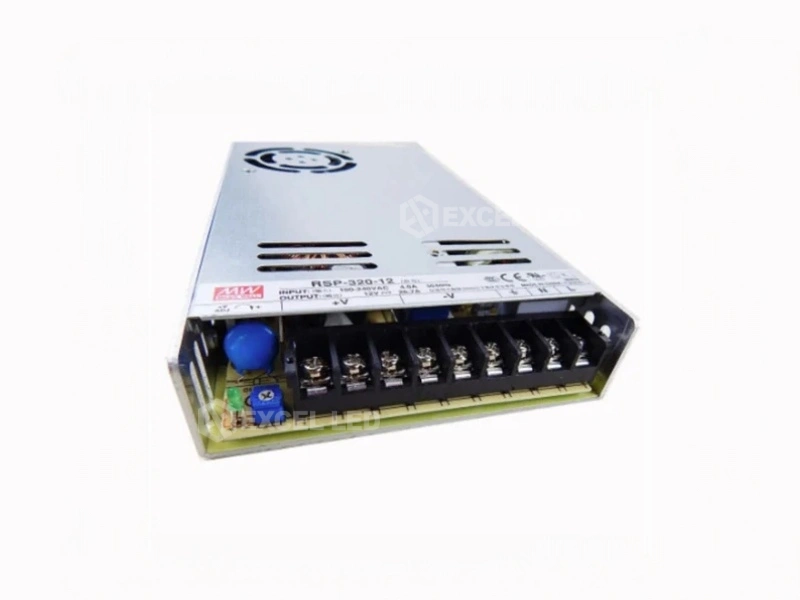
The RSP-320-5 terminates in a 9-pin screw terminal block, with the assignment printed on the unit and marked on the mechanical drawing:
| Pin | Assignment | Practical note |
|---|---|---|
| 1 | AC/L — live | Mains live input |
| 2 | AC/N — neutral | Mains neutral input |
| 3 | FG — frame ground | Bond to the cabinet earth; do not omit |
| 4 ∼ 6 | DC OUTPUT −V | Three terminals, shared negative rail |
| 7 ∼ 9 | DC OUTPUT +V | Three terminals, shared positive rail |

The label in that photograph reads RSP-320-24, the 24V model in the same series — the terminal arrangement and case are shared across the range, but the printed model number is not the 5V variant. We use it here to show the terminal layout and certification marking, not to evidence the 5V output. Confirm the 5V rating from the datasheet and from the label on the unit you receive.
There is no input voltage switch to set
The RSP-320-5 is full-range 88–264VAC by design, unlike the LRS-family supplies which carry a 115/230V selector that ships in one position and destroys the unit if mains is applied in the wrong one. Nothing to select, nothing to get wrong — and one part number covers both 120V and 230V sites.
Split the load across the output terminals
At 60A, use more than one terminal per rail. Use at least two of the three +V and −V terminals on any load above roughly half rating, and keep the DC run to the first module as short as the cabinet allows. At this current, terminal contact resistance and local heating are the practical limits rather than the supply’s own regulation.
Leave the airflow path clear
The mechanical drawing marks the air flow direction through the case. Unlike the fanless models in the range, this supply will not tolerate being boxed in: its rating assumes forced air moving across the internals. Keep the intake and exhaust clear, mount horizontally as the derating curve specifies, and do not stack units tight against each other. Mounting is by 4 × M4 holes at 3mm depth on the base, with additional M4 fixings on both sides.
The same wiring discipline applies to the control hardware inside the cabinet. Our guides to the MCTRL660 LED display controller and the Colorlight X2 LED video processor cover the signal side, and the Huidu HD-A5 LED display player covers standalone playback for screens that run without a PC.
Conformal Coating on the RSP-320-5: Coated Models for Humid Sites
The RSP-320 series lists optional conformal coating as a series feature. The coated variant is the same supply with its circuit board treated, and it addresses the one weakness a fan-cooled design introduces: a fan pulls cabinet air through the case, and cabinet air carries dust and moisture with it.
| Item | What the datasheet states |
|---|---|
| Option name | Optional conformal coating, listed as a series feature |
| Power-on indication | LED indicator for power on, fitted as standard |
| Warranty | 3 years on the series |
| Cooling | Forced air cooling by built-in DC fan with fan speed control |
When to specify the coated version
- Dusty installations — the main reason on a fan-cooled model. Every hour the fan runs, it draws cabinet air across the board. In a workshop, a foundry or a roadside cabinet, that deposits contamination on live circuitry.
- Coastal and high-humidity sites. Salt-laden or persistently damp air builds a conductive film over time. A coating interrupts that path.
- Screens that condense. An outdoor cabinet that cools overnight can condense moisture inside. Coatings are the standard board-level mitigation.
- But coating is not a substitute for enclosure design. It protects the board. It does not make the supply waterproof, does not change its IP rating, and does not remove the need to manage dust and condensation in the cabinet itself.
When the RSP-320-5 Is the Wrong Power Supply
A page that cannot tell you when not to buy something is a catalogue entry, not advice. The RSP-320-5 is the right answer for 5V work at 60A on a PFC-specified project in a ventilated cabinet, and clearly wrong in the following cases:
| Situation | Why the RSP-320-5 does not fit |
|---|---|
| No fan can be tolerated — acoustic or cleanroom requirement | This model has a built-in fan. The ceiling for fanless 5V in this range is 40A / 200W, at the RSP-200-5. |
| Tender names EN61558-1/2-16 | On the datasheet that approval is for 12V or higher models. The 5V variant does not carry it. Choose a higher voltage in the series or verify alternative certification. |
| 5V load above 300W per supply section | The 60A ceiling is the limit of this model. Step up to the RSP-500-5 power supply, or split the cabinet into separately supplied sections. |
| The control scheme must switch supplies over a signal line | No remote ON/OFF on this model. The RSP-150-5 provides it natively; otherwise remote switching has to be done on the mains side. |
| Sealed, unventilated enclosure | The rating assumes forced airflow across the internals. A sealed box provides none, and the fan recirculates its own heated air. |
| Dusty site and no cleaning or filtering plan | The fan draws contamination across the board. Either specify the conformal coating option and plan cleaning intervals, or choose a fanless model. |
| Power budget assumes 90% efficiency | The “up to 90%” figure on the series cover is the 48V model. The 5V model is 83%, and its waste heat at full load is roughly 61W. |
| No PFC or harmonic requirement, and cost decides | PFC is much of what you are paying for. An LRS-600-5 gives 500W of 5V for less money where nothing in the specification demands PFC. |
| Modules that require 4.2V or 3.3V | The 5V model adjusts only between 4.5V and 5.5V. RSP-320-3.3 and RSP-320-4 cover the lower rails. |
Where the power supply is the wrong component to be choosing at all, the constraint is usually elsewhere in the system. On the indoor product side, pages such as the P3.91 rental LED display and the P2.5 indoor LED display set out the module-level specifications those decisions start from.
RSP-320-5 Troubleshooting: Fan Noise, Hiccup Mode and Start-Up Delay
Three protection behaviours differ from each other on this model, which is why the same visible symptom can have unrelated causes. Work through them in order; each step separates one cause from the others.
The fan is louder than expected, or runs continuously
- Possible cause: this is a fan-speed-controlled unit, so the fan tracks thermal load. Continuous high-speed running usually means the supply is genuinely hot, not that the control is faulty.
- How to check: measure cabinet ambient and case temperature. If ambient is above roughly 50°C, the fan is doing its job.
- Fix: improve cabinet ventilation or reduce the load per supply. Do not disconnect or obstruct the fan — the rating depends on forced airflow.
Output drops out and recovers on its own, repeatedly
- Possible cause: overload hiccup mode at 105–135% of rated power, or over-temperature protection. Both recover automatically, so both look identical from outside.
- How to check: measure DC current with the screen at full white, then measure the case temperature and cabinet ambient. A clamp meter and a thermometer usually separate the two.
- Fix: if current exceeds the planning ceiling, split the load across an additional supply. If the cabinet is hot, fix the airflow — and check the fan is actually turning.
No output at all, and it stays off after a power cycle
- Possible cause: over-voltage protection has latched. Unlike the overload protection, OVP on this model shuts the output down and requires a re-power to recover.
- How to check: remove the load and re-power. If the output returns with no load connected, the trip was load-related rather than a supply failure.
- Fix: find what drove the output above 5.75–6.75V — typically a load fault or a wiring error — and correct it before reconnecting.
The screen takes two to three seconds to come on after mains is applied
- Possible cause: nothing is faulty. Set-up time is 1500ms at 230VAC and 3000ms at 115VAC, plus a 50ms rise time.
- How to check: measure the delay from mains applied to output stable, and compare with the datasheet figure for the site voltage.
- Fix: no fix required if the delay matches the specification. If control logic assumes supplies are ready sooner, adjust the sequence timing rather than replacing hardware.
Screen brightness drops or pixels discolour at the far end of a run
- Possible cause: voltage drop along the DC path, not a supply fault. At 5V and 60A, cable resistance takes a proportionally large bite out of the delivered voltage.
- How to check: measure voltage at the supply terminals and again at the input of the last module on the run. The difference is the drop.
- Fix: shorten the run, increase the conductor cross-section, or split the feed. Then trim the output adjustment so the module input reads its specified 5V under load — not so the supply terminal reads 5V.
The supply trips on start-up but runs fine once loaded
- Possible cause: external output capacitance exceeding the recommended ceiling. The datasheet strongly recommends not exceeding 5000µF on the 5V model.
- How to check: total the capacitance across the 5V rail — module-side capacitors included, not just the ones next to the supply.
- Fix: reduce the bank, or spread the capacitance across separately supplied sections rather than concentrating it on one supply.
RSP-320-5 Datasheet and Series Documentation
The documents below are the manufacturer’s own files, hosted by MEAN WELL. They are the reference we work from, and the correct place to verify any specification quoted on this page — including the per-model certification qualifications discussed above.
| Document | What it covers |
|---|---|
| RSP-320 series datasheet (PDF) | Full specification table for all twelve voltage models, derating curve, block diagram, mechanical drawing and terminal pin assignment |
| RSP-320 series product page | All voltage variants with their individual model datasheets, certificates and the conformal coating option |
| Installation manual | Manufacturer installation guidance for the RSP enclosed series |
| EMI testing of component power supplies | The manufacturer’s own guidance on re-confirming EMC when a component supply is installed into final equipment |

MEAN WELL prints a serial number on each unit that can be traced on the manufacturer’s own website. That is the authoritative way to confirm a batch’s provenance and production date — more reliable than any listing photograph, including ours.
Mean Well RSP-320-5: Frequently Asked Questions
QHow many watts is the Mean Well RSP-320-5?
300W, not 320W. At 5V and 60A the output is 300W. The four lowest-voltage models in the RSP-320 series share a 60A current ceiling, and at 5V that caps the output at 300W regardless of the series name.
QDoes the RSP-320-5 have a fan?
Yes. The RSP-320-5 is cooled by a built-in DC fan with fan speed control, as stated in the datasheet feature list. It is the point in the RSP range where cooling changes from fanless to forced air: the RSP-150-5 and RSP-200-5 below it are both fanless.
QWhy is the RSP-320-5 only 83% efficient when the series claims up to 90%?
The “up to 90%” figure applies to the 48V model. The 5V model is rated 83%, the lowest of the twelve models in the series. Low-voltage high-current conversion has higher conduction losses in the output stage, and rectifying 60A at 5V costs more than rectifying 6.7A at 48V for the same wattage.
QDoes the RSP-320-5 have power factor correction?
Yes. It has a built-in active PFC function with a typical power factor above 0.95 at 230VAC and above 0.98 at 115VAC at full load. The datasheet block diagram shows the active PFC stage running at 100KHz alongside the fan PWM control, also at 100KHz.
QWhat is the operating altitude of the RSP-320-5?
Up to 5000 metres, which the datasheet lists as a headline feature. Above 2000m an ambient temperature derating of 5 degrees Celsius per 1000 metres applies to fan models, so a site at 4000m should be evaluated with the derating curve shifted 10 degrees hotter than the measured ambient.
QDoes the RSP-320-5 need a 115V or 230V selector switch set?
No. The RSP-320-5 accepts a universal 88 to 264VAC input with no selector switch, and also accepts 124 to 370VDC. That removes the most common commissioning error on supplies with a manual voltage selector, and one part number covers both 120V and 230V installations.
QHow do I wire the RSP-320-5 terminal block?
Pin 1 is AC live, pin 2 is AC neutral and pin 3 is frame ground. Pins 4 to 6 are the DC negative output and pins 7 to 9 are the DC positive output. There is no voltage selector to configure. The output is adjustable between 4.5V and 5.5V, and at 60A the load should be split across more than one output terminal per rail.
QIs the RSP-320-5 certified to EN61558-1/2-16?
No. On the RSP-320 datasheet the Dekra EN 61558-1/2-16 and IEC 61558-1/2-16 approvals are stated for 12V or higher models. The 5V variant does not carry them. The unit does hold UL62368-1, TUV BS EN/EN62368-1, CCC GB4943.1 and the other standards listed without a voltage qualification.
QWhat is the difference between the RSP-320-5 and the RSP-200-5?
Current, cooling and efficiency. The RSP-320-5 delivers 60A and 300W with a built-in fan at 83% efficiency; the RSP-200-5 delivers 40A and 200W fanless at 87%. The 320 also carries a 5000-metre altitude rating and a much higher Telcordia MTBF figure.
QCan the RSP-320-5 be used in a sealed enclosure?
No. The rating assumes forced airflow across the internals, provided by the built-in fan drawing air through the case. In a sealed box the fan simply recirculates its own heated air, so the supply runs hotter than its rating assumes. A ventilated cabinet with a clear intake and exhaust path is required.
QCan the RSP-320-5 be used in a dusty environment?
It can, with provisions. Because the fan draws cabinet air across the board, a dusty site needs either the optional conformal coating and a cleaning schedule, or a different cooling strategy. The RSP-320 series lists optional conformal coating as a feature, and it has to be specified at quotation rather than added later.
QWhat is the hold-up time of the RSP-320-5?
A typical 8 milliseconds at full load on either 230VAC or 115VAC. At 50Hz that is under half a mains cycle, so the supply rides through small notches and transients but not a brownout, a source transfer or a generator changeover. Those need system-level ride-through such as a UPS.
Excelled Display supplies MEAN WELL power supplies alongside the modules, cabinets and control hardware they run with, so the power budget, the heat load and the screen specification are confirmed together rather than in isolation. For the rest of the chain, see the LED control system collection, the outdoor LED display range and the LED display manufacturing process behind them.
Related reading: Mean Well RSP-200-5 power supply · Mean Well RSP-150-5 power supply · Mean Well RSP-500-5 power supply · Mean Well LRS-600-5 power supply · MCTRL660 LED display controller