

960×960 Outdoor LED Display
B960 Series · Die-Cast Aluminum Cabinet · Common-Anode Energy Saving · P4.44 / P6.67 · IP66
One 25 kg cabinet that stays flat from -30°C to 60°C — B960 is our 960×960 mm common-anode energy-saving outdoor LED display platform — supplied by Excelled, a trusted LED display manufacturer for global B2B system integrators.
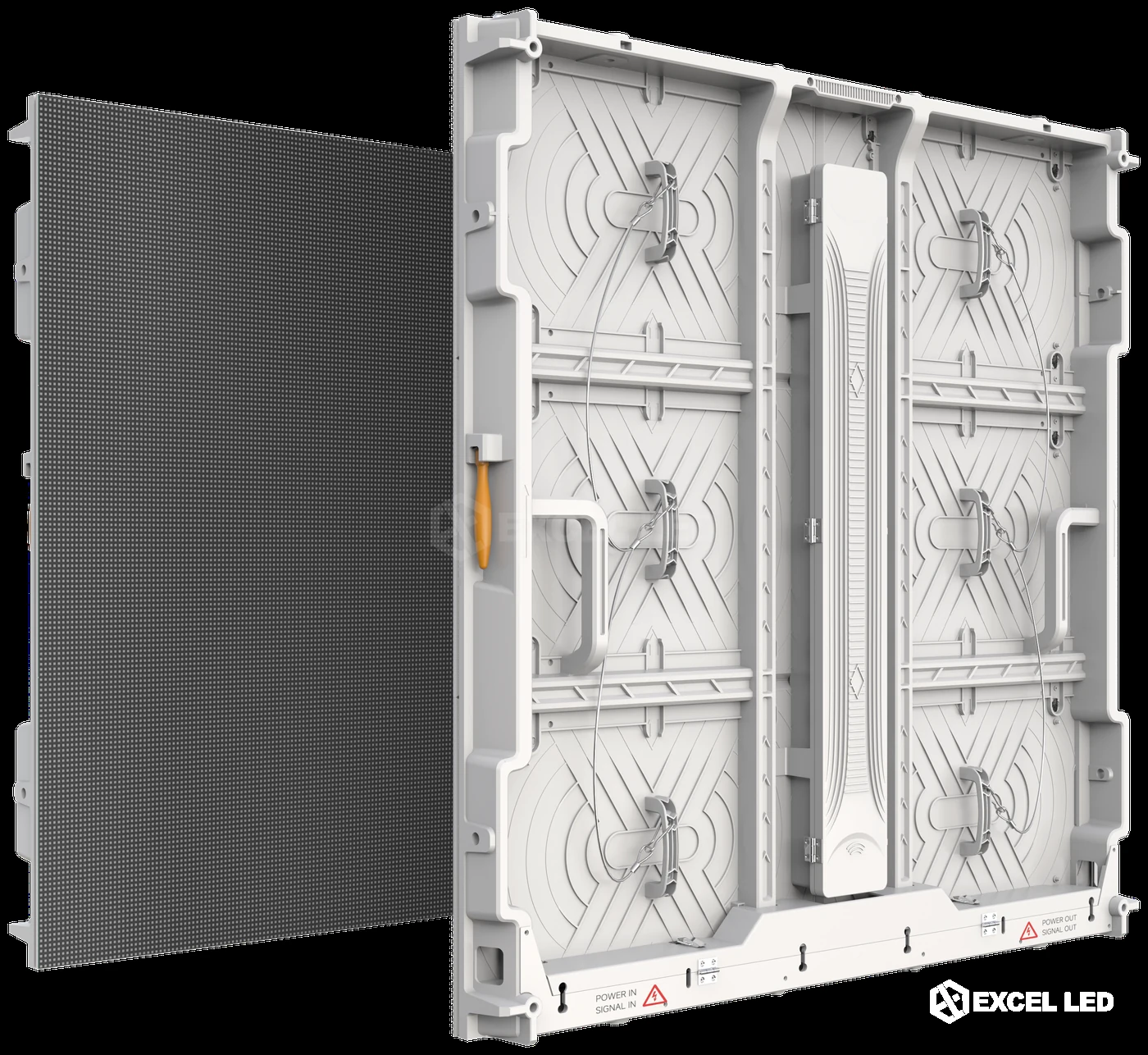
B960 960×960 Outdoor LED Display: Quick Answers
What is it? A fixed-install outdoor LED display built on 960×960 mm die-cast aluminum cabinets, offered in two pitches: FC4.44 (SMD1921) and FC6.67 (SMD2727).
How heavy is one cabinet? 25 kg per 960×960 mm cabinet (about 27 kg per square meter), so steel structures can be smaller and install crews work faster.
How much power does it use? Maximum ≤600 W/m², average ≤200 W/m² (confirmed), driven by a common-anode energy-saving design with two 400 W power supplies per cabinet.
Is it waterproof? Yes — IP66 on both faces, rated for -30°C to 60°C operation, used in coastal projects such as Sokcho, South Korea.
Which maintenance does it support? Both front and rear service; modules, cabinet and power box are modular with hard connections.
What is the refresh rate? 3840 Hz with 14–16 bit gray scale, so the screen looks smooth on camera and up close.
What Is the B960 960×960 Outdoor LED Display?
The B960 is a 960×960 outdoor LED display platform: every cabinet measures exactly 960 mm by 960 mm, the size that has become the default for outdoor advertising screens worldwide. Because the module, cabinet and power box are all modular, you can build almost any billboard size — from a 1.92×1.92 m shop-front sign to a 100 m² facade — out of the same cabinet.
Two versions share this cabinet. FC4.44 uses a 4.44 mm pitch with SMD1921 lamps for closer viewing (roughly 5–45 m), while FC6.67 uses a 6.67 mm pitch with SMD2727 lamps for long-distance billboards. Both are common-anode energy-saving designs rated IP66. If you are comparing pitches, our P4 outdoor LED display guide covers the finer end of the range, and the coarser pitches appear in the comparison below.
In our production records, this cabinet family has been used for stadium screens, double-sided highway billboards, building facades and seaside installations in China, the United States and South Korea — the same projects you will see further down this page.
960×960 mm Cabinet
The standard outdoor footprint. 0.92 m² per cabinet, 2×3 modules inside, 85–87 mm thin.
Two Pitch Options
FC4.44 for 5–45 m viewing; FC6.67 for long-range billboard advertising on highways.
25 kg per Cabinet
Die-cast aluminum body, roughly 27 kg/m² — lighter structures, faster installation.
All-Weather IP66
Rated -30°C to 60°C with salt-fog-resistant die-cast aluminum for coastal sites.
960×960 mm Die-Cast Aluminum Cabinet: Light, Strong, Flat
The cabinet is the load-bearing unit of any 960×960 outdoor LED display, and it decides two things you pay for years later: structural cost and screen flatness. The B960 answers both with a die-cast aluminum body: 25 kg per cabinet (confirmed) and an overall depth of only 85 mm (FC4.44) or 87 mm (FC6.67).
| Cabinet Parameter | FC4.44 | FC6.67 |
|---|---|---|
| Cabinet size | 960×960×85 mm (confirmed) | 960×960×87 mm (confirmed) |
| Module layout (W×H) | 2×3 = 6 modules | 2×3 = 6 modules |
| Cabinet resolution | 216×216 px (confirmed) | 144×144 px (confirmed) |
| Cabinet area | 0.92 m² | 0.92 m² |
| Cabinet weight | 25 kg (confirmed) | 25 kg (confirmed) |
| Material | Die-cast aluminum | Die-cast aluminum |
| Pixel density | 50,625 px/m² | 22,500 px/m² |
| IP rating | IP66 (confirmed) | IP66 (confirmed) |

Why die-cast aluminum instead of a welded steel cabinet?
Die casting forms the whole rear shell in one molded piece, so there are no welded seams to rust and the ribbed back keeps the panel flat under thermal cycling. The material itself is corrosion-resistant, high-melting-point and flame-retardant, which is why the FC series spec sheet lists it as suitable for long-term seaside operation. Steel cabinets are cheaper per unit in some markets, but they typically weigh 40–50 kg at this size (typical industry value) — nearly double the B960 — which pushes up steel structure, crane time and labor.
480×320 mm Die-Cast Aluminum LED Module: SMD1921 / SMD2727
Each cabinet carries six 480×320 mm modules in a 2×3 layout. The module frame is also die-cast aluminum — not plastic — which does two jobs: it holds the lamp surface flat for uniform images, and it conducts heat from the LED boards into the cabinet body. This is the thermal path that lets the B960 run without a dedicated air conditioner (per the FC series specification).
| Module Parameter | FC4.44 | FC6.67 |
|---|---|---|
| Pixel structure (SMD) | SMD1921 (confirmed) | SMD2727 (confirmed) |
| Pixel pitch | 4.44 mm | 6.67 mm |
| Module resolution (W×H) | 108×72 px | 72×48 px |
| Module size | 480×320 mm | 480×320 mm |
| Module weight | 2 kg | 2 kg |
| Scan mode | 1/9 scan | 1/6 scan |


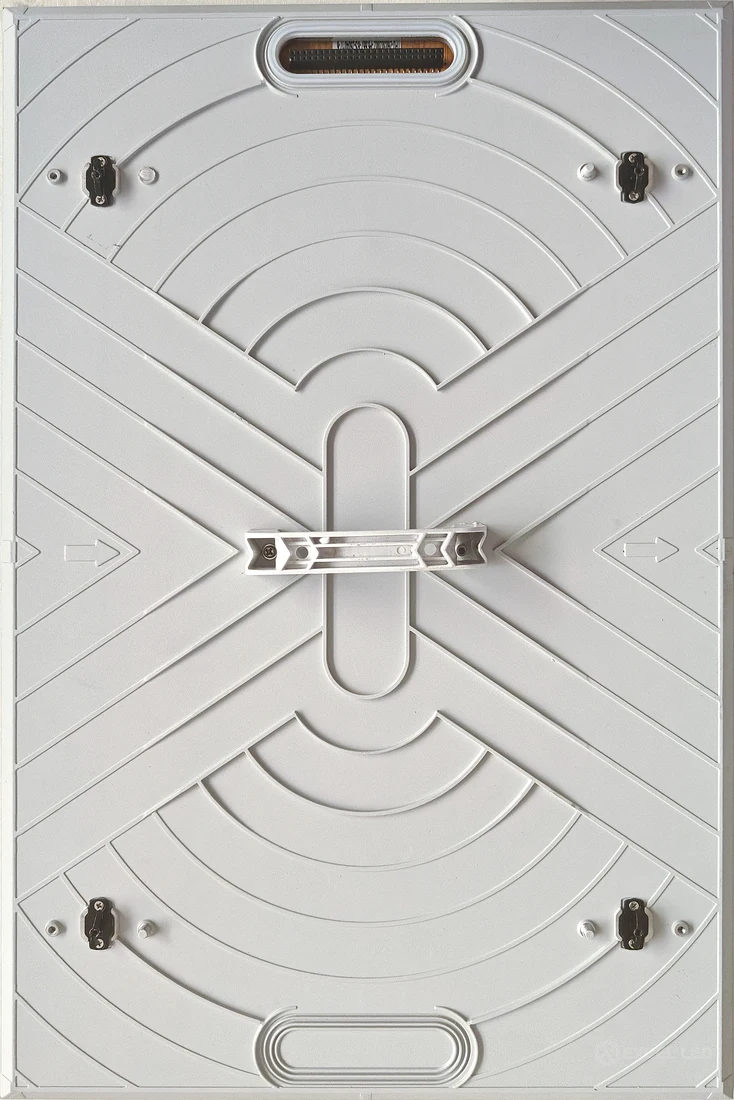
The rear of the module shows the standard HUB75 data interface and the screw-lock mechanism: a technician can pull one failed module from the front or the back without touching its neighbors. Spare modules are cheap insurance — a common planning rule is to keep 2–4 spare modules per 100 m² (common planning rule, not a standard).
Common-Anode Energy-Saving Power System: ≤200 W/m² Average
Quick answer: the B960 is a common-anode (CA) LED display — all LED anodes share one positive rail, and the energy saving comes from pairing that circuit with high-efficiency LED lamps and switching power supplies. The measured result in the specification: maximum ≤600 W/m², average ≤200 W/m² (confirmed), on AC 200–240 V input.
Each cabinet’s integrated power box carries two 400 W power supplies (confirmed). At the FC4.44 maximum of 600 W/m², one 0.92 m² cabinet draws about 552 W — roughly 69% of the 800 W installed supply capacity, which sits inside the common ≤80% power-supply loading rule (common planning rule; final sizing should be verified per project).
| Electrical Parameter | Specification |
|---|---|
| Power supply ratio | 2 × 400 W per cabinet (confirmed) |
| Maximum power | ≤600 W/m² (confirmed) |
| Average power | ≤200 W/m² (confirmed) |
| Supply requirement | AC 200–240 V |
| Frame frequency | 50 & 60 Hz |
Low consumption also means low heat. The FC specification describes ultra-low temperature rise and low decay; combined with the aluminum module’s conduction path, the screen is specified to run without air conditioning in standard configurations. For the engineering background, see our guide on outdoor LED display heat dissipation.
Signal Path & Control System Compatibility
The B960 follows the standard fixed-install architecture: a video processor and sending card sit in your control room, and each cabinet’s integrated power box hosts one receiving card that drives its six modules over HUB75. Signal and power both daisy-chain from cabinet to cabinet through the labeled POWER IN / SIGNAL IN and POWER OUT / SIGNAL OUT ports on the bottom rail.
Compatible control platforms
The cabinet and modules use the industry-standard HUB75 interface and conventional scan modes, so they work with the three control families we stock and support: NovaStar, Linsn and Colorlight receiving and sending hardware. The driver ICs support row-top and row-bottom blanking, high refresh and first-row dark-line correction, so image tuning tools (brightness, gray scale, low-gray color shift) behave the way integrators expect on those platforms.
Not sure which platform fits your project? Our LED control system collection compares the sending cards and video processors we ship most often.
IP66 Weatherproofing from -30°C to 60°C
Quick answer: IP66 means the cabinet is fully dust-tight and protected against powerful water jets from any direction — one grade above the IP65 that most outdoor LED display products quote. The B960 is specified for -30°C to 60°C operation and 10–98% RH (non-condensing), with storage from -40°C to 80°C.
| Condition | Specification (confirmed) |
|---|---|
| Working temperature | -30°C to +60°C |
| Working humidity | 10% RH – 98% RH (non-condensing) |
| Storage temperature | -40°C to +80°C |
| Storage humidity | 10% RH – 98% RH (non-condensing) |
| Protection rating | IP66 (dust-tight + powerful jet protection) |
| LED lifetime | 100,000 hours |
For readers comparing ratings: the IP code is defined by the international standard IEC 60529 — see the IP Code reference for what each digit officially means. In practice, the second digit 6 (powerful jetting) versus 5 (low-pressure jetting) is the difference that matters on storm-exposed facades. We explain the full rating ladder in our IP65 waterproof LED display guide.
The harshest proof: seaside operation
Salt fog corrodes cheap steel cabinets within a few seasons, which is why we watch our coastal projects closely. In Sokcho, South Korea, two B960-class aluminum screens — roughly 90 m² on the west side and 150 m² on the south side of the same beachfront complex — run meters from the surf, backed by the die-cast aluminum body and salt-spray-resistant surface treatment described in the FC specification.

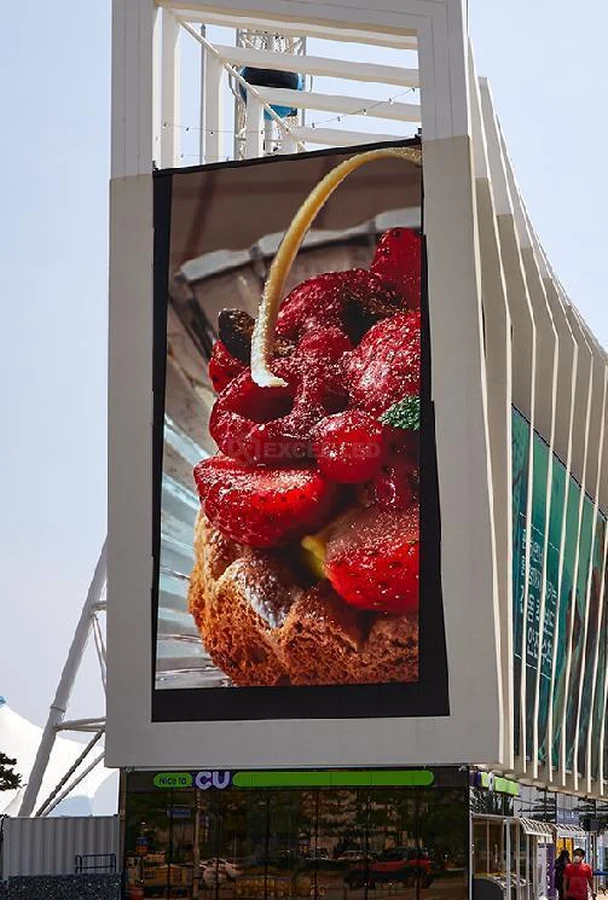
Picture Quality: 3840 Hz Refresh, 14–16 Bit, 5000+ nits
An outdoor screen lives or dies by how it looks at night on camera and at noon in direct sun. The B960’s optical package was specified for exactly those two moments — and each spec below is translated into what it does for your project.
3840 Hz Refresh
No banding or flicker when the screen appears in photos, live streams or slow-motion broadcast footage.
14–16 Bit Gray Scale
Smooth gradients in shadows and skin tones — no posterized clouds in dark video content.
≥5000 / 5500 nits
FC4.44 delivers ≥5000 nits and FC6.67 ≥5500 nits, keeping content legible in direct sunlight.
140° / 120° View Angle
Wide horizontal coverage so pedestrians on both sides still read the message clearly.
≥15,000:1 Contrast
Deep blacks between content and cabinet face — text stays sharp instead of washing out.
≥97% Brightness Uniformity
Lamp center deviation under 3% and chromaticity held within ±0.003 Cx,Cy across the wall.
Color temperature is adjustable between 6500–9000 K, so the screen can be tuned cooler for bright daylight impact or warmer for evening viewing comfort. Brightness and color uniformity are calibrated before shipping; the acceptance method our own QA uses is described in the maintenance section below.
FC4.44 vs FC6.67: Which Pixel Pitch Fits Your Project?
Both versions share the same 960×960 cabinet, IP66 rating and power architecture — the pitch decides viewing distance, resolution and budget. Here is the direct comparison:
| Item | FC4.44 ★ | FC6.67 |
|---|---|---|
| Pixel pitch | 4.44 mm | 6.67 mm |
| SMD lamp | SMD1921 | SMD2727 |
| Resolution per cabinet | 216×216 = 46,656 px | 144×144 = 20,736 px |
| Recommended viewing | ~5–45 m | ~7–67 m |
| Best applications | Urban facades, shop fronts, roadside screens at close range | Highway billboards, large elevated screens, stadium perimeters |
| Brightness | ≥5000 nits | ≥5500 nits |
| Resolution per m² | 50,625 px/m² — sharper close-up | 22,500 px/m² — lower cost at long range |
Who should choose FC4.44?
Choose FC4.44 when people will watch from a sidewalk, plaza or shop-front distance — roughly 5 m and closer is where FC6.67 starts showing pixel structure. It is the right pick for urban retail facades and roadside screens where vehicles pass at 20–40 m but pedestrians stand much closer.
Who should choose FC6.67?
Choose FC6.67 when the nearest viewer is a moving car 30 m away or further, and you are buying by the square meter: highway billboards, elevated stadium screens and long-range advertising. You get the same cabinet, the same IP66 body and a lower cost per square meter. If your site is even further out, compare our P10 outdoor LED display before deciding.
Screen Size, Resolution & Cabinet Count Guide
Every B960 wall is a grid of 960×960 cabinets, so you can calculate size, resolution and weight before you ever contact sales. The table below lists the most requested formats — resolution values are exact cabinet arithmetic, not estimates.
| Cabinets (W×H) | Screen size | FC4.44 resolution | FC6.67 resolution | Total weight |
|---|---|---|---|---|
| 2×2 (4) | 1.92×1.92 m | 432×432 (186,624 px) | 288×288 (82,944 px) | 100 kg |
| 3×3 (9) | 2.88×2.88 m | 648×648 (419,904 px) | 432×432 (186,624 px) | 225 kg |
| 4×3 (12) | 3.84×2.88 m | 864×648 (559,872 px) | 576×432 (248,832 px) | 300 kg |
| 4×4 (16) | 3.84×3.84 m | 864×864 (746,496 px) | 576×576 (331,776 px) | 400 kg |
| 6×4 (24) | 5.76×3.84 m | 1,296×864 (1,119,744 px) | 864×576 (497,664 px) | 600 kg |
| 8×5 (40) | 7.68×4.80 m | 1,728×1,080 (1,866,240 px) | 1,152×720 (829,440 px) | 1,000 kg |
| 10×6 (60) | 9.60×5.76 m | 2,160×1,296 (2,799,360 px) | 1,440×864 (1,244,160 px) | 1,500 kg |
Viewing distance rules of thumb
- Minimum comfortable distance ≈ pixel pitch in mm, read as meters: FC4.44 ≈ 4.4 m; FC6.67 ≈ 6.7 m (common planning heuristic).
- Comfortable viewing band ≈ pitch × 1,000 to pitch × 10,000: FC4.44 ≈ 4.4–44 m; FC6.67 ≈ 6.7–67 m (common planning heuristic).
- Match content size to distance: at 60 m, text needs to be at least ~60 mm tall per pixel of legibility budget — keep ad headlines large and high-contrast on long-range screens.
Six Installation Ways for the 960×960 Outdoor LED Display
The FC specification supports six mounting methods: wall-mounted, pillar-mounted, floor-standing, support-structure, suspended and inlaid (embedded). Because modules, cabinets and power boxes connect with hard connectors, the wall needs no secondary frame behind the cabinets — the steel structure carries the cabinet rails directly, which is where the structural savings come from.
Wall-mounted
Fixed directly to an existing facade with a mounting rail.
Pillar-mounted
Two steel columns for roadside and parking-lot screens.
Floor-standing
Self-supporting base for plazas and exhibition grounds.
Support structure
Braced truss frame for elevated, large-format walls.
Suspended
Hung from beams or gantries over entrances and stages.
Inlaid / embedded
Flush-mounted into building skin for architectural walls.
Whichever method you choose, the per-cabinet procedure is the same: hang the cabinet on the rail, lock the position, join power and signal through the bottom ports, and continue to the next. For the complete civil-works and wiring checklist, see our outdoor LED display installation guide.
Real B960 Outdoor LED Display Projects
Project records from the FC aluminum-cabinet line include installations across China, the United States and South Korea. Each entry below is from our project archive; sizes are the recorded built areas.
| Project | Type | Area |
|---|---|---|
| Jiangyin Stadium, China | Stadium screen | 280 m² |
| Zhengzhou University, China | Double-sided aluminum screen | 220 m² |
| Houston, USA | Double-sided aluminum screen | 180 m² |
| Baoli Plaza, Dongguan, China | Commercial facade | 130 m² |
| Sokcho seaside, south side, South Korea | Coastal facade | 150 m² |
| Sokcho seaside, west side, South Korea | Coastal facade | 90 m² |

Decision logic — the Sokcho seaside pair. The client needed screens meters from the ocean: salt fog, storm jetting and humid sea air. The choice came down to cabinet material and sealing rather than pitch. The die-cast aluminum body (corrosion-resistant, non-welded) plus IP66 sealing answered all three, so both facades — 90 m² and 150 m² — were built on this cabinet line and continue to run beach-front. That is the same reasoning we recommend for any coastal site.

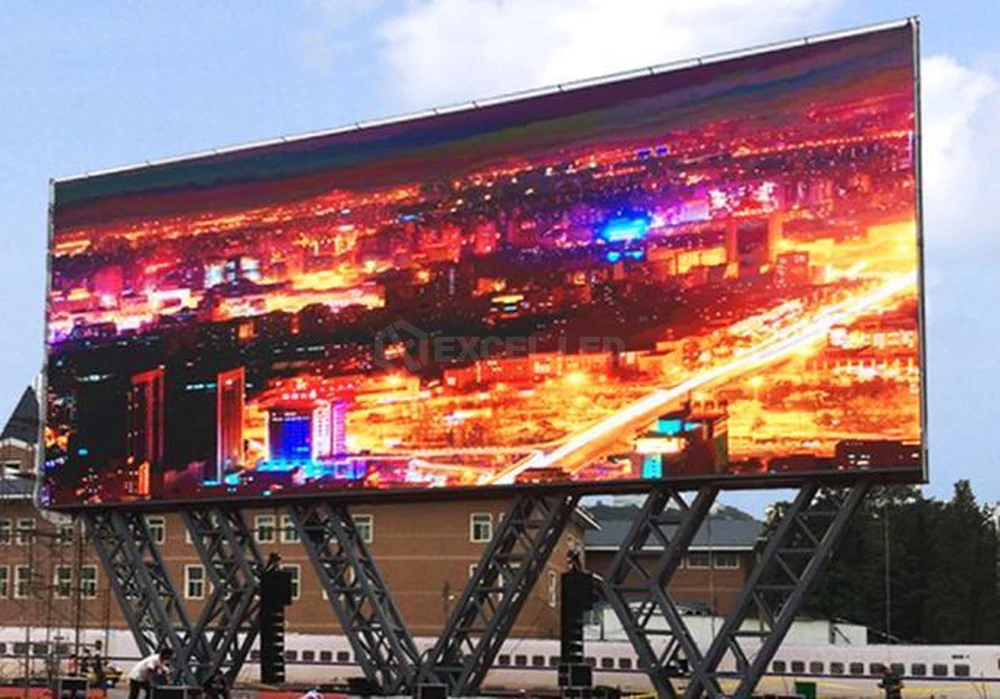
If you are weighing a double-sided format for a roadside site, read our comparison of single-sided vs double-sided outdoor LED billboards, and browse more reference builds in our LED display case library.
Front & Rear Service, Dehumidification and Acceptance
Two-sided maintenance access
Every cabinet supports front and rear maintenance (confirmed). Wall-mounted screens with no rear walkway use front service: unlock the module, pull it out on its guides, replace it in minutes. Screens on steel frames with rear access use rear service through the power box. Either way, one technician handles a 25 kg cabinet without special lifting gear.
Restart procedure after long storage (dehumidification)
Moisture is the quiet killer of stored LED screens. The FC series operation manual prescribes a gradient power-on that drives humidity out gradually — follow it whenever the screen has been off for weeks:
- Normal humidity (10–65% RH): power the screen on at least once a day for 4+ hours to expel moisture.
- High humidity (65%+ RH): dehumidify the room first, then run the screen 8+ hours daily with doors closed.
- After long storage, step brightness up every 2 hours: 20% → 40% → 60% → 80% → 100%, two hours per step, before returning to normal schedules.
How our QA accepts a finished screen
The FC series acceptance method is unusually concrete, and we hand it to buyers so they can re-verify on site: with the screen at full white, measure brightness within 10 minutes using a luminance gun held perpendicular to the face, with the lens window covering at least 16 pixels in focus. For viewing angle, check from ±140° horizontal and 65° downward — no obvious dark patches should appear. Plan ongoing care with our outdoor LED display maintenance schedule.
When the B960 960×960 Outdoor LED Display Is NOT the Right Choice
No screen fits every site, and telling you when to walk away is part of the job. Four situations where we would steer you elsewhere:
- Viewers closer than ~4 m or indoor use. A 4.44 mm pitch shows pixel structure up close. For indoor walls and close-range retail, see the P2.5 LED display or finer-pitch indoor ranges instead.
- Rental and touring events. The B960 is a fixed-install cabinet. Frequent rigging, stacking and truck-packing need rental-style quick-lock cabinets — compare fixed vs rental outdoor LED displays.
- Glass facades that must stay transparent. An opaque 960×960 wall blocks the window behind it. Transparent film or grid screens fit there — see our transparent outdoor LED screen guide.
- Very long viewing with a tight budget. If the nearest viewer is 60 m+ away and content is simple, a coarser pitch such as P10 class delivers the same message for less per square meter — ask us for the long-range option in your quote request.
How Much Does a 960×960 Outdoor LED Display Cost?
We do not publish a fixed price, and any honest supplier will tell you why: with quote-based products, a per-square-meter number published today is wrong for half the inquiries by next quarter. What we can do is show you exactly what drives the price, so you can judge quotations line by line:
- Pitch — the biggest lever. FC4.44 carries 2.3× the lamps of FC6.67 per square meter (50,625 vs 22,500), so cost per m² falls as pitch grows.
- Screen size and cabinet count. Larger walls spread the sending system and spare-parts kit across more area, lowering effective cost per m².
- Brightness and IC configuration. Higher brightness grades and driver IC features (blanking, low-gray correction) change the module BOM.
- Control system brand. NovaStar, Linsn and Colorlight sit at different price points with different tuning features.
- Structure and installation. Wall-mount reuses the building; pillar and support builds add steel, footings and crane time — the B960’s 25 kg cabinet keeps this line item smaller than heavier cabinets would.
- Shipping and destination costs. Cabinet packing, sea/air freight, duties and local labor are quoted separately per incoterms.
For market context on the whole category, read our outdoor LED screen price guide, then send us your dimensions — the quotation below itemizes every line above.
B960 Technical Specifications
All values below are from the FC series specification sheet (confirmed); maximum power may fluctuate up to 10% with LED chip batches, per the manufacturer’s note.
| Parameter | FC4.44 | FC6.67 |
|---|---|---|
| Pixel structure (SMD) | 1921 | 2727 |
| Pixel pitch | 4.44 mm | 6.67 mm |
| Module resolution (W×H) | 108×72 | 72×48 |
| Module size / weight | 480×320 mm / 2 kg | 480×320 mm / 2 kg |
| Cabinet module layout | 2×3 | 2×3 |
| Cabinet resolution | 216×216 | 144×144 |
| Cabinet size | 960×960×85 mm | 960×960×87 mm |
| Cabinet area / weight | 0.92 m² / 25 kg | 0.92 m² / 25 kg |
| Cabinet material | Die-cast aluminum | Die-cast aluminum |
| Pixel density | 50,625 px/m² | 22,500 px/m² |
| IP rating | IP66 | IP66 |
| Brightness | ≥5000 nits | ≥5500 nits |
| Gray scale | 14–16 bit | 14–16 bit |
| Color temperature | 6500–9000 K adjustable | 6500–9000 K adjustable |
| View angle (H×V) | 140° / 120° | 140° / 120° |
| Lamp center deviation | <3% | <3% |
| Brightness / chromaticity uniformity | ≥97% / ±0.003 Cx,Cy | ≥97% / ±0.003 Cx,Cy |
| Contrast ratio | ≥15,000:1 | ≥15,000:1 |
| Maximum / average power | ≤600 W/m² / ≤200 W/m² | ≤600 W/m² / ≤200 W/m² |
| Supply requirement | AC 200–240 V | AC 200–240 V |
| Power supply ratio | 2 × 400 W | 2 × 400 W |
| Frame frequency | 50 & 60 Hz | 50 & 60 Hz |
| Scan mode | 1/9 | 1/6 |
| Refresh rate | 3840 Hz | 3840 Hz |
| Maintenance | Front / rear | Front / rear |
| LED lifetime | 100,000 hours | 100,000 hours |
| Working temp / humidity | -30°C–60°C / 10–98% RH | -30°C–60°C / 10–98% RH |
| Storage temp / humidity | -40°C–80°C / 10–98% RH | -40°C–80°C / 10–98% RH |
Each shipment includes the display set, user manual, certificate, warranty card and construction notes. Need the spec sheet as a PDF? Request it with the quotation button below and we will send the current revision.
FAQ: 960×960 Outdoor LED Display
Q1What does 960×960 mm mean on an outdoor LED display?
It is the cabinet footprint: 960 mm wide by 960 mm high, about 0.92 square meters per cabinet. Because every cabinet is identical, screens are planned as a simple grid — a 5.76×3.84 m billboard is exactly 6×4 = 24 cabinets — which makes size, resolution and weight predictable before ordering.
Q2How heavy is the B960 cabinet, and does it reduce structural cost?
One die-cast aluminum cabinet weighs 25 kg, or about 27 kg per square meter of wall. Heavier welded-steel cabinets at this size typically weigh 40–50 kg each (typical industry value). The lighter wall means a smaller support frame, smaller foundations and faster installation, which is where the structural savings come from.
Q3Should I choose FC4.44 or FC6.67 for my site?
Match pitch to viewing distance. FC4.44 suits viewers from about 5 m outward — sidewalks, plazas, shop fronts. FC6.67 suits 7 m and beyond — highways and elevated billboards — at a lower cost per square meter. Use the common heuristic: minimum distance in meters roughly equals the pitch number in millimeters.
Q4Is IP66 enough for heavy rain and coastal salt fog?
IP66 is fully dust-tight and withstands powerful water jets from any direction, one grade above IP65. For coastal sites, the die-cast aluminum body adds corrosion resistance that welded steel cannot match. Our Sokcho beachfront installations in South Korea — 90 m² and 150 m² — run in exactly this salt-fog environment.
Q5Why does the B960 not need an air conditioner?
Three reasons from the specification: average power is only about 200 W/m², the driver design produces an ultra-low temperature rise, and the die-cast aluminum module conducts heat from the LED boards into the cabinet shell. With that thermal path the screen is specified to run without dedicated air conditioning in standard configurations.
Q6What does common-anode energy-saving mean on this screen?
In a common-anode circuit all LED anodes share one positive supply rail, simplifying the drive path. The energy saving comes from pairing that circuit with high-efficiency LED lamps and switching power supplies, which is how the screen holds average consumption at or below 200 W/m² with maximum 600 W/m².
Q7How many cabinets do I need for a 6×12 ft double-sided sign?
A 6×12 ft sign (about 1.83×3.66 m) is almost exactly a 2×4 cabinet grid — 8 cabinets per face, 16 for both sides, about 400 kg of display. FC6.67 delivers 576×1,152 pixels per face, which is ample for sign-reading distances of 30 m and more.
Q8Can I service the screen from the front?
Yes. The B960 supports both front and rear maintenance. Front service unlocks and withdraws the module on its guides — the right choice for wall-mounted screens with no rear walkway. Rear service runs through the integrated power box when the structure provides rear access.
Q9The screen was stored for months — how do I restart it safely?
Use the gradient power-on from the FC operation manual: two hours at 20% brightness, then 40%, 60%, 80% and 100%, two hours per step. This drives absorbed moisture out gradually and protects the lamps. In normal humidity, power the screen on daily for at least 4 hours as routine dehumidification.
Q10Which control systems work with the B960?
The cabinet uses the standard HUB75 interface and conventional scanning, so it integrates with NovaStar, Linsn and Colorlight sending and receiving hardware — the three platforms we stock and support. The driver ICs support row blanking and low-gray correction, so tuning tools on those platforms behave normally.
Q11What warranty comes with the B960?
Excel LED screens ship with a standard 2-year warranty covering LED lamps, driver ICs and power supplies, with extended terms available for large projects. Every shipment includes a warranty card and construction notes; keep them with the screen for service claims.
Q12How long is production and delivery?
Standard production is typically 15–25 working days depending on order size and configuration, followed by sea or air freight to your port or site. Rush builds can be arranged for urgent openings — tell us the deadline in your quotation request and we will confirm feasibility before you commit.
960×960 Outdoor LED Display: A Safer Buy by Design
The B960 keeps the decision simple: one proven 960×960 mm die-cast aluminum cabinet at 25 kg, two pitch options that map cleanly to viewing distance, IP66 sealing for the worst weather your site offers, and a common-anode power budget of about 200 W/m² that pays you back every month it runs. Check the drawing, count the cabinets, verify the loads — then let our engineers confirm the rest.
Related reading: how to choose an outdoor LED display · how long do outdoor LED screens last · P6 mall facade project in Dubai · Excel LED screen manufacturing