
Mean Well NEL-400-5 Power Supply
5V 80A · 400W exactly · 180–264VAC only · fan-cooled · no PFC
A 400W 5V supply whose name finally matches its output — at a price that reflects its simpler architecture: no PFC stage, 230V-class input only, and an EAC-only EMC listing. Read the input range before you specify it. Supplied by Excelled Display, LED display manufacturer and component supplier for global B2B integrators.
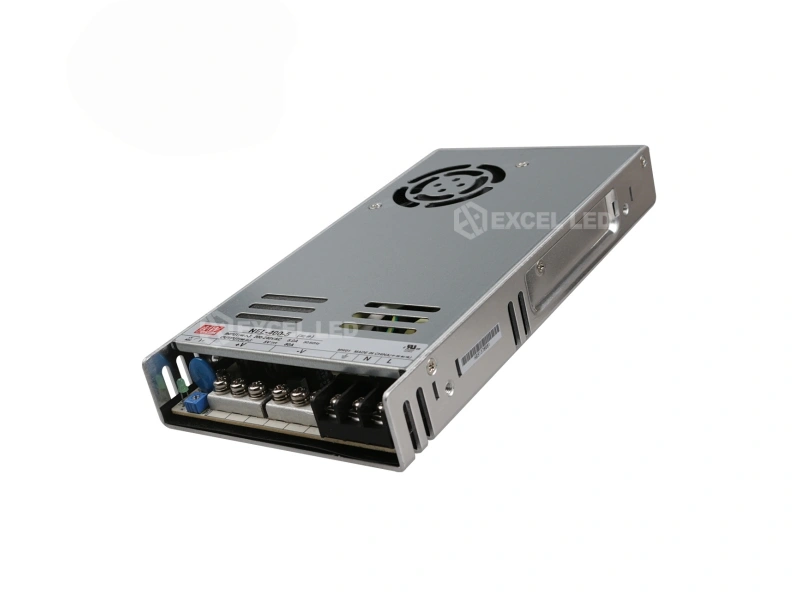
Mean Well NEL-400-5 Power Supply at a Glance
What is it? The NEL-400-5 is the 5V model in the MEAN WELL NEL-400 series of single-output enclosed switching power supplies. It delivers a regulated 5V DC output at up to 80A from a fan-cooled case measuring 215 × 115 × 30mm and weighing 0.85kg.
How much power does it deliver? 400W — exactly what the name says. 5V × 80A = 400W. After a family where names routinely overstate the 5V rating — 300W on an LRS-350-5, 400W on a UHP-500-5 — this one is honest, and the 2.8V and 4.2V models in the same series are not: they share the 80A ceiling and deliver 224W and 336W.
What is the catch? Three, and they are all on the datasheet rather than in the marketing.
- Input is 180–264VAC only. This is not a full-range supply. There is no 115VAC operation, so it cannot be used on 110/120V mains — the United States, Canada, Japan, Taiwan and Mexico are all out unless a step-up transformer is part of the design.
- There is no PFC stage. The block diagram shows EMI filter → rectifiers → power switching → rectifiers and filter, with no power-factor-correction block, and the specification table carries no power factor row at all.
- EMC compliance is EAC TP TC 020 only. There is no EN55032, no Class B, no EN61000-3-2 and no EN61000-6-2 listed. Safety approvals are UL 62368-1 and EAC TP TC 004, and nothing European.
How efficient is it? 84% typical at 5V — the lowest of every model in this comparison set, and consistent with the absence of a PFC stage. At full load roughly 76W becomes heat, and unlike the UHP slim range there is a fan to remove it.
Does it need an aluminium mounting plate? No. This is a forced-air-cooled supply with a built-in DC fan, and the datasheet specifies no mounting-plate condition at all. That removes the biggest installation constraint of the UHP range — and adds a moving part that the UHP range does not have.
What is it used for? LED display cabinets on 230V-class mains where the harmonic and EMC requirements are met by other means, industrial control and automation equipment running from a 220/230V supply, and mechanical and electrical apparatus in the same conditions. Configuration, MOQ and pricing from our sales team.

The NEL-400 Series: Three Voltages and an Honest 400W
The NEL-400 series is a short one — just three voltages, all sharing the same 80A current ceiling. Only the 5V model reaches the 400W the family is named for.
| Model | Output voltage | Rated current | Rated power | Efficiency (typ.) |
|---|---|---|---|---|
| NEL-400-2.8 | 2.8V | 80A | 224W | 79% |
| NEL-400-4.2 | 4.2V | 80A | 336W | 83% |
| NEL-400-5 | 5V | 80A | 400W | 84% |
Efficiency climbs with voltage across the three models: 79%, 83%, 84%. Even the best of them, at 84%, is well below the 90% of the UHP-500-5 at the same 5V and the same 400W output — which is the practical cost of the simpler circuit. At full load the difference is roughly 76W of heat here against 40W on the UHP-500-5, and that difference is precisely why one design has a fan and the other has an aluminium plate.
NEL-400-5 Specifications: Datasheet Parameters for the 5V 80A Model
Transcribed from the MEAN WELL NEL-400 specification sheet (NEL-400-SPEC, revision dated 2024-10-16) for the 5V model. Note that the datasheet quotes its set-up, hold-up and input figures at 230VAC only, consistent with the 180–264VAC input range.
| Parameter | NEL-400-5 specification |
|---|---|
| DC output voltage | 5V, adjustable 4.5 ∼ 5.5V via the ADJ control |
| Rated current | 80A, current range 0 ∼ 80A |
| Rated power | 400W |
| Ripple & noise (max.) | 150mVp-p at 20MHz bandwidth — lower than the 200mVp-p of the UHP slim models at the same output |
| Voltage tolerance | ±3.0% (the 2.8V and 4.2V models are quoted +3%, −4.5%) |
| Line regulation | ±0.5% |
| Load regulation | ±2.0% from 0% to 100% rated load — looser than the ±1.0% of the UHP slim models |
| Set-up / rise time | 2500ms, 50ms/230VAC at full load — the slowest set-up of the models in this comparison set |
| Hold-up time (typ.) | 20ms/230VAC — the longest of any model in this comparison set, against 10–12ms on the UHP range |
| Input voltage range | 180 ∼ 264VAC only; 254 ∼ 370VDC. No 115VAC operation |
| Input frequency | 47 ∼ 63Hz |
| Power factor | Not specified. The datasheet carries no power factor row, and the block diagram shows no PFC stage |
| Efficiency (typ.) | 84% at 5V; 79% at 2.8V and 83% at 4.2V |
| AC current (typ.) | 5A/230VAC for the 5V model (4A for the 4.2V model, 3A for the 2.8V model) — quoted per model, unlike the grouped figures on some other datasheets |
| Inrush current (typ.) | 100A/230VAC — substantially higher than the 60A/230VAC of the UHP slim models |
| Leakage current | <1mA / 240VAC |
| Overload protection | 105 ∼ 140% rated output power; hiccup mode, recovers automatically once the fault is removed |
| Over-voltage protection | 5.6 ∼ 7V on the 5V model; hiccup mode, recovers automatically — see the note below, this differs from the UHP range |
| Over-temperature protection | Shuts down output, recovers automatically once temperature falls |
| Cooling | Forced air — built-in DC fan. The mechanical drawing marks an air flow direction. No aluminium mounting plate is specified |
| DC OK / redundant functions | Not offered. This series lists no DC OK signal and no redundant parallel function |
| Working temperature | −20 ∼ +60°C with output load derating — a narrower window than the −30 ∼ +70°C of the UHP range |
| Working humidity | 20 ∼ 90% RH non-condensing |
| Storage | −20 ∼ +85°C, 10 ∼ 95% RH — a warmer cold end than the −40°C of the UHP range |
| Temperature coefficient | ±0.03%/°C (0 ∼ 50°C) |
| Vibration | 10 ∼ 500Hz, 3G, 10 min per cycle, 60 min each along X, Y and Z axes |
| Withstand voltage | I/P–O/P 3KVAC; I/P–FG 2KVAC; O/P–FG 0.5KVAC |
| Isolation resistance | 100MΩ / 500VDC at 25°C, 70% RH |
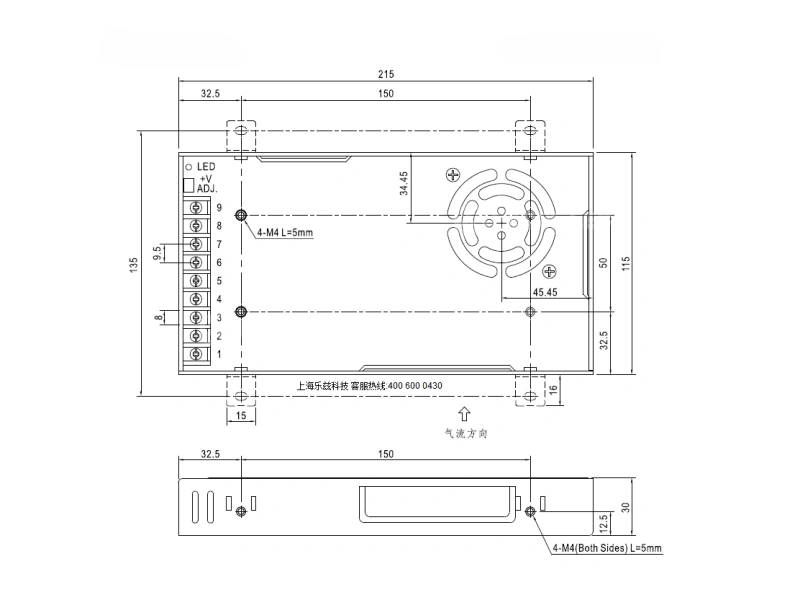
| Dimensions (L×W×H) | 215 × 115 × 30mm (Case No. 207D), tolerance ±1mm |
| Weight / packing | 0.85kg per unit; 15pcs / 13.8kg / 0.67CUFT per carton |
| MTBF | 1708.9K hrs min. Telcordia SR-332 (Bellcore); 220.9K hrs min. MIL-HDBK-217F at 25°C |
| Warranty | 3 years (manufacturer’s stated warranty on the datasheet) |
The NEL-400-5 Input Range: 180–264VAC, and Why It Rules Out 115V Sites
This is the single most important specification on the page, and the one most likely to be missed because the model number and the output rating look interchangeable with a UHP-500-5.
| Input specification | NEL-400-5 | UHP-500-5 |
|---|---|---|
| AC input range | 180 ∼ 264VAC | 90 ∼ 264VAC |
| 115VAC operation | Not supported | Supported |
| DC input range | 254 ∼ 370VDC | 127 ∼ 370VDC |
| Selector switch needed | No — but the low line is 180VAC | No — full range |
| Set-up quoted at | 230VAC only | 230VAC and 115VAC |
| Hold-up quoted at | 230VAC only | 230VAC and 115VAC |
What 180VAC as a low line actually costs you
- No 120V markets at all. The United States, Canada, Japan, Taiwan and Mexico run 100–120V mains. A NEL-400-5 cannot be installed on them. That is not a marginal derating issue — the supply simply will not start.
- Little margin on a nominal 220V supply. A 180VAC floor leaves 40V of headroom below a nominal 220V, or about 18%. On a site with a heavily loaded distribution board, long service drops or a generator, that margin can disappear during a brownout or a motor start.
- It sits close to a common 208V three-phase tap. A 208V line-to-line tap is only 28V above the minimum. Verify against the static characteristic curve before designing a 208V installation around this model.
- The static characteristic is not flat across 180–264VAC. The datasheet draws load against input voltage across that span, and the curve dips at the low end. A site running near 180VAC should be checked against that curve rather than assumed to deliver full load.
- Set-up and hold-up are only quoted at 230VAC. There is no 115VAC column to read because the model does not operate there — a small but telling detail that confirms this is a 230V-class supply rather than a full-range one.
NEL-400-5 Without PFC: What the Block Diagram and the Compliance List Both Show
The NEL-400 series is titled 400W Single Output Switching Power Supply. It does not carry the “with PFC” wording that the UHP and RSP series carry in their own titles, and three independent parts of the datasheet agree on why.
| Evidence | What the datasheet shows |
|---|---|
| The block diagram | EMI filter → rectifiers → power switching → rectifiers and filter, with O.L.P., O.T.P. and O.V.P. loops into a PWM control block. There is no PFC circuit block, where the UHP-200, UHP-350 and UHP-500 diagrams each show one explicitly |
| The specification table | There is no power factor row at all. Every UHP and RSP datasheet in this range carries one, quoted as PF > 0.94 to 0.98 |
| The EMC emission list | EAC TP TC 020 only. No EN61000-3-2 and no EN61000-3-3 — the two harmonic and flicker standards that a PFC stage exists to satisfy. Every UHP sheet lists both |
| Switching frequency | A single fosc of 80KHz is quoted. The UHP sheets quote two — a PFC frequency and a separate PWM frequency |
What the absence of PFC means in practice
- The power factor is likely to be low. An uncorrected switch-mode supply of this class typically presents a power factor in the region of 0.6, against the >0.95 of a PFC-corrected unit. We are giving that as a general expectation rather than a measured figure for this model, because MEAN WELL does not state one on this datasheet — and we will not print a number the manufacturer has not published.
- Apparent input current is higher than the real power suggests. The datasheet quotes 5A/230VAC for the 5V model, which is the figure to size cabling, breakers and distribution against — not the efficiency-corrected calculation.
- Harmonic limits are not addressed. Where a project must meet EN61000-3-2, this datasheet provides no evidence of compliance, and neither does the safety listing. That is not a defect in the product; it is a scope statement about what this model is for.
- This is where part of the cost difference comes from. A PFC stage is real components and real engineering. A design without one is simpler and cheaper to build, which is the trade being offered — and the reason to choose it is a project that does not need PFC.
NEL-400-5 Fan Cooling: 215 × 115 × 30mm, 0.85kg and No Aluminium Plate
The NEL-400-5 takes the opposite approach to heat from the entire UHP slim range. It has a built-in DC fan, and the datasheet specifies no mounting-plate condition at all — the mechanical drawing instead marks an air flow direction that the installation has to respect.
| Thermal design | NEL-400-5 | UHP-500-5 |
|---|---|---|
| Cooling | Forced air, built-in DC fan | Fanless, free air convection |
| Moving parts | One fan | None |
| Mounting plate required | No | Yes, 450 × 450mm |
| Efficiency at 5V | 84% | 90% |
| Heat to remove at full load | ≈76W | ≈40W |
| Air flow direction | Specified and must be respected | Convection only; keep the perforated faces clear |
| Height | 30mm | 31mm |
| Weight | 0.85kg | 0.905kg |
What you gain, and what you take on
- You gain freedom in the cabinet design. No 450 × 450mm aluminium surface has to be provided, and the unit does not have to sit flat against a thermally conductive plate. On a cabinet whose structure cannot serve as a heatsink — and that is a real constraint on many LED display frames — this removes the hardest installation requirement in the UHP range.
- You take on a moving part. A fan has bearings. In a fan-cooled supply the fan is typically the first component to fail, and its failure is quiet: the supply keeps working until the thermal margin is gone. That is the maintenance exposure the fanless range does not have.
- You take on an air path. The air flow direction is marked on the mechanical drawing for a reason. The intake must not be blocked, the exhaust must not recirculate, and the cabinet needs a route for that air to leave. A fan-cooled supply in a sealed cabinet moves hot air around rather than removing it.
- You take on contamination. Air carries dust and, in some environments, moisture and conductive particles into the unit. Fan-cooled supplies in dusty or humid cabinets need a maintenance interval that fanless ones do not.
- The derating curve still applies. Working temperature is −20 ∼ +60°C with output load derating, and the curve is drawn across that range. A fan does not exempt the supply from ambient limits — a 60°C ceiling is 10°C narrower than the UHP range’s +70°C.

NEL-400-5 vs UHP-500-5: The Same 400W, Two Different Power Supplies
Both deliver 400W at 5V and 80A. Almost nothing else about them is the same, and the datasheets are unusually clear about which project each is for.
| Parameter | NEL-400-5 | UHP-500-5 |
|---|---|---|
| Output | 5V / 80A | 5V / 80A |
| Rated power | 400W | 400W |
| Name accuracy at 5V | Exact | 100W overstated |
| AC input range | 180∼264VAC only | 90∼264VAC |
| Power factor | Not specified, no PFC stage | PF > 0.95, active PFC |
| Efficiency (typ.) | 84% | 90% |
| Heat at full load | ≈76W | ≈40W |
| Cooling | Built-in DC fan | Fanless |
| Mounting plate | Not required | 450×450mm required |
| Ripple & noise | 150mVp-p | 200mVp-p |
| Voltage tolerance | ±3.0% | ±2.0% |
| Load regulation | ±2.0% | ±1.0% |
| Hold-up time | 20ms | 12ms |
| Set-up time | 2500ms | 1000ms |
| Inrush current | 100A/230VAC | 60A/230VAC |
| Working temperature | −20∼+60°C | −30∼+70°C |
| OVP behaviour | Hiccup, self-recovering | Shutdown, re-power required |
| Vibration | 3G | 5G |
| O/P–FG withstand | 0.5KVAC | 1.25KVAC |
| Safety approvals | UL 62368-1, EAC only | UL, TUV EN, EN61558, EN60335, CCC, BSMI, BIS |
| EMC emission | EAC TP TC 020 only | EN55032 Class B, EN61000-3-2/-3 |
| EMC immunity | EAC TP TC 020 only | EN61000-6-2 heavy industry |
| DC OK / redundant | Not offered | 30Vdc/1A relay, redundant option |
| MTBF — Telcordia | 1708.9K hrs | 1264.1K hrs |
| Dimensions | 215×115×30mm | 232×81×31mm |
| Weight | 0.85kg | 0.905kg |
How to choose between them in one line each
- Choose the NEL-400-5 when the project is on 220–240V mains, when no PFC or EN61000-3-2 requirement applies, when the cabinet cannot provide a 450 × 450mm aluminium surface, and when a fan and its maintenance is acceptable. The longer 20ms hold-up and the lower 150mVp-p ripple are genuine advantages.
- Choose the UHP-500-5 when the site is on 100–120V, when PFC or European EMC compliance is required, when the installation is dusty or humid, when the cabinet is sealed or hot, when the screen must report supply status, or when the fanless construction is the point.
- Do not choose on wattage. They are identical at 400W and 80A. Every other line in that table is the actual decision, and the first two — input range and PFC — eliminate one of them outright for most projects.
How Many LED Modules Can One NEL-400-5 Power?
No supplier can answer this without knowing your module. The count depends on the maximum power rating of your LED module from its own datasheet, the number of modules on the supply, and the thermal headroom you leave — which here depends on the cabinet ambient and the fan’s air path.
- Start from the real rating. 400W at 5V, which is 80A.
- Apply a load ceiling. A common planning rule in LED cabinet builds is to keep continuous load at or below about 80% of rated output — roughly 320W, or 64A, on a NEL-400-5. This is an engineering convention rather than a MEAN WELL figure; confirm it against your own project’s thermal and warranty conditions.
- Check the ambient against the derating curve. Working temperature is −20 to +60°C with derating, and the curve applies to the cabinet’s internal ambient, not the room temperature. A cabinet mounted in sun can sit 15°C above the outside air.
- Divide by the module’s maximum power, taken from the module datasheet rather than a marketing page — full white is the condition a screen is commissioned under.
- Check the current path. 64A still has to leave through a 9-pin terminal block and reach the modules. Confirm wire gauge, terminal rating and the number of feeds.
- Confirm the mains supply actually stays above 180VAC. This is the step that is unique to this model, and it comes before the thermal ones.
Worked as an Illustrative Example — substitute your own module figures; these numbers are for the arithmetic only:
| Step | Illustrative calculation |
|---|---|
| Supply rating | 400W / 80A at 5V |
| Usable at 80% planning ceiling | 320W / 64A |
| Module maximum power (illustrative) | 25W per module |
| Modules per supply (320 ÷ 25) | 12 modules, with 20W of the usable budget unspent |
| Heat into the cabinet at that load | ≈61W at 84% efficiency — and unlike the fanless UHP range, that heat is moved by a fan and therefore has to be able to leave the cabinet |
| Input current to size against | Up to 5A/230VAC per unit at full load, per the datasheet |
For the control and signal side of the same cabinet, the LED control system collection covers how sending cards, receiving cards and processors are powered and wired alongside the supplies.
NEL-400-5 Wiring: The 9-Pin Terminal and the Air Flow Direction
The NEL-400-5 uses a single 9-pin terminal block carrying both AC input and DC output — a different arrangement from the UHP slim models, which use a separate AC block, two DC blocks and a signal connector.
| Pin | Assignment | Practical note |
|---|---|---|
| 1 | AC/L — live | Mains live input |
| 2 | AC/N — neutral | Mains neutral input |
| 3 | FG — frame ground | Bond to the cabinet earth; do not omit |
| 4 ∼ 6 | DC OUTPUT −V | Three terminals, shared negative rail |
| 7 ∼ 9 | DC OUTPUT +V | Three terminals, shared positive rail |
Terminal details from the mechanical drawing: the unit takes 4-M4 × 5mm mounting screws, and the datasheet notes 4-M4 (both sides) L=5mm for the side mounting positions. The body carries an LED indicator and an ADJ control for the 4.5–5.5V adjustment. There is no separate signal connector, because this series offers no DC OK function.
Wire it for 5A of input, not for 400W of output
Because there is no PFC stage, the input current is higher than a corrected supply of the same output would draw. The datasheet’s own figure for the 5V model is 5A/230VAC, and that is what cabling, circuit breakers and internal distribution have to be sized against. Sizing from the output wattage divided by voltage and efficiency will understate it.
Respect the air flow direction
The mechanical drawing marks an air flow direction, and on a fan-cooled supply this is a specification rather than a suggestion. The unit draws air in on one face and exhausts it on another, and the installation has to give both a path.
- Leave the intake and exhaust clear. A supply pressed against a flat panel with no clearance on the intake face will recirculate its own hot exhaust and derate itself long before the cabinet ambient suggests it should.
- Give the exhaust somewhere to go. In a sealed cabinet a fan moves heat around the enclosure rather than out of it. The cabinet needs ventilation, or the hot air needs a route to the outside.
- Do not stack units against each other’s exhaust. Two of these mounted so that one draws the other’s exhaust will run hotter than either would alone, and the second one will be the one that fails.
- Plan for cleaning. A dusty intake restricts flow. In an industrial or outdoor-adjacent cabinet, an inspection interval for the intake and the fan itself is part of owning a fan-cooled supply.

The unit in our own photograph carries a label reading NEL-400-5 with 5V / 80A, which makes this the one image in our set that directly evidences the 5V model rather than the series. We still recommend confirming any batch against its printed serial number on the manufacturer’s site, as with any supply.
There is no input voltage switch — and nothing to select
The NEL-400-5 has no 115/230V selector switch because it has no 115V mode at all. Wire it to a 220–240V nominal supply and it runs; wire it to 120V and it will not start. Before installing, confirm the supply voltage at the point of connection rather than assuming it from the country, since 208V and 220V taps exist in nominally higher-voltage markets.
The same wiring discipline applies to the control hardware inside the cabinet. Our guides to the MCTRL660 LED display controller and the Colorlight X2 LED video processor cover the signal side, and the Huidu HD-A5 LED display player covers standalone playback for screens that run without a PC.
NEL-400-5 Certifications: UL 62368-1 and EAC, and Nothing European
The compliance profile of the NEL-400-5 is markedly thinner than any other model on this site, and that is a statement about the product’s intended market rather than a criticism of it. It has to be read before the model is specified into an EU, UK or Australian project.
| Item | Detail from the NEL-400 datasheet (revision dated 2024-10-16) |
|---|---|
| Safety standards | UL 62368-1 and EAC TP TC 004 approved. No TUV EN, no EN61558, no EN60335, no CCC, no BSMI and no BIS listed |
| EMC emission | Compliance to EAC TP TC 020 only. No EN55032, no Class B listing, no EN61000-3-2, no EN61000-3-3 |
| EMC immunity | Compliance to EAC TP TC 020 only. No EN61000-4 series and no EN61000-6-2 listing |
| Withstand voltage | I/P–O/P 3KVAC; I/P–FG 2KVAC; O/P–FG 0.5KVAC |
| Isolation resistance | 100MΩ / 500VDC at 25°C, 70% RH |
| MTBF | 1708.9K hrs min. Telcordia SR-332 (Bellcore); 220.9K hrs min. MIL-HDBK-217F at 25°C |
What is present, and what a European project needs
- UL 62368-1 is a genuine safety approval and covers the audio/video, IT and communication equipment safety standard. That is a real certification, not a self-declaration.
- EAC TP TC 004 and TP TC 020 are the Eurasian Economic Union approvals for safety and for electromagnetic compatibility respectively. A supply approved for the EAEU market is not thereby approved for the EU market.
- For an EU or UK project, the missing entries are the ones that matter. An EN55032 emission listing and EN61000-3-2 harmonic compliance are what a CE-marked installation is normally evidenced against. This datasheet provides neither.
- For a US or Canadian project the input range disqualifies it anyway. UL 62368-1 would be the relevant approval there, and it is present — but the supply cannot run on 120V mains.
MEAN WELL specifies this unit as a component to be installed into final equipment and states that the final equipment must be re-confirmed as still meeting the EMC directives. On this model that statement carries more weight than usual, because the component-level EMC evidence is limited to the EAC approvals.
When the NEL-400-5 Is the Wrong Power Supply
A page that cannot tell you when not to buy something is a catalogue entry, not advice. The NEL-400-5 is a straightforward 400W 5V supply for 230V-class mains with no PFC requirement, and clearly wrong in the following cases — several of which are absolute rather than matters of degree.
| Situation | Why the NEL-400-5 does not fit |
|---|---|
| The destination runs on 100–120V mains | Disqualifying. The input range is 180–264VAC, so the US, Canada, Japan, Taiwan and Mexico are out. No configuration changes this. |
| The project must meet EN61000-3-2 or EN55032 | Disqualifying on this evidence. The datasheet lists neither. The UHP-500-5 offers the same 400W with active PFC and both listings. |
| PFC or a harmonic limit is written into the specification | There is no PFC stage and no power factor figure published. Choose a supply from the RSP or UHP ranges. |
| A dusty, humid or coastal installation | A fan draws air, dust and moisture into the unit. The fanless UHP range has no such path, and the RSP series offers a conformal coating option. |
| A sealed cabinet with no route for exhaust air | A fan in a sealed enclosure recirculates hot air. Without ventilation this model derates or shuts down; the UHP range at least rejects heat into the plate. |
| The screen must report supply status or run with a redundant spare | This series offers no DC OK signal and no redundant parallel function. The UHP range offers both. |
| Low ambient or outdoor winter conditions | Working temperature starts at −20°C, against −30°C on the UHP range, and storage at −20°C against −40°C. |
| Efficiency or waste heat is the constraint | 84% at 5V is the lowest of every model in this set, and roughly 76W becomes heat at full load against 40W on a UHP-500-5. In a hot cabinet that difference feeds back into the derating. |
| A high-vibration installation | 3G here, against 5G on the UHP range — and a fan is a moving part that vibration acts on. |
| Tight output regulation is needed | Voltage tolerance is ±3.0% and load regulation ±2.0%, against ±2.0% and ±1.0% on the UHP slim models. On a 5V rail that is a wider band end to end. |
Where the power supply is the wrong component to be choosing at all, the constraint is usually elsewhere in the system. On the indoor product side, pages such as the P3.91 rental LED display and the P2.5 indoor LED display set out the module-level specifications those decisions start from.
NEL-400-5 Troubleshooting: Fan Cooling, the 180VAC Floor and Hiccup OVP
Two of the most common problems with this model are not faults at all: they are a supply that will not start on the wrong mains voltage, and a supply that keeps retrying by design. Work through these in order.
The supply does not start at all
- Possible cause: the mains is below 180VAC. This is the first thing to check on this model, before anything else, because the supply has no 115V mode.
- How to check: measure the AC voltage at the input terminals with the supply connected. Below 180VAC it will not run, and near 180VAC it will be at the edge of the static characteristic curve.
- Fix: connect to a 220–240V nominal supply. If only 100–120V is available, this model is the wrong choice and a full-range supply is required.
The screen dims or the supply shuts down as the cabinet warms up
- Possible cause: restricted air flow, not a faulty fan. The intake blocked, the exhaust recirculating into the intake, or two units stacked so one draws the other’s exhaust.
- How to check: measure the cabinet ambient and the temperature of the air leaving the unit. A large rise across the unit with a hot exhaust indicates the air is not being replaced. Confirm the fan is turning and that the intake is clear of dust.
- Fix: restore clearance on both faces per the air flow direction marked on the drawing, ventilate the cabinet, and separate stacked units. Then re-check the load against the derating curve for the actual ambient.
Output drops out and recovers on its own, repeatedly
- Possible cause: any of the three protections. Overload trips at 105–140% of rated power in hiccup mode; over-voltage is also hiccup mode on this model; over-temperature shuts down and self-recovers. All three recover automatically, so all three look identical from outside.
- How to check: measure DC current at full white and the cabinet ambient together. If the current is within rating and the unit is cool, the cause is more likely over-voltage from a load fault than a thermal or load issue.
- Fix: if current exceeds the planning ceiling, split the load. If it is hot, restore the air path. If neither, look for a load or wiring fault driving the output above the 5.6–7V OVP band.
A monitoring system reports the supply as failed when it is running
- Possible cause: a momentary protection trip that self-recovered. Because OVP on this model is hiccup mode rather than the latching shutdown used on the UHP range, a transient fault produces a brief output loss that a naive monitor reads as a hard failure.
- How to check: log the output over time rather than sampling it. A supply that recovers within a second or two and continues is behaving as specified.
- Fix: filter the monitoring logic for short interruptions, and investigate the underlying fault that caused the trip rather than the trip itself. Note also that this series offers no DC OK signal, so any status monitoring has to be built externally from the output.
The screen takes two to three seconds to come on after mains is applied
- Possible cause: nothing is faulty. Set-up is 2500ms at 230VAC with a 50ms rise — the slowest of the models in this set, against 1000ms on the UHP-500-5.
- How to check: measure the delay from mains applied to output stable and compare with 2500ms.
- Fix: no fix required if the delay matches specification. If control logic assumes supplies are ready sooner, adjust the sequence timing rather than replacing hardware.
Screen brightness drops or pixels discolour at the far end of a run
- Possible cause: voltage drop along the DC path, compounded by the wider regulation band. At 5V and up to 80A, cable resistance takes a proportionally large bite, and the output may already sit anywhere within ±3.0% before the run begins.
- How to check: measure voltage at the supply terminals and again at the input of the last module on the run. The difference is the drop, and the starting voltage is the other half of the problem.
- Fix: shorten the run, increase the conductor cross-section, or split the feed. Then set the ADJ control so the module input reads its specified 5V under load rather than so the supply terminal does. This model has no remote sense to correct the drop for you.
NEL-400-5 Datasheet and Series Documentation
The documents below are the manufacturer’s own files, hosted by MEAN WELL. They are the reference we work from, and the correct place to verify any specification quoted on this page — particularly the 180–264VAC input range, the absence of a power factor figure and the extent of the approval list.
| Document | What it covers |
|---|---|
| NEL-400 series datasheet (PDF) | Full specification table for all three voltage models, the derating curve, static characteristic, block diagram, mechanical drawing with air flow direction, and the 9-pin terminal assignment |
| NEL-400 series product page | All voltage variants with their individual model datasheets and certificates |
| Installation manual | Manufacturer installation guidance |
MEAN WELL prints a serial number on each unit that can be traced on the manufacturer’s own website. That is the authoritative way to confirm a batch’s provenance and production date — more reliable than any listing photograph, including ours.
Mean Well NEL-400-5: Frequently Asked Questions
QHow many watts is the Mean Well NEL-400-5?
400W exactly. At 5V and 80A the output is 400W, so the series name matches the 5V rating on this model. The 2.8V and 4.2V models share the same 80A ceiling but deliver only 224W and 336W, so the name is accurate at 5V and not at the lower voltages.
QWhat is the input voltage range of the NEL-400-5?
180 to 264VAC, or 254 to 370VDC. This is not a full-range supply: it has no 115VAC operation, so it cannot be used on 100 to 120V mains such as the United States, Canada, Japan, Taiwan or Mexico. Set-up and hold-up times are quoted at 230VAC only, consistent with the 230V-class input.
QDoes the NEL-400-5 have PFC?
No. The block diagram shows EMI filter, rectifiers, power switching and output rectifiers with no power factor correction stage, the specification table carries no power factor row at all, and the EMC emission list omits EN61000-3-2 and EN61000-3-3, the harmonic standards a PFC stage exists to satisfy. The series title is Single Output Switching Power Supply rather than with PFC.
QDoes the NEL-400-5 have a fan?
Yes. It is cooled by forced air from a built-in DC fan, and the mechanical drawing marks an air flow direction that the installation has to respect. Because it is fan-cooled, the datasheet specifies no aluminium mounting plate requirement, unlike the fanless UHP slim range.
QWhat is the efficiency of the NEL-400-5?
84% typical at the 5V output. That is the lowest of the models in this comparison set and reflects the absence of a PFC stage. At full load roughly 76W becomes heat, against roughly 40W for the UHP-500-5 at the same 400W output, which is why this design needs a fan and the UHP design needs an aluminium plate.
QWhat certifications does the NEL-400-5 carry?
Safety is UL 62368-1 and EAC TP TC 004 approved. EMC emission and immunity are both listed as compliance to EAC TP TC 020 only. There is no TUV EN, no EN61558, no EN60335, no EN55032, no Class B and no EN61000-3-2 listing, so it is not a model to specify where CE marking on EMC grounds is required.
QWhat is the difference between the NEL-400-5 and the UHP-500-5?
Both deliver 400W at 5V and 80A, but almost nothing else matches. The NEL-400-5 is fan-cooled with 180 to 264VAC input, no PFC, 84% efficiency and an EAC-only EMC listing, and needs no mounting plate. The UHP-500-5 is fanless with 90 to 264VAC input, active PFC, 90% efficiency and full European listings, and requires a 450 by 450mm aluminium plate. The input range and the compliance requirements usually decide between them.
QDoes the NEL-400-5 have a DC OK signal or redundant function?
No. This series lists neither a DC OK signal nor a redundant parallel function, and there is no separate signal connector on the unit. Any status monitoring has to be built externally from the output. Both functions are available on the UHP range, where the UHP-500-5 offers a 30Vdc at 1A DC OK relay contact.
QHow do I wire the NEL-400-5?
It uses a single 9-pin terminal block: pin 1 is AC/L, pin 2 is AC/N and pin 3 is frame ground. Pins 4 to 6 are DC output negative and pins 7 to 9 are DC output positive. The output is adjustable between 4.5V and 5.5V using the ADJ control. Size input cabling against the datasheet figure of 5A/230VAC, not against the output wattage.
QWhat is the overload and over-voltage protection behaviour?
Overload is hiccup mode at 105 to 140% of rated output power, recovering automatically. Over-voltage on this model is also hiccup mode with automatic recovery, tripping between 5.6V and 7V, which differs from the UHP range where over-voltage latches and requires a re-power. Over-temperature shuts down and recovers automatically.
QWhat is the hold-up time of the NEL-400-5?
A typical 20 milliseconds at 230VAC, which is the longest of any model in this comparison set against 10 to 12 milliseconds on the UHP range. At 50Hz that is a full mains cycle rather than half of one, so the supply rides through longer notches and transients. It is still not enough for a brownout, a source transfer or a generator changeover.
QWhat are the dimensions and weight of the NEL-400-5?
215mm long by 115mm wide by 30mm high, weighing 0.85kg, with 15 units per carton at 13.8kg. The case is MEAN WELL Case No. 207D and it mounts with 4-M4 by 5mm screws. It shares the 215 by 115mm footprint of the RSP-200 and RSP-320 models, which makes it a drop-in size match for those installations.
Excelled Display supplies MEAN WELL power supplies alongside the modules, cabinets and control hardware they run with, so the mains conditions, the thermal path and the screen specification are confirmed together rather than in isolation. For the rest of the chain, see the LED control system collection, the outdoor LED display range and the LED display manufacturing process behind them.
Related reading: Mean Well UHP-500-5 power supply · Mean Well RSP-500-5 power supply · Mean Well LRS-600-5 power supply · Mean Well UHP-350-5 power supply · MCTRL660 LED display controller