
P6.67 Outdoor LED Display
6.67 mm pixel pitch · 960×960 mm die-cast cabinet · 22,500 px/m² · IP66
One pixel pitch, many physical forms. This page collects everything the 6.67 mm pitch exists as on the Excel LED outdoor line: three module sizes, three cabinet sizes, the pixel math that connects them, and every control system that can drive the wall — supplied factory-direct by Excel LED (LEGIDATECH).

Quick Answer: What Is a P6.67 Outdoor LED Display?
A P6.67 outdoor LED display is a 6.67 mm pixel pitch outdoor LED video wall built on the 960×960 mm die-cast cabinet platform.
• Cabinet: 144×144 pixels (20,736 px), 25 kg die-cast, IP66, −30 °C to +60 °C
• Density: 22,500 px/m² — 7 m minimum viewing, ~7–67 m working range
• Modules: 480×320 mm die-cast (6 per cabinet) or 320×160 mm SMD2727 (18 per cabinet)
• Brightness & refresh: ≥5,500 nits, 3,840 Hz, 14–16 bit grayscale
• Control: NovaStar · Colorlight · Huidu · Linsn, one receiving card per cabinet as standard
• Best for: highway billboards, elevated facades, stadium perimeters, long-range DOOH
- Bottom line for engineers — the same 960×960 grid as our FC4.44 and P10 lines, so a wall structure can be re-pitched without redesigning the steel.
- Bottom line for buyers — P6.67 is the cost-per-square-meter sweet spot between P4.44 (sharper, costlier) and P10 (cheaper, coarser).
- Not the right pitch for — sidewalks, shop windows and touring stages: see outdoor P4 and P3.91 rental instead.
Every Form a P6.67 Outdoor LED Display Comes In
A pixel pitch is not one product — it is a family. The same 6.67 mm grid is built into boards of different sizes, those boards are loaded into cabinets of different sizes, and the combination decides your wall’s resolution, weight, service mode and price. Buyers who compare “P6.67 price” from two suppliers are usually comparing two different members of this family.
| Form | What it is | Where it is used |
|---|---|---|
| Module sizes | 480×320 mm die-cast · 320×160 mm SMD board · 160×160 mm legacy board | The replaceable pixel board inside a cabinet |
| Cabinet sizes | 960×960 mm standard · 1280×960 mm long span · 640×640 mm compact | The sealed, structure-mounted box that holds the modules |
| Mounting forms | Wall-mount, pillar-mount, floor-standing, support structure, suspended, inlaid | How the cabinet grid meets the building |
| Service forms | Front service (T-wrench / magnetic) · rear service | Chosen at design stage, not at the first repair |
| Control forms | Synchronous (sender + receiving card) · asynchronous (onboard player) · cloud / 4G group control | How content reaches the pixels — full breakdown below |
Which Module Sizes Does a P6.67 Outdoor LED Display Use?
Three board formats carry the 6.67 mm grid on our outdoor lines. All three produce the identical 22,500 px/m² wall — they differ in board size, how many fit a cabinet, drive scheme, service access and price. Every pixel count below is exact arithmetic from the pitch: 1,000 ÷ 6.67 = 150 pixels per meter.
① 480×320 mm die-cast module — the 960×960 platform standard
The board our FC6.67 line actually ships: a die-cast aluminium module, 72×48 pixels = 3,456 px, six of them in a 2×3 layout filling one 960×960 cabinet (6 × 3,456 = 20,736 px ✓). Hard-connection module linking removes the flexible cables that loosen over years of thermal cycling, which is why this format holds a flush face on floor-level and 24/7 transit walls.
| Property | 480×320 mm die-cast module |
|---|---|
| Board size | 480 × 320 mm (2:3 ratio, matches the 960×960 grid exactly) |
| Pixels per module | 72 × 48 = 3,456 pixels (arithmetic from 6.67 mm pitch) |
| Modules per m² | 6.51 boards per m² (20,736 px ÷ 3,456 px) |
| Modules per 960×960 cabinet | 6 (2 wide × 3 high) |
| LED package | SMD2727 (confirmed on the FC6.67 module) |
| Interface | HUB75 to the cabinet’s receiving card |
| Maintenance | Front and rear access (platform standard) |
| Where it wins | Fewer boards, fewer connectors, faster wall assembly — the default for large billboards |
② 320×160 mm SMD2727 board — the volume standard
The most widely produced outdoor board in the industry, and the one factory price lists quote for 6.67 mm. It carries 48×24 pixels = 1,152 px — mathematically, one sixth of the 480×320 board — and 18 boards fill one 960×960 cabinet (3 wide × 6 high; 18 × 1,152 = 20,736 px ✓). The factory module list for this format specifies 36 driver ICs per board, which is exactly what a 1/6-scan drive scheme needs (1,152 px × 3 colours ÷ 16 channels ÷ 6 = 36 ICs ✓) — the arithmetic agrees with the 1/6 scan you find on most 6.67 mm outdoor boards.
| Property | 320×160 mm SMD2727 board |
|---|---|
| Board size | 320 × 160 mm (industry volume standard) |
| Pixels per module | 48 × 24 = 1,152 pixels (confirmed factory module list) |
| Driver ICs | 36 per board (confirmed factory list; consistent with 1/6 scan) |
| Modules per 960×960 cabinet | 18 (3 wide × 6 high) |
| Modules per m² | 19.53 boards per m² |
| LED package | SMD2727 (SMD3535 also available on coarser lines) |
| Maintenance | Front or rear, board-by-board replacement |
| Where it wins | Finer service granularity — one failed board costs less to swap and stock |
③ 160×160 mm board — the legacy small-board format
The square format that older 160-series outdoor cabinets were designed around: 24×24 pixels = 576 px, 36 boards filling a 960×960 cabinet (6 × 6; 36 × 576 = 20,736 px ✓). It is still quoted where an existing wall must be repaired board-for-board, or where a very granular module grid suits an odd-shaped face. Treat it as the compatibility option, not the volume choice — board count per square meter is double the 480×320 format, so assembly labour and connector count go up.
| Property | 160×160 mm legacy board (typical, on request) |
|---|---|
| Pixels per module | 24 × 24 = 576 pixels |
| Modules per 960×960 cabinet | 36 (6 × 6) |
| Modules per m² | 39.06 boards per m² |
| Why buyers still ask for it | Matching a wall already in service; non-standard face layouts |
| Trade-off | More boards, more connectors, more install labour per square meter |
Module formats side by side
| Item | 480×320 die-cast | 320×160 SMD2727 | 160×160 legacy |
|---|---|---|---|
| Pixels per board | 72×48 = 3,456 | 48×24 = 1,152 | 24×24 = 576 |
| Boards per 960×960 cabinet | 6 | 18 | 36 |
| Boards per m² | 6.51 | 19.53 | 39.06 |
| Pixel density (identical) | 22,500 px/m² | 22,500 px/m² | 22,500 px/m² |
| Cabinet resolution (identical) | 144×144 = 20,736 px | 144×144 = 20,736 px | 144×144 = 20,736 px |
| Best for | Large billboards, fast assembly | Most fixed outdoor projects | Repair compatibility |
Which Cabinet Sizes Does a P6.67 Wall Ship In?
960×960 mm is the platform standard and the format our FC6.67 line is built and stocked around — it is also the world’s billboard unit, so structures, cladding grids and replacement cabinets are dimensioned around it. Two further grids are built for specific layouts.
| Cabinet (W×H) | Modules inside | Cabinet resolution | Weight / depth | Body material | Service |
|---|---|---|---|---|---|
| 960 × 960 mm standard |
6 × 480×320 mm or 18 × 320×160 mm | 144 × 144 = 20,736 px | 25 kg (die-cast) · 88 mm deep 28 kg (aluminium profile / magnesium) · 77 mm deep |
Die-cast aluminium (confirmed) · aluminium profile · magnesium alloy | Front & rear; front T-wrench on profile builds |
| 1280 × 960 mm long spans |
24 × 320×160 mm (4 × 6) | 192 × 144 = 27,648 px | ≈ 33 kg class · 77–88 mm deep | Aluminium profile / die-cast (typical) | Front or rear |
| 640 × 640 mm compact / retrofit |
8 × 320×160 mm (2 × 4) | 96 × 96 = 9,216 px | ≈ 11 kg class · 77–88 mm deep | Aluminium profile / die-cast (typical) | Front or rear |
| Custom sizes on request |
Whatever the module grid allows | Width and height must both divide by the module size | Quoted per drawing | Aluminium profile · die-cast · magnesium · galvanised steel | As specified |
Why 960 mm became the standard grid
Three practical reasons, and they all save money later. First, structure arithmetic: a 960 mm unit gives clean multiples for billboard frames and facade cladding modules (2.88 m, 3.84 m, 5.76 m wide walls are 3, 4 and 6 cabinets). Second, ratio: 4:3 and 16:9 screen shapes land close to whole-cabinet counts, so you buy few cut cabinets. Third, interchangeability: replacement cabinets in five years still bolt onto the same holes — which is why we keep the same grid across FC4.44, FC6.67 and P10.
| Cabinets (W×H) | Screen size | Resolution (total pixels) | Cabinet weight |
|---|---|---|---|
| 2 × 2 (4) | 1.92 × 1.92 m | 288 × 288 (82,944 px) | 100 kg |
| 3 × 3 (9) | 2.88 × 2.88 m | 432 × 432 (186,624 px) | 225 kg |
| 4 × 3 (12) | 3.84 × 2.88 m | 576 × 432 (248,832 px) | 300 kg |
| 4 × 4 (16) | 3.84 × 3.84 m | 576 × 576 (331,776 px) | 400 kg |
| 6 × 4 (24) | 5.76 × 3.84 m | 864 × 576 (497,664 px) | 600 kg |
Which cabinet form should you pick?
- Highway billboard, long span, lifted by crane once → 1280×960 mm cabinets: fewer crane picks and fewer splices for the same picture.
- Standard roadside or stadium facade → 960×960 mm: the price and lead-time sweet spot, and the format that spares are stocked in.
- Retrofit onto an existing steel frame, or a narrow pillar face → 640×640 mm: lighter per piece, easier to hand-carry up a ladder or into a lift.
- Coastal or highly corrosive site → the cabinet body matters more than the size: die-cast aluminium with IP66 sealing, as on our Sokcho seaside facades.
- Curved, corner or creative shape → a pitch this coarse is the wrong tool; use a finer pitch with a bendable board instead.
Which Control Systems Work With a P6.67 Outdoor LED Display?
A P6.67 cabinet is electrically ordinary: standard HUB75 module interface, conventional outdoor scan, 5 V DC module rails. That is why it accepts essentially every mainstream control ecosystem — the real decision is not “which system is compatible” but which family your operators already run, because sending cards and receiving cards must come from the same family.
The signal chain, end to end
- 1. Video source — media player, PC, camera, streaming decoder, or an onboard async player.
- 2. Video processor / sender — scales, switches and layers the source, then packetises it: HDMI / DVI / SDI in, gigabit Ethernet out. Some units combine both jobs (2-in-1 processors).
- 3. Transport — Cat6 (up to ~100 m per hop) or fibre for longer runs and lightning-prone routes.
- 4. Receiving card — one per 960×960 cabinet is the standard loading; it decodes the stream and drives the cabinet’s modules over HUB75.
- 5. Modules — 6 × 480×320 mm or 18 × 320×160 mm per cabinet, daisy-chained POWER IN/OUT and SIGNAL IN/OUT at the bottom rail.
| Ecosystem | Role in the chain | Typical hardware (our catalogue) | Best for |
|---|---|---|---|
| NovaStar factory-confirmed |
Sending + receiving + processing, one of the widest spare networks | MRV336 / MRV416 receiving, MCTRL660, MCTRL4K, Taurus TB players | DOOH networks needing remote diagnostics and calibration |
| Colorlight factory-confirmed |
Sending + receiving, strong price-to-port ratio | i9+ / i9 / i6 receiving, X16 / X-series processors | Billboard and signage budgets; sites already running Colorlight |
| Huidu factory-confirmed |
Asynchronous specialist — player, sender and receiver roles on single boards | HD-C16C / HD-C36C async cards, VP-series processors | Single-screen ad sites scheduled from a phone, no PC on site |
| Linsn factory-confirmed |
Sending + receiving with mature large-wall mapping | DH-series receiving cards (DH7508 / 7512 / 7516) | City-scale walls and centralised control rooms |
| Mooncell processor / 2-in-1 line we stock |
Cost-controlled sending, processing and player hardware | MVB20E-G / MVB12E 2-in-1, MTB sending controllers, MB players | Budget-conscious fixed installs and second-source spares |
| VDWALL video processing |
Front-end scaling and switching, feed any sender family | LVP605 / LVP615S / LVP909 | Stadium, broadcast and multi-source control rooms |
| RGBlink video processing |
Switcher-processor hybrids with broadcast I/O | X2 / X3 / mini series | Live production, streaming and event workflows |
The architecture of each role — sender, processor, receiving card, async player — is compared in our LED control system collection.
Synchronous or asynchronous control?
| Question | Synchronous | Asynchronous |
|---|---|---|
| Where content lives | Live source in the control room (PC, player, camera) | Onboard storage in the cabinet’s player card |
| Updates | Real time — what plays at the source plays on the wall | Scheduled playlists pushed by phone app, LAN, 4G or cloud |
| Operators needed | Someone on site or on the network when content changes | Nobody — the wall runs unattended |
| Fits a P6.67 wall | Billboards with live feeds, stadium perimeters, multi-screen networks | Single roadside signs, storefront screens, monitoring panels |
| Hardware example | MCTRL/Colorlight sender + MRV/i9+ receiving card | Huidu HD-C16C class card with onboard storage |
How many receiving cards does a P6.67 wall need?
Two limits apply, and the smaller one wins. Pixel capacity: one 960×960 cabinet holds 20,736 px, and a mid-range card such as the MRV336 loads 256×256 = 65,536 px at 60 Hz — pixel-wise, three cabinets fit on one card. Port and data-group loading: the card drives modules through HUB75 ports, and the port count binds first. In the 480×320 mm configuration a cabinet needs only six module feeds, so a 12-port card comfortably covers two cabinets (six modules each, with headroom for the power box and the daisy chain to the next cabinet). In the 18 × 320×160 mm configuration the same cabinet needs eighteen module feeds, so plan one card per cabinet — or confirm port loading with the platform you choose.
- Redundancy — on revenue-critical DOOH walls, add a second sending card in hot standby; the receiving side already tolerates a failed cabinet without taking the wall down.
- Remote management — NovaStar and Colorlight sending platforms both report cabinet temperature and voltage, and support scheduled brightness by time of day, which is what cuts both power cost and LED ageing.
- Sensors — an ambient-light sensor for auto-brightness (and a smoke/voltage monitor where the site needs it) connects through the sending platform of whichever family you pick.
- The one rule that saves the most money — sending card and receiving cards from the same family. Mixing families is the single most common commissioning failure we get called about.
The 960×960 Platform Behind This Pitch
Excel LED builds 6.67 mm on the FC die-cast aluminium cabinet line — the same IP66 body we ship at 4.44 mm and on the P10 line. Buying the pitch and the platform together is why a P6.67 wall behaves like a premium outdoor product: weatherproofing, structural flatness and service access are inherited, not re-engineered.
Sealed to IP66
Fully dust-tight and protected against powerful water jets, rated −30 °C to +60 °C, with conformal-coated boards and sealed connectors.
Die-Cast, 25 kg
Tight part-to-part dimensional consistency, hard-connection module linking and a flush face that stays flat through thermal cycles.
Common-Anode Power
Common-anode architecture holds average draw to about 200 W/m² — a real operating-cost difference on a 24/7 billboard.
Camera-Ready
3,840 Hz refresh and 14–16 bit grayscale, so the wall reads clean on phone video, broadcast cameras and drive-by filming.
| Item | FC4.44 | FC6.67 ★ |
|---|---|---|
| Pixel pitch | 4.44 mm | 6.67 mm |
| LED package | SMD1921 | SMD2727 |
| Resolution per 960×960 cabinet | 216 × 216 = 46,656 px | 144 × 144 = 20,736 px |
| Density | 50,625 px/m² | 22,500 px/m² |
| Recommended viewing | ~5–45 m | ~7–67 m |
| Brightness | ≥5,000 nits | ≥5,500 nits |
| Best applications | Urban facades, shop fronts, roadside screens at close range | Highway billboards, elevated screens, stadium perimeters |
Both versions share the same cabinet, IP66 rating and power architecture — details on the 960×960 outdoor LED display (B960) page, and the B-series and A960 variants on the common-anode A960 platform.
P6.67 Outdoor LED Display Technical Specifications
| Parameter | P6.67 Outdoor LED Display |
|---|---|
| Pixel pitch | 6.67 mm (confirmed) |
| Pixel density | 22,500 px/m² (confirmed) |
| Module sizes | 480×320 mm die-cast (confirmed) · 320×160 mm (confirmed, factory list) · 160×160 mm (typical) |
| Module resolution | 480×320 mm → 72×48 px (3,456) · 320×160 mm → 48×24 px (1,152) · 160×160 mm → 24×24 px (576) |
| Cabinet sizes | 960×960 mm (confirmed) · 1280×960 mm and 640×640 mm (typical, on request) |
| Cabinet resolution | 960×960 → 144×144 px (20,736) · 1280×960 → 192×144 px (27,648) · 640×640 → 96×96 px (9,216) |
| Cabinet body | Die-cast aluminium 25 kg, 88 mm deep; aluminium profile / magnesium 28 kg, 77 mm deep (confirmed) |
| LED package | SMD2727 (confirmed) |
| Driver ICs | 36 per 320×160 mm board (confirmed, factory list; consistent with 1/6 scan) |
| Scan mode | 1/6 class outdoor scan (typical — confirmed per order) |
| Brightness | ≥5,500 nits (confirmed); 6,500-nit and 10,000-nit options exist on this platform (typical) |
| Refresh rate | 3,840 Hz (confirmed) |
| Grayscale | 14–16 bit (confirmed) |
| Viewing angle | 140° horizontal / 120° vertical (platform value) |
| Contrast ratio | ≥15,000:1 (platform value) |
| Average power | ≈200 W/m² average on the common-anode build (confirmed) |
| Ingress protection | IP66 (confirmed), −30 °C to +60 °C |
| Recommended viewing distance | ~7 m minimum, ~7–67 m working range (confirmed) |
| Service access | Front and rear (confirmed on die-cast builds) |
| Control systems | NovaStar · Colorlight · Huidu · Linsn (factory-confirmed), plus VDWALL / RGBlink / Mooncell front-end and 2-in-1 processing |
Values marked “confirmed” are from the FC6.67 product and factory module data; “typical” values are industry-standard configurations we build on request — the final sheet is issued with your quotation, since scan tier, IC count and cabinet material are confirmed per order.
P6.67 Viewing Distance and Resolution Math
Pitch sets the floor of your viewing range. Stand closer than the floor and the pixel grid shows; stand far past the ceiling and you paid for pixels nobody can resolve. For 6.67 mm the floor is about 7 m — a fine-pitch screen would be wasted on a highway sign, and a coarser pitch would look soft at a stadium reading distance.
| Measurement | Formula | For P6.67 |
|---|---|---|
| Pixels per meter | 1,000 ÷ pitch (mm) | 150 px/m |
| Pixel density | 150 × 150 | 22,500 px/m² |
| Minimum comfortable viewing | ≈ pitch (mm) × 1 m | ≈ 6.7 m — use 7 m as the planning floor |
| Comfortable viewing band | Pitch × 1 m to pitch × 10 m | 7–67 m |
| Screen pixels | Width (m) × 150 by height (m) × 150 | 5.76 × 3.84 m → 864 × 576 px |
Where a P6.67 Outdoor LED Display Earns Its Money
- Highway and expressway billboards — the classic use case: nearest viewer is a moving car 30 m away or further, so density beyond 22,500 px/m² buys nothing, and the lower cost per square meter buys a bigger face.
- Stadium perimeters and jumbotron surrounds — long viewing distances, camera coverage, and the need for brightness that survives direct sun; our ST960 stadium line runs this family of cabinets.
- Elevated building facades and rooftop media — where the audience is on the far side of a road or plaza, and cabinet weight matters to the steel design.
- Transit, airport approach and logistics hubs — 24/7 runtime, unattended scheduling, remote brightness control; a common-anode build keeps the electricity line modest.
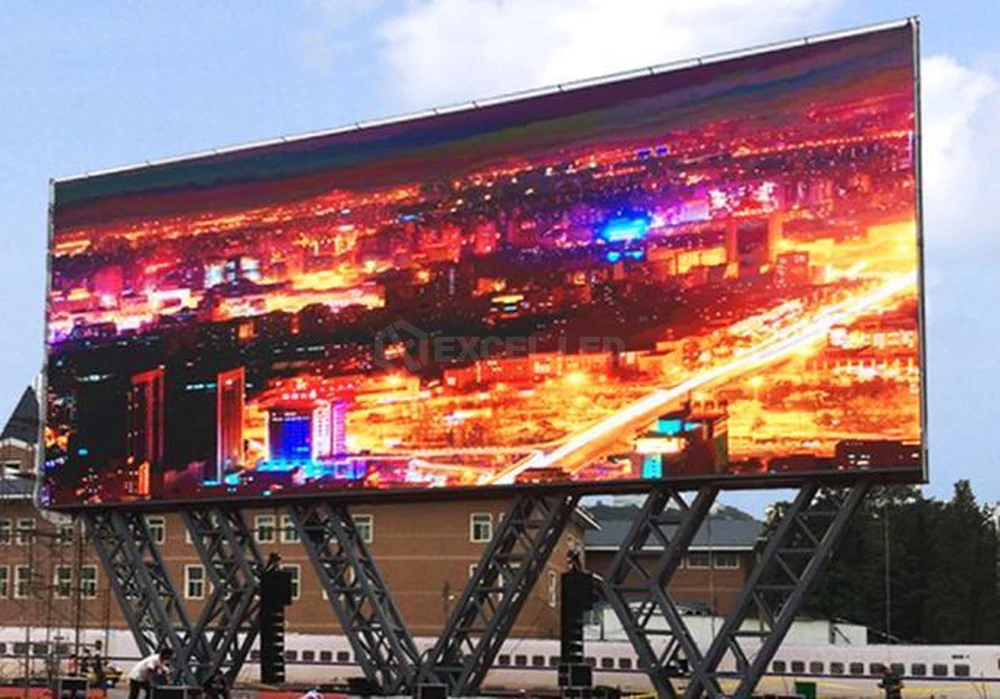
- Single-sided and double-sided roadside signs — the double-sided steel-truss format we build regularly, where cabinet count is doubled but control can stay on one processor.
Where P6.67 is the wrong answer
- Sidewalks, shop windows, lobbies — viewers stand 2–5 m away; choose outdoor P4 or finer.
- Touring, events and temporary stages — you need a rental chassis with quick locks and curved options, not a fixed die-cast grid; see P3.91 rental.
- Very long-range roadside signage with strict budget — at 60 m+ the coarser P10 does the same job for less.
P6.67 vs P4.44, P8 and P10: Which Outdoor Pitch Should You Choose?
| Pitch | Density | 960×960 cabinet resolution | Best viewing | Choose it when |
|---|---|---|---|---|
| P4.44 / P4 | 50,625 px/m² | 216×216 (46,656 px) | 5–45 m | Pedestrians or slow traffic come close to the screen |
| P6.67 ★ | 22,500 px/m² | 144×144 (20,736 px) | 7–67 m | Billboards and stadium walls where nobody stands close |
| P8 | 15,625 px/m² | 120×120 (14,400 px) | 8–80 m | Budget ledges and long facades with distant audiences |
| P10 | 10,000 px/m² | 96×96 (9,216 px) | 10 m+ | Classic highway signage where cost per m² dominates |
Rules of thumb for the whole outdoor family: indoor-grade viewing → P2.5 or P3.076; street-level outdoor → P4/P4.44; billboard and stadium → P6.67; long-range economy → P8/P10.
How Much Does a P6.67 Outdoor LED Display Cost?
There is no single P6.67 price, because “P6.67” is a family — the module format, cabinet size, material, control platform and service mode you pick move the number more than the pitch itself. In order of impact:
| Cost driver | Why it moves the price |
|---|---|
| Screen area and cabinet count | Everything scales with area: modules, receiving cards, power supplies, steel and freight. This is the largest single line. |
| Cabinet material and size | Die-cast aluminium costs more than an aluminium profile frame but saves labour and alignment time; a non-standard size adds tooling and spoils the volume discount. |
| Module format | 480×320 mm boards mean fewer parts and less assembly labour; 320×160 mm boards cost less to replace individually. |
| LED package and grade | SMD2727 grade tiers (binning, brand, gold vs copper wire) set brightness stability and price; high-brightness gold-wire builds cost more. |
| Drive scheme and refresh tier | Higher refresh with more driver ICs costs more and buys camera performance; a still-image billboard rarely needs the top tier. |
| Control platform and redundancy | NovaStar-class sending with remote monitoring costs more than a basic sender; hot-standby sending cards add cost but protect revenue. |
| Weatherproofing and finish | IP66 sealing, conformal coating, anti-corrosion treatment for coastal sites and the mask/finish spec all add cost — and all extend service life. |
| Structure, installation and freight | Steel, lifting, commissioning and shipping to site are project costs, not product costs — quote them together or the comparison is meaningless. |
Why Buy a P6.67 Outdoor LED Display From Excel LED
Factory-Direct
Excel LED (LEGIDATECH) manufactures in Shenzhen with a Changsha production base. You buy from the line, not through a trading layer — module, cabinet and control are specified together.
Trade Shows & Factory Visits
We exhibit at international LED and AV trade shows and host factory visits: watch your cabinet spliced and aged before it ships, and meet the line that builds it.
Factory-Direct Pricing
No middle margin. Module tiers, cabinet material and control platform are priced openly, so you can see exactly what each upgrade costs per square meter.
OEM & ODM
Your brand on the product, your specifications in the BOM, your structure in the drawing. Custom cabinet sizes and pitches outside the standard grid are quoted per project.
Support that continues after delivery
- Aging before shipment — every cabinet runs a factory aging cycle, and the wall is assembled and tested as a grid before packing.
- Documentation pack — datasheet, module and cabinet drawings, port map, receiving-card loading sheet and the control configuration file with every order.
- Spares stock — we ship spare boards and cards with the wall and hold the same batch afterwards, which is what makes a five-year-old cabinet repairable.
- Remote commissioning — engineers on video during first power-up, and remote diagnostics through the sending platform once the wall is live.
Real Projects on This Cabinet Platform
Recorded installations from the FC aluminium-cabinet line — the same 960×960 platform this pitch ships in, across different pitches and site conditions. Ask us which of them run FC6.67 and we will send the project sheet with the pitch, area and site photos.
| Project | Type | Built area |
|---|---|---|
| Jiangyin Stadium, China | Stadium screen | 280 m² |
| Zhengzhou University, China | Double-sided aluminium screen | 220 m² |
| Houston, USA | Double-sided aluminium screen | 180 m² |
| Baoli Plaza, Dongguan, China | Commercial facade | 130 m² |
| Sokcho seaside, South Korea (south side) | Coastal facade | 150 m² |
| Sokcho seaside, South Korea (west side) | Coastal facade | 90 m² |
The Sokcho pair is the useful lesson for a P6.67 site: the client needed screens meters from the ocean, and the deciding factor was cabinet material and sealing rather than pitch — a non-welded die-cast body with IP66 sealing answered salt fog, storm jetting and humid air at once. That is the same reasoning we apply to any coastal P6.67 wall. See more LED display projects.

Frequently Asked Questions About P6.67 Outdoor LED Displays
Q1 What does P6.67 mean on an LED display?
P6.67 means the pixel pitch is 6.67 mm — the center-to-center distance between neighbouring pixels. One square meter carries 22,500 pixels, and the display is designed to be viewed from about 7 m and beyond.
Q2 What is the best viewing distance for a P6.67 outdoor LED display?
About 7 m minimum, with a working range of roughly 7–67 m. The industry rule of thumb is pitch in millimetres ≈ minimum distance in metres, so 6.67 mm suits billboards, elevated facades and stadium perimeters where nobody stands close.
Q3 Which module sizes are available for P6.67?
Three: a 480×320 mm die-cast module (72×48 px, 3,456 px), a 320×160 mm SMD2727 board (48×24 px, 1,152 px) and a 160×160 mm legacy board (24×24 px, 576 px). All three deliver exactly 22,500 px/m² — they differ in board count, connectors, assembly labour and spare-part granularity.
Q4 Which cabinet sizes are available for P6.67?
960×960 mm is the standard grid and the format we stock around: six 480×320 mm modules or eighteen 320×160 mm modules, 144×144 pixels, 25 kg die-cast. 1280×960 mm cabinets are built for long billboard spans and 640×640 mm for compact or retrofit faces. Custom sizes are quoted to your drawing.
Q5 How many pixels are on a 320×160 mm P6.67 module?
48 × 24 = 1,152 pixels, driven by 36 driver ICs on the factory module list — arithmetic that matches a 1/6 scan scheme. Eighteen such boards make one 960×960 cabinet (20,736 px).
Q6 How many modules are in a 960×960 mm P6.67 cabinet?
Six, if you use the 480×320 mm die-cast module (2×3 layout) — or eighteen, if you use the 320×160 mm board (3×6 layout). Both fill the same cabinet and produce the same 144×144 pixel resolution.
Q7 Which control systems work with a P6.67 LED wall?
The cabinet uses the standard HUB75 interface and conventional outdoor scan, so it works with the platforms we stock and support: NovaStar, Colorlight, Huidu and Linsn for sending and receiving, plus VDWALL, RGBlink and Mooncell hardware for front-end processing and 2-in-1 duties. Keep sending and receiving cards in the same family.
Q8 How many receiving cards does a P6.67 wall need?
In the 480×320 mm module configuration, plan roughly one receiving card per two cabinets; in the 18 × 320×160 mm configuration, one card per cabinet. Port loading binds before pixel capacity does — we issue the exact card list and port map with every quotation.
Q9 Is P6.67 available as a rental LED display?
No — 6.67 mm does not divide cleanly into the 250×250 mm rental module grid, so this pitch is built as a fixed installation. For touring and events choose a rental chassis such as P3.91 or P4.81 instead.
Q10 P6.67 vs P4.44 vs P10: which pitch should I choose?
Use P4.44 (or P4) when viewers come within about 5 m, P6.67 when the nearest audience is around 7 m and beyond, and P10 when the audience is 30 m+ away and cost per square meter matters most. All three run on the same 960×960 cabinet grid.
Q11 How bright does a P6.67 outdoor LED display need to be?
≥5,500 nits is the standard for this pitch, with brighter builds available on the same platform where the screen faces low sun or is filmed for broadcast. For a still-image billboard, brightness stability and auto-dimming over 24 hours matter more than the peak figure.
Q12 How much does a P6.67 outdoor LED display cost?
It depends on screen area, cabinet material and size, module format, LED grade, drive scheme, control platform and weatherproofing — not on the pitch alone. Send your wall dimensions and viewing distance and we return a factory-direct quotation with the cabinet layout drawing.
Q13 What cabinet should I choose for a coastal P6.67 site?
Die-cast aluminium with IP66 sealing and conformal-coated boards. On our Sokcho seaside facades (90 m² and 150 m²) the deciding factor was cabinet material and sealing rather than pitch — a non-welded body resists salt fog and storm jetting far better than a welded steel box.
Related P6.67 Outdoor LED Display Resources
Engineering and buying guides that pair with this page — all from the Excel LED knowledge base:
- Same cabinet, other pitches — 960×960 outdoor LED display (FC4.44 / FC6.67) · P4 outdoor · P8 outdoor · P10 outdoor
- Adjacent outdoor options — P2.5 outdoor · P3.076 outdoor · P3.91 rental · all outdoor LED displays
- Control & processing — LED control system collection · NovaStar MRV336 receiving card · Colorlight i9+ receiving card · Huidu HD-C16C async card
- Sizing & engineering — LED screen size and dimensions guide · front service vs rear service · common-anode A960 platform
- Downloads — the BOM-level FC6.67 datasheet, cabinet drawing and port map are issued with your quotation (PDF).
P6.67 Outdoor LED Display — One Pitch, Three Modules, Three Cabinets, Every Control Platform
The P6.67 outdoor LED display is a 6.67 mm pitch family, not a single product: on the 960×960 mm platform it ships with 480×320 mm die-cast modules (6 per cabinet) or 320×160 mm SMD2727 boards (18 per cabinet), both resolving to 144×144 pixels and 22,500 px/m², with 1280×960 mm and 640×640 mm cabinet options for long spans and retrofits. It runs IP66 from −30 °C to +60 °C, holds ≥5,500 nits at 3,840 Hz, draws about 200 W/m² on the common-anode build, and accepts NovaStar, Colorlight, Huidu and Linsn control with one receiving card per cabinet as the standard loading — plus VDWALL, RGBlink and Mooncell processing at the front end. Choose it when the nearest viewer is 7 m away or further, and buy it factory-direct from Excel LED.