
Mooncell A10X LED Receiving Card
compact receiving card · 120-pin connector · 32 RGB groups · 512×640 @60Hz PWM
Inside every LED cabinet sits a receiving card — the board that takes the gigabit data stream from the sending controller and turns it into the RGB signals each lamp board needs. The Mooncell A10X is the compact receiving card for that job: an 80×45 mm board with a dustproof, shockproof 120-pin communication connector, up to 32 RGB data groups, 22-bit grayscale, loop and dual-power backup — supplied factory-direct by Excelled, your LED display control-system partner.

A10X LED Receiving Card at a Glance
What is it? A small-sized LED receiving card from Mooncell — a 80×45 mm board that mounts inside the LED cabinet, receives gigabit data from the sending controller and drives the lamp boards through its connectors.
How much can it load? Up to 512×640 @60Hz in PWM mode (512×512 conventional) per card, with up to 32 RGB data groups and 1–128 scanning supported.
What makes it different? Communication and data run through 120-pin high-density connectors instead of separate cable ports — the spec sheet cites dustproof and shockproof connection with high stability for compact cabinet builds.
What picture features? Software-enableable 22-bit grayscale (64× grayscale levels), 18-bit pixel-by-pixel chromaticity correction, RGB-independent Gamma, low delay down to 1 frame, rotation and scaling.
How is it protected? Network loop backup, dual-power backup with software feedback, FPGA dual-program startup, and optional dual-card hot backup — with AutoLED software for mapping, monitoring and diagnostics.
What an A10X Receiving Card Does Inside the LED Cabinet
An LED wall has two processing halves. Upstream, a sending controller or 2-in-1 processor — like the MTB400E sending controller or the M40 2-in-1 video processor — receives the source signal and broadcasts it over gigabit links. Downstream, inside every cabinet, a receiving card takes that stream and drives the lamp boards: converting pixels into the CLK/LAT/OE serial signals and supplying the RGB data groups that light each module.
The A10X is the compact player in that second half. Its board keeps the footprint small — 80×45 mm at 20.2 g — and moves both communication and data onto two 120-pin high-density connectors, so a cabinet fitted for the 120-pin link carries gigabit data, loop-backup pairs and up to 32 RGB data groups through one dustproof, shockproof connection instead of a spread of headers and jacks. An MCU on the board handles flexible application logic, strong LED driver-chip compatibility and the basis for dual-card backup — which is why Mooncell positions it for varied field environments and tight cabinet builds. Its standard sibling, the A712 receiving card, uses classic HUB75E interfaces on a larger board — the two cards cover opposite ends of the cabinet-construction spectrum.
RGB Data Groups
Up to 32 groups of RGB parallel data through the 120-pin connectors for high-density module wiring.
512×640 Load
Maximum on-load resolution 512×640@60Hz in PWM mode; 512×512@60Hz conventional.
22-Bit Grayscale
Software-enabled 22-bit processing multiplies grayscale 64× and cleans up low-gray pitting.
Connector Comms
Gigabit signals and data ride the 120-pin connector pair — dustproof, shockproof and compact.
A10X Picture Processing: 22-Bit Grayscale, Pixel Correction and Low Delay
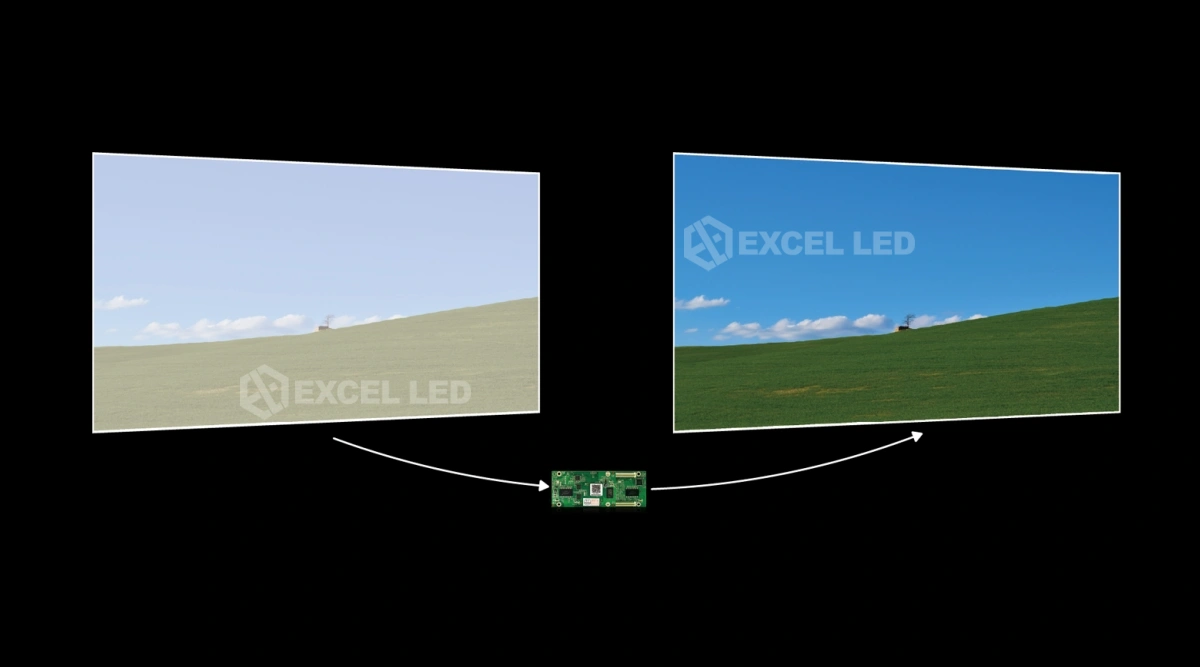
Dim a white LED wall and quality shows — low-brightness gray steps go patchy as grayscale collapses. The A10X tackles that at the source: enabling 22-bit in the software raises the LED screen grayscale 64 times, compensating the grayscale loss that brightness reduction causes, smoothing the pitting problem of low gray and keeping low-gray transitions natural. Chromaticity is handled pixel by pixel with 18-bit correction — brightness and chromaticity of every pixel get corrected from calibration data, so panels from different batches show consistent color instead of a patchwork.
Timing matters for content with motion: low delay reaches as little as 1 frame on lamp boards whose driver IC uses built-in RAM. RGB-independent Gamma adjustment lets you trim red, green and blue separately to control uneven low gray and white-balance drift, and AutoLED adds picture rotation in 90° multiples (0/90/180/270) plus multi-time pixel scaling so a card can be redeployed on a differently-shaped screen without re-cabling.

3D is supported when the installation needs it: the 3D picture effect is viewed with 3D glasses, with the 3D signal format transmitted to the glasses through a 3D signal transceiver.
A10X Reliability: Network Loop, Dual Power Backup and Dual-Program Boot
A receiving card failure takes out a block of wall mid-event, so the A10X spends its protection budget on the failure modes that matter in serial chains:
- Network loop backup — main and standby network cable paths loop through the chain; when one serial line fails, the other keeps the screen displaying.
- Dual-power backup — the card detects power-supply status and feeds it back to the software, so a failing PSU is flagged before it takes the cabinet down.
- FPGA dual-program startup — if the main FPGA program fails to configure, the card boots the standby BOOT program and resumes normal communication.
- Interruption display setting — on communication loss the screen shows what you choose: black screen, a standby picture, or the last frame.
- Online firmware update — software upgrades the receiving card firmware without opening the cabinet.
Every receiving card has a position in the wall, and field service time follows the same logic: AutoLED’s network-port debugging shows each card’s serial number and port on the screen itself, communication working state is monitored in real time, cable signal quality is measured to catch bad network cables fast, and configuration parameters read back and save locally — so a replacement card can be re-commissioned from a stored profile instead of rebuilt from memory.

A10X and AutoLED: Visualized Screen Mapping and Puzzle-Style Layout
Wiring a wall of cabinets into a single image is the classic receiving-card headache — every chain, every cabinet position has to match the software map. AutoLED turns that into a visual job: visualized screen mapping shows each card’s physical location and lets you map the wall on screen, and the modular, puzzle-like operation mode arranges boxes quickly while the advanced layout tools build complex structures and complex large-screen connections at will. Output data can be detected and edited directly, which makes cabinet-level debugging a screen-side exercise instead of a cable-chasing one.

The same software surface covers daily operation: communication monitoring, error detection on cabling, configuration readback and online firmware updates all run from AutoLED, which keeps the A10X in the same toolchain as the Mooncell sending controllers upstream.
A10X Options: Intelligent Modules, Module Auto-Calibration and Card Hot Backup
Beyond the standard board, the A10X is built to take the customization that big-installation engineers ask for. These options are configured with the card at order time:
Intelligent Module
Flash stores correction coefficients and an MCU reports module-level temperature, voltage and cable status — no separate monitoring card needed.
Module Auto-Calibration
After a lamp-board replacement, the new board’s ID and correction factors are read automatically at power-on and saved to the card Flash.
Card Hot Backup
Dual-card main/standby mechanism: the standby card takes over instantly if the main card fails, so the wall keeps showing.
LCD Module
An optional LCD on the HUB board displays temperature, voltage and single/total running time at a glance.
Voltage detection and temperature detection options report the card’s operating status into the management system. Note the honest split in Mooncell’s spec sheet: card hot backup, the intelligent module, LCD module and voltage/temperature detection are custom-order features, while the module auto-calibration is an optional function — confirm with Excelled which options apply to your batch before quoting the service contract.

A10X Board Design: 80×45 mm and the 120-Pin Communication Connector
Look at the A10X and the first thing you notice is what is not there: no spread of ribbon headers and jacks. The card carries two 120-pin high-density connectors (JH1/JH2) that handle communication and output together — gigabit differential pairs, loop-backup pairs and up to 32 RGB data groups all route through the connector system the spec sheet describes as dustproof and shockproof, with high connection stability. Cabinets built around the 120-pin link keep the interior clean, the connections protected from dust and vibration, and the board itself at 80×45 mm / 20.2 g — small enough for the tightest module enclosures and ultra-thin cabinet designs.

The board draws DC 3.5–5.5 V at 0.6 A rated (3 W rated power), operates from −20 to 70 °C at 10–90% RH without condensation, and is housed 100 cards per box (490×335×120 mm, 3.5 kg gross including wiring and accessories) — RoHS and CE-EMC compliant.
A10X vs A712: Which Mooncell Receiving Card Fits the Cabinet Plan?
Mooncell’s two receiving cards in this range split by cabinet architecture. Figures follow the published A10X V4.0 and A712 V4.0 sheets; the decision is connector topology and board format.
| Decision Row | A10X ☆ | A712 |
|---|---|---|
| Board type | Small-sized compact card | Standard receiving card |
| Board size / weight | 80 × 45 mm / 20.2 g | 146.2 × 91.2 mm / 90.4 g |
| Data interface | 120-pin high-density connectors ×2 | 12 × HUB75E standard headers |
| RGB data groups | Up to 32 | Up to 24 |
| Max load, PWM | 512 × 640 @60Hz | 512 × 512 @60Hz |
| Max load, conventional | 512 × 512 @60Hz | 512 × 384 @60Hz |
| Grayscale boost | 22-bit — 64× grayscale | 18-bit — 4× grayscale |
| HDR / seam-tool | — | HDR10 + HLG; Seam Tool |
| Redundancy | Loop backup; dual-power backup | Loop backup |
| Custom monitoring | Intelligent module, LCD module, auto-calibration, hot backup | Power-on / run-time records, power-status detection |
| Typical fit | Compact cabinets, 120-pin wired builds, high group count | Standard HUB75E walls and boxes |
Related reading: Mooncell A712 receiving card · upstream driving stages: MTB400E sending controller · MTB2000E sending controller. Send your cabinet design and module interface and we’ll match the card before you order.
A10X Buying Guide: 5 Checks Before You Buy LED Receiving Cards
- Confirm the cabinet’s connector topology. The A10X communicates over the 120-pin connector system — your cabinet, HUB board or module backplane must be wired for that link. If your boxes are standard HUB75E-header designs, the A712 is the plug-compatible route.
- Budget the load per card against the wall. Divide your panel by cabinets and count pixels per card: the A10X loads up to 512×512 conventional or 512×640@60Hz PWM per card — the honest cap before you need more cards or a bigger card.
- Count data groups against your lamp boards. Up to 32 RGB data groups serve high-density wiring; a module that needs many groups per cabinet will consume them faster than you expect. List module interfaces and count groups before pricing the card count.
- Pick the redundancy tier the contract needs. Loop backup and dual-power backup are standard; dual-card hot backup, intelligent module and LCD monitoring are custom-order options — a site with after-hours failure risk may justify the optioned tier, a rental fleet may not.
- Verify environment and power. The board runs DC 3.5–5.5 V at 3 W rated from −20 to 70 °C; the 120-pin connector adds dust and shock protection that open-header designs lack — match that to where the cabinets actually live.
Price and Cost Factors
Receiving-card pricing follows card count and option tier — plain cards for standard walls, optioned cards (intelligent modules, LCD, hot backup) for monitored or high-availability installations — and the honest comparison is against the labor cost of a failure: loop backup and dual-power backup are built in, but a monitored wall adds the intelligent-module option rather than a separate monitoring-card layer that consumes box space and budget. Packing is 100 cards per box; quantity pricing applies from there.
A10X LED Receiving Card Technical Specifications
| Parameter | Specification |
|---|---|
| Product type | Small-sized LED receiving card (Mooncell A10X, spec V4.0, hardware A10X V4.0.0) |
| Data interface | Two 120-pin high-density connectors; communication (gigabit, P0/P1 main-standby pairs) and data through the connector system — dustproof and shockproof; up to 32 groups of RGB parallel data |
| Max load, conventional | 512 × 512 @60Hz |
| Max load, PWM | 512 × 640 @60Hz (brightness-correction band load 512 × 640; chromaticity-correction band load 512 × 512) |
| Cascading / scanning | Up to 1,000 cascaded cards; 1–128 scanning lines supported |
| Grayscale | 22-bit via software — raises grayscale 64×, recovers low-brightness grayscale loss, smooths low-gray pitting; 18-bit pixel-by-pixel chromaticity correction |
| Picture features | Low delay down to 1 frame (driver IC with built-in RAM lamp boards); RGB-independent Gamma adjustment; rotation in 90° multiples; multi-time picture scaling; 3D (glasses + 3D signal transceiver) |
| Reliability | Network loop backup (main/standby); dual-power backup with status feedback to software; FPGA dual-program startup; interruption display setting (black screen / standby picture / last frame); online firmware update |
| Maintenance | Card serial-number detection, output data detection/editing, communication monitoring, cable error detection, configuration parameter readback (all via AutoLED) |
| Custom options | Card hot backup; intelligent module (Flash + MCU: correction coefficient storage, module-level temperature/voltage/cable monitoring); module auto-calibration on replacement; voltage detection; LCD module (temperature, voltage, run times); temperature detection |
| Input voltage / power | DC 3.5–5.5 V (3.3–5.5 V recommended for VCC) / 0.6 A rated / 3 W rated |
| Working temperature / humidity | −20–70 °C / 10–90% RH, no condensation |
| Storage temperature | −40–85 °C |
| Board size | 80 × 45 mm (tolerance ±0.3) |
| Net weight | 20.2 g (single card) |
| Packing | 100 pcs/box; 490 × 335 × 120 mm; gross 3.5 kg including wiring and accessories |
| Certification | RoHS; CE-EMC |
Mooncell A10X LED Receiving Card FAQ
Q1 What is the Mooncell A10X LED receiving card?
The A10X is a small-sized LED receiving card that mounts inside the display cabinet, receives gigabit data from the sending controller and drives the lamp boards. At 80×45 mm with a 120-pin high-density connector system, it is Mooncell’s compact card for tight cabinet builds.
Q2 What is the maximum load of an A10X receiving card?
The A10X loads up to 512×512@60Hz in conventional mode and 512×640@60Hz in PWM mode per card, supports 1–128 scanning lines, and up to 1,000 cards can be cascaded in one system.
Q3 Why does the A10X use 120-pin connectors instead of separate ports?
Communication and data both route through two 120-pin high-density connectors, carrying gigabit pairs, loop-backup pairs and up to 32 RGB data groups. The spec sheet cites the connector system as dustproof and shockproof with high connection stability — built for compact cabinets and clean protected wiring.
Q4 Which sending controllers work with the A10X?
Any Mooncell sending stage with gigabit output feeds the A10X chain — sending controllers such as MTB400E and MTB2000E, 2-in-1 processors like the M40, or a player-controller such as the MB400S. Excelled confirms pairing against the source signal and wall size at quotation.
Q5 What is 22-bit grayscale on the A10X?
Enabling 22-bit in the software multiplies the LED screen’s grayscale by 64, compensating the grayscale loss that comes with reduced brightness, smoothing low-gray pitting and making low-gray transitions natural — dimmer, smoother images without visible banding.
Q6 What picture corrections does the A10X support?
Pixel-by-pixel brightness and chromaticity correction at 18-bit precision from calibration data, RGB-independent Gamma adjustment to control uneven low gray and white-balance drift, plus rotation in 90-degree multiples and multi-time picture scaling through AutoLED.
Q7 Does the A10X support 3D playback?
Yes, with the right equipment: the 3D effect is viewed with 3D glasses, and the 3D signal format is passed to the glasses through a 3D signal transceiver connected to the system.
Q8 How does the A10X protect the wall against failures?
Network loop backup keeps the chain alive if one main/standby serial line fails; dual-power backup detects supply status and reports it to software; FPGA dual-program startup boots a standby program if the main configuration fails; and interruption display can show black, a standby picture or the last frame on signal loss.
Q9 What is the A10X intelligent module option?
A custom-order option where a Flash-plus-MCU module on the lamp board stores correction coefficients and monitors module-level temperature, voltage and cable communication status — so operators get cabinet monitoring without installing a separate monitoring card and using up box space.
Q10 What happens when a lamp board or module is replaced?
With the module auto-calibration option, the receiving card reads the new lamp board’s ID and correction factors automatically at power-on and saves them to the card’s Flash — replacement modules come up calibrated instead of needing manual re-correction.
Q11 Can I monitor A10X temperature, voltage and running status?
Yes, at the level you choose: AutoLED monitors communication state and reads back configuration parameters, and custom options add voltage detection, temperature detection and an LCD module on the HUB board that shows temperature, voltage and single and total running time.
Q12 What are the A10X’s specifications and price?
The board measures 80×45 mm at 20.2 g, runs DC 3.5–5.5 V at 3 W rated from −20 to 70 °C, and ships 100 cards per box — RoHS and CE-EMC compliant. Pricing scales with quantity and option tier; contact Excelled for a quote on your card count.
A10X: The Compact Receiving Card for 120-Pin Cabinet Builds
The Mooncell A10X is the compact LED receiving card for tight cabinets and high-density wiring — 80×45 mm with dustproof, shockproof 120-pin connector communication, up to 32 RGB data groups and a 512×640@60Hz PWM load, plus 22-bit grayscale, pixel-level correction, network loop and dual-power backup — supplied factory-direct by Excelled with the upstream sending stage matched to your wall.
Related reading: Mooncell A712 receiving card · Mooncell MTB400E sending controller · Mooncell MTB2000E sending controller · Request a quote