
Mooncell MTB2000E LED Sending Controller
10.4M-pixel drive · 20 Gigabit outputs · HDMI 2.0 / DP 4K60 · active 3D
The big-canvas sending controller from Mooncell: one 4K60 source drives up to 10.4 million pixels across 20 gigabit ports, with loopback and dual-master backup — distributed factory-direct by Excelled, a trusted LED display manufacturer and control-system supplier for global B2B projects.
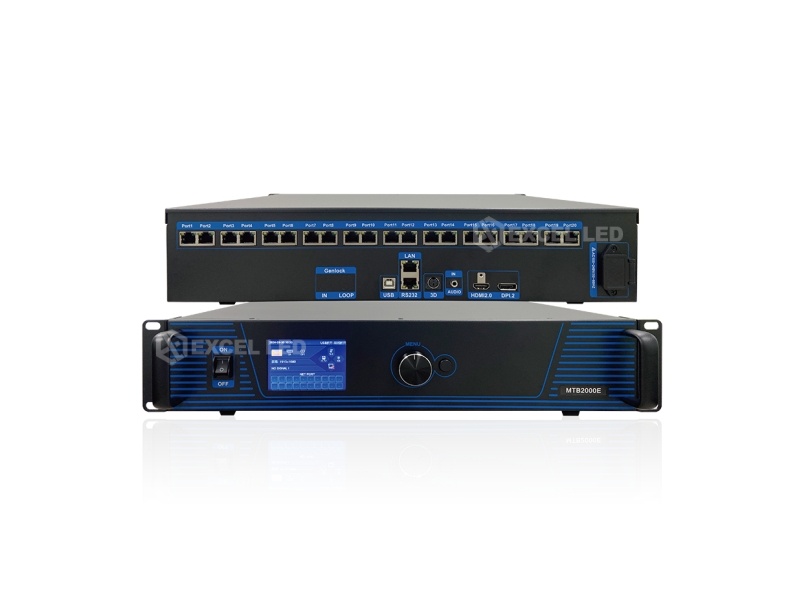
MTB2000E LED Sending Controller at a Glance
What is it? Mooncell’s 20-port LED sending controller (sending box) — the transmission stage that turns one 4K-class source into per-panel data streams for LED receiving cards — supplied factory-direct by Excelled Display.
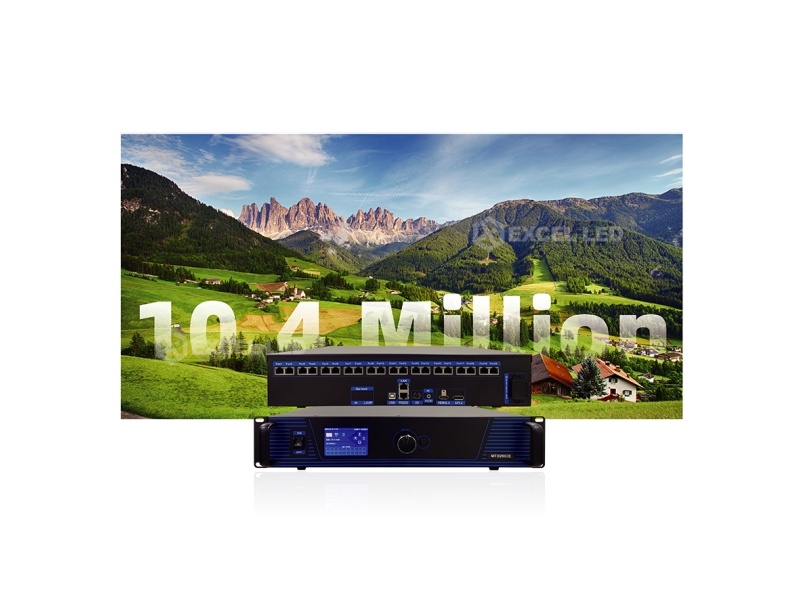
How big a screen can it drive? Up to 10.4 million pixels over 20 gigabit Ethernet ports, with canvas width and height up to 8,192 pixels — enough for large 4K-content walls, perimeter screens and multi-block video displays.
What video does it take? A native HDMI 2.0 (4K@60Hz) or DP 1.2 (4K@60Hz) input — two 4K-capable inputs where you use one at a time — plus 3.5mm audio carried over the network cable.
What makes it different from smaller sending controllers? Capacity and drive depth: 20 outputs for 10.4M pixels, plus active 3D display via its 3D transceiver port and RS232 for central control.
Who is it for? Large commercial fixed walls, stadium and transportation displays, and any project where a 4K60 source must reach a canvas well past 2.6M pixels without a second sender.
Why a 10.4M-Class Dedicated Sending Controller, Not a Video Processor
Once a wall outgrows what a 2-in-1 processor’s sending stage can carry, integrators face a fork: buy processing and sending fused, or keep processing upstream and let a dedicated sender own the drive. The MTB2000E is the second route — a sending stage sized for 10.4M pixels with a 4K60-native input, for chains where a separate processor, media server or switcher already feeds it a finished signal.
Dedicated senders also stay attractive where reliability is contractual: the drive stage is standalone, so dual-master backup — two MTB2000E units, one hot — protects the whole wall without doubling processor costs. And on retrofit jobs, swapping a sender never disturbs the video-processing topology your control room already runs.
Full-Course Drive
20 gigabit outputs with canvas up to 8,192 pixels wide or tall in any tiling direction.
Native 4K60 In
HDMI 2.0 and DP 1.2 inputs, each accepting 3840×2160@60Hz sources with GPU-resizable canvas to 8,192.
Active 3D Drive
3D transceiver port with RS232 central control for attractions and special-format displays.
Uptime Stack
Ethernet loopback and dual-master backup, status monitoring, readback and gigabit error detection.
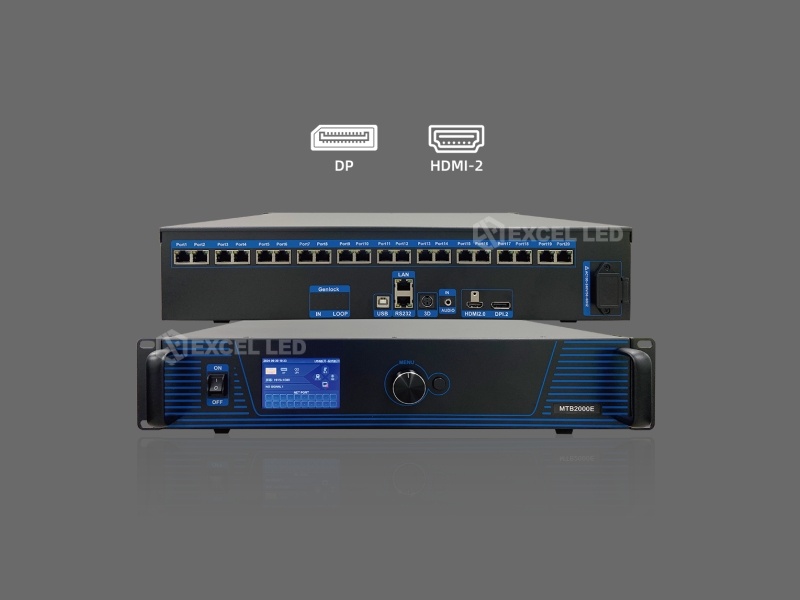
MTB2000E Interfaces: HDMI 2.0, DP 1.2, Audio and Twenty Gigabit Outputs
The input bank is built around one 4K60-capable source path: HDMI 2.0 and DP 1.2 are both present and both accept 3840×2160@60Hz, used one at a time (select-one-of-two). When the GPU drives the input, custom resolutions up to 8,192 pixels wide or tall are possible — the practical route for ultra-wide canvases. A 3.5mm audio input rides along over the network cable, and the 320×240 LCD front panel with rotary knob gives local status without a laptop.
| Interface | QTY | Capability |
|---|---|---|
| HDMI 2.0 input | 1 | 4K sources up to 3840×2160@60Hz; GPU-custom canvas up to 8,192 px; EDID managed. |
| DP 1.2 input | 1 | Up to 3840×2160@60Hz; used select-one-of-two with HDMI; GPU-custom canvas to 8,192 px. |
| Audio in | 1 | 3.5mm; synchronized with video over the network cable to the receiving side. |
| Gigabit outputs | 20 | Ports 1–20, up to 10.4M pixels; Ethernet loopback backup supported between ports. |
| Control | 3 | USB-B (multi-unit cascade on one PC), 100M LAN debug, RS232 for central control systems. |
| Extension | 1 | 3D transceiver interface for active 3D display; ST_EXT expansion board support. |
MTB2000E Load Rules: 10.4M-Pixel Canvas Across 20 Ports
Twenty ports give the MTB2000E unusual layout freedom. Each output carries up to 655,360 pixels in a 1280×512 per-port load; the overall canvas runs 128–8,192 pixels wide and 64–8,192 high with a total cap of 10.4M pixels, and the image offset is adjustable up to 8,191 pixels — essential when one sender must place a large canvas that is wider or taller than the visible screen it feeds.
| Load Parameter | MTB2000E Specification |
|---|---|
| Output ports | 20 × gigabit Ethernet, any tiling direction |
| Max total load | 10.4 million pixels (10,400,000) |
| Overall load range | Width 128–8,192 px; height 64–8,192 px |
| Single-port load range | Width 128–4,096 px; height 64–4,096 px; max 655,360 px (1280×512 format) |
| Offset range | 0–8,191 px (width and height) |
| Input frame rates | Compatible with 30 / 50 / 60 / 120 Hz sources |
Ethernet Loopback Backup and Dual-Master Backup at 20-Port Scale
At 10.4M pixels a dark column is not a spot check — it is a visible failure. Mooncell packs the MTB2000E with the same reliability stack as its smaller sibling, scaled up: Ethernet loopback backup reroutes data through the surviving ports if a gigabit segment fails, and dual-master controller backup keeps a second MTB2000E hot so a failed unit is swapped without a black screen. In large-wall practice this is the configuration control-room contracts usually require.
Fleet tools ride on top: host software monitors sending-card operating parameters and status, configuration readback restores a known-good setup after any intervention, and gigabit Ethernet error-rate detection warns on a degrading cable before pixels drop. Combined with RS232, the box can sit inside a room-wide central control topology rather than needing a technician on site.
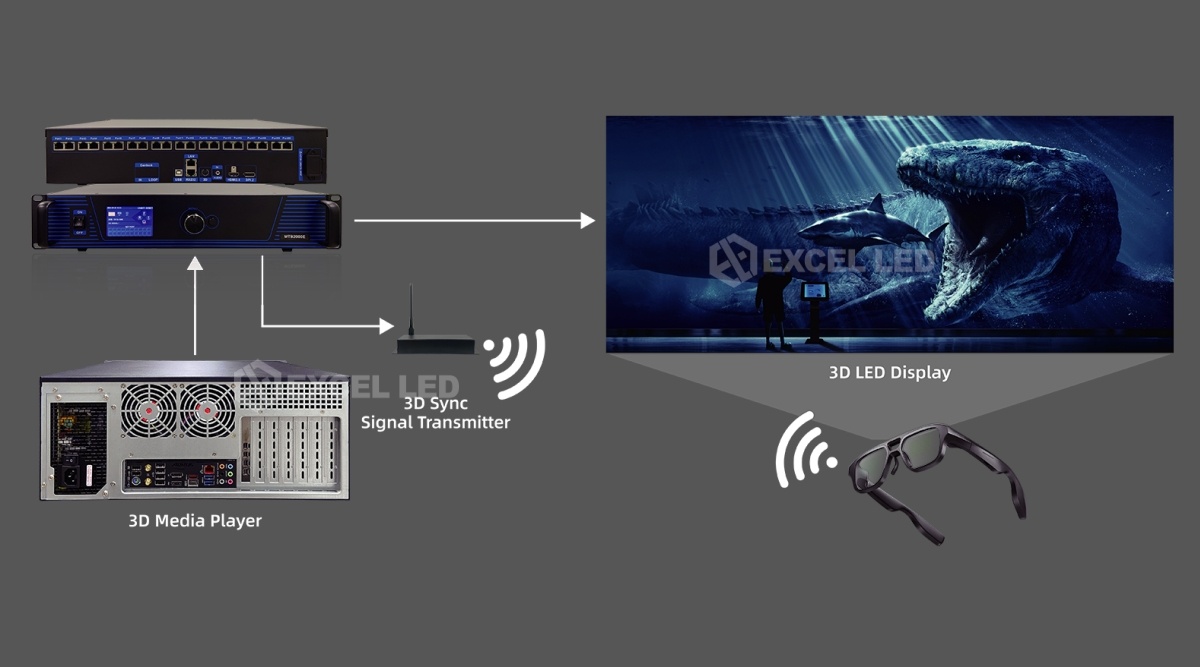
Active 3D Display Drive and RS232 Integration on the MTB2000E
Where the MTB400E limits itself to a 3D interface hookup, the MTB2000E is specified for active 3D display: its 3D transceiver interface pairs with the 3D transceiver unit in the system chain, giving attractions and showcase displays true alternating-frame 3D on large canvases. Frame-rate compatibility extends to 30/50/60/120 Hz inputs, which is the range active-3D workflows typically live in.
Around the video path sits RS232 central control — the interface building-management and control-room systems expect — so the sending controller obeys commands from a central seat instead of a local laptop. For operators who do stand in front of the rack, the 320×240 LCD front panel with knob and ESC key handles local checks without software.
MTB2000E Front Panel: 320×240 LCD, Knob Control and Brightness Automation
A 20-port sender deserves local intelligence. The MTB2000E’s front panel pairs a 320×240 LCD with a rotary knob and ESC key, so load status, port behavior and settings are readable and adjustable at the rack — a real time-saver during commissioning of a multi-thousand-panel wall. The rest of the panel follows Mooncell’s sending-controller ergonomics: indicators and keys for the workflows that happen in front of the unit.
Brightness keeps the facility theme running: ST_EXT expansion board support brings cascaded brightness control and automatic brightness across multiple sending stages, letting a whole venue dim and brighten together from one brightness program. When the MTB2000E runs 4K60 with 10.4M pixels the front LCD is also where an engineer first confirms the source locked and the load distributed before touching software.
Where the 10.4M-Pixel MTB2000E LED Sending Controller Belongs
Large Commercial and DOOH Walls: One 4K60 Source, Full Coverage
Architectural and digital-out-of-home walls in the 6–10M-pixel class usually run one polished 4K60 feed from a media server or signage engine. The MTB2000E takes that single signal and covers the entire canvas through 20 ports — no daisy-chained senders, one load plan, one status screen.
Stadium, Arena and Perimeter Displays: 8,192-Wide Tiling and Spare Ports
Perimeter rings and giant center-hung screens exceed what compact senders reach. An 8,192-wide canvas with offset up to 8,191 px lets the MTB2000E place and drive very wide screen sections cleanly — and with five-odd ports in reserve at typical loads, a backup wiring topology can share the same unit.
Attractions and Special-Format Displays: Active 3D and Central Control
Theme-park and showcase screens that want alternating-frame 3D on a large canvas are the MTB2000E’s niche — the 3D transceiver port is specified on this model, and RS232 puts the wall inside the venue’s central control rather than beside it.
Mooncell Sending Controllers: MTB2000E vs MTB400E
Mooncell’s sending-controller line covers the MTB2000E at 10.4M pixels and the MTB400E at 2.6M. Both share the reliability stack; capacity, inputs and 3D depth are where they differ. Figures below come from the published specification sheets.
| Model | MTB2000E ☆ | MTB400E |
|---|---|---|
| Max load | 10.4M px | 2.6M px |
| Gigabit outputs | 20 | 4 |
| Max canvas width / height | 8,192 / 8,192 | 4,096 / 4,096 |
| Max input resolution | HDMI 2.0 / DP 1.2, 4K@60Hz | HDMI 1.4, 4K@30Hz |
| GPU-custom input canvas | Up to 8,192 px | Custom resolution supported |
| Ethernet loopback backup | Yes | Yes |
| Dual-master backup | Yes | Yes |
| Active 3D | Yes — 3D transceiver port | 3D interface hookup |
| Serial control | RS232 central control | UART IN/OUT |
| Front display | 320×240 LCD + knob | Digital brightness display + keys |
| Rated power | 70 W | 16 W |
| Typical fit | 4K60 content walls up to 10.4M px, stadium & DOOH | 2.6M-class commercial & rental walls |
Model pages: MTB400E LED sending controller · processing family: M40 2-in-1 processor · MVB20E-G 2-in-1 processor. For a load plan matched to your wall and receiving cards, send us the screen resolution.
MTB2000E LED Sending Controller Technical Specifications
| Parameter | Specification |
|---|---|
| Processing & transmission | Full 4K × 2K @ 60Hz processing and transmission |
| Load capacity per port | Max 655,360 px per port (1280 × 512 per-port load); 650,000 px per port at 8-bit |
| Max total load / canvas | 10.4M pixels; overall width 128–8,192 px, height 64–8,192 px; offset 0–8,191 px |
| Video inputs | HDMI 2.0 or DP 1.2 (select one), each up to 3840×2160@60Hz; GPU-custom canvas up to 8,192 px; 3.5mm audio in |
| Audio | Synchronized over the network cable to the receiving side |
| Control interfaces | USB-B (multi-unit cascade on one PC), 100M LAN debug, RS232 central control |
| 3D | Active 3D display supported via 3D transceiver interface |
| Brightness ecosystem | ST_EXT expansion board: cascaded brightness control and automatic brightness |
| Rated voltage / power | AC 100–240 V, 50/60 Hz / 70 W |
| Working temperature / humidity | −20–60 °C / 10–90% RH, non-condensing |
| Storage temperature | −20–70 °C |
| Unit dimensions (W×D×H) | 481.6 × 398.6 × 99.3 mm |
| Net weight | 4.7 kg |
| Outer carton / gross weight | 565 × 445 × 185 mm / 6.4 kg |
| Packing | 1 unit per carton |
| Accessories | Power cord, USB cable, DP cable, HDMI cable, certificate, 2 hangers, 4 × M3 screws |
MTB2000E Buying Guide: 5 Checks Before You Order a 10.4M Sender
- Run the real load plan. Multiply screen width by height and confirm the result under 10.4M px, width 128–8,192 and height 64–8,192 — and partition it into per-port loads no larger than 1280×512 (655,360 px).
- Match the input to your source. HDMI 2.0 or DP 1.2, one 4K60 signal at a time. If your source is an old HDMI 1.4 player at 4K30, a 2.6M-class sender like the MTB400E may serve the same content at lower cost.
- Count the outputs twice. A 10.4M canvas near the cap uses all 20 ports; typical walls use 12–18, leaving spare ports — decide now whether spares are for future screen sections or a backup cabling topology.
- Decide 3D and control scope. Active 3D needs the transceiver unit and 3D-capable receiving cards and panels — confirm the whole chain, not just the sender. If the wall will sit in a facility control system, budget RS232 integration in the tender documents.
- Verify receiving cards and backup depth. Send us your receiving-card model and module scan configuration; dual-master backup means a second MTB2000E, which should be priced into redundancy-critical bids from the start.
Price and Cost Factors
MTB2000E pricing scales with the drive plan rather than a flat list: quantity, dual-master backup units, the 3D transceiver and glasses system, ST_EXT brightness stages, and the network cabling bundle for 20 ports. A 10.4M sender normally pairs with hundreds of receiving cards — ask for the whole-chain quote so the receiving-card count and the sender are priced against the same configuration.
MTB2000E LED Sending Controller FAQ
Q1 What is the MTB2000E LED sending controller?
The MTB2000E is Mooncell’s 20-port LED sending controller, built to turn one 4K-class signal into per-panel data streams for LED receiving cards. It drives up to 10.4 million pixels on canvases up to 8,192 pixels wide or tall, and is the large-canvas member of Mooncell’s sending-controller line alongside the 2.6M MTB400E.
Q2 How many pixels can the MTB2000E drive?
Up to 10.4 million pixels across 20 gigabit Ethernet ports. Each port carries a maximum of 655,360 pixels in a 1280×512 per-port load format, the overall canvas runs 128–8,192 pixels wide and 64–8,192 high, and the load tiles in any horizontal or vertical arrangement.
Q3 What video inputs does the MTB2000E sending controller support?
Two 4K60-capable inputs used one at a time: HDMI 2.0 up to 3840×2160@60Hz and DP 1.2 up to 3840×2160@60Hz. With a GPU driving the source, the input canvas can be customized up to 8,192 pixels. A 3.5mm audio input synchronizes sound with video over the network cable.
Q4 Does the MTB2000E support active 3D LED display?
Yes. The MTB2000E is specified for active 3D display: its 3D transceiver interface connects to the 3D transceiver unit in the system chain for alternating-frame 3D on large canvases. The full chain — sender, transceiver, receiving cards, panels and shutter glasses — must support 3D together.
Q5 How does Ethernet loopback backup work on the MTB2000E?
If one gigabit output segment fails, the signal path loops back through the remaining network ports so the panels on the failed segment keep receiving data. It is Mooncell’s cable-level protection and protects a single cable or port failure without requiring a second controller.
Q6 What is dual-master controller backup on the MTB2000E?
Dual-master backup pairs a second MTB2000E as a hot standby. If the active controller fails, the standby unit takes over the wall — the standard protection for stadium, control-room and critical commercial screens, and usually a line item in redundancy-critical tenders from day one.
Q7 Does the MTB2000E have RS232 central control?
Yes. RS232 is built in for central control systems, so the sending controller can be commanded from a facility or control-room seat rather than a local laptop. USB-B and a 100M LAN debug port complete the control bank, and multiple sending controllers can be cascaded on one PC.
Q8 What does the MTB2000E front panel show?
A 320×240 LCD with a rotary knob and ESC key sits on the front panel, showing load, port and operating status locally — useful during commissioning of large walls. The unit also integrates with Mooncell host software for status monitoring, configuration readback and gigabit error-rate detection.
Q9 Can the MTB2000E control brightness automatically?
Through ST_EXT expansion board support, the MTB2000E joins cascaded brightness control and automatic brightness schemes across multiple sending stages — so an entire venue’s walls follow one brightness program. The expansion stage is specified as a board add-on rather than built into the unit itself.
Q10 What source frame rates does the MTB2000E accept?
The MTB2000E is compatible with 30Hz, 50Hz, 60Hz and 120Hz input frame rates, spanning broadcast regions and PC refresh workflows. That 120Hz compatibility also matters for active-3D systems, which typically alternate frames at high refresh to serve both eyes.
Q11 MTB2000E vs MTB400E — which sending controller should I choose?
Choose the MTB2000E for canvases above ~2.6M pixels up to 10.4M, for native 4K60 sources, or when the project needs active 3D and RS232. Choose the MTB400E for 2.6M-class walls at HDMI 1.4 4K30 levels — same backup and monitoring stack, roughly a quarter of the ports, lower price.
Q12 How much does the MTB2000E cost and what is in the box?
Pricing depends on quantity, backup units, the 3D chain and cabling; contact Excelled for a factory-direct quote built around your load plan. The box includes the MTB2000E, power cord, USB cable, DP cable, HDMI cable, certificate of conformity, 2 hangers and 4 M3 screws, one unit per carton at 4.7 kg net.
MTB2000E: The 10.4M-Pixel Sending Controller for 4K60 Walls
Mooncell MTB2000E gives large LED walls a single, dependable 20-port sending stage — 10.4M-pixel drive from one HDMI 2.0 or DP 4K60 source, loopback and dual-master backup, active 3D and RS232 — shipped after Excelled’s compatibility checks against your receiving-card chain.
Related reading: Mooncell MTB400E sending controller · Mooncell MVB20E-G 2-in-1 · Mooncell MVB12E 2-in-1 · Request a quote