
How LED Displays Are Manufactured
Excel LED is a direct factory LED screen manufacturer in Shenzhen, China — 5,000 m² production facility, 5 SMT lines, 12+ years exporting to 80+ countries. Every display passes through 12 rigorous production stages before shipping. Every screen we ship is built through our 12-stage LED display manufacturing process.
Transparency matters. The difference between a display that lasts 3 years and one that lasts 8+ years is the production discipline behind every solder joint, calibration pass, and aging test hour. Visit our LED display manufacturing facility to see the full process.
- 12+ Production Stages
- 72-Hour Aging on Every Order
- Sub-0.01% Dead Pixel Rate
- IP65 Outdoor Verified

Production Stages
From raw material inspection to shipping — every stage quality-controlled with defined pass/fail criteria.
Aging Test
Every cabinet runs 72 hours of continuous operation with cycling patterns before shipping — non-negotiable.
Dead Pixel Rate
Target field dead pixel rate after shipping — versus 5–10% industry average for cost-cutting manufacturers.
Outdoor Verified
Waterproof seals pressure-tested on every outdoor-rated cabinet. Conformal coating on all outdoor PCBs.
See Our Factory
LED Display Factory Production — Real Workshop Video
Watch LED screens being assembled and produced at our Shenzhen factory. Real workshop footage — not stock video. Every stage of the LED display manufacturing process shown here is performed in-house at our Shenzhen facility.
For more factory videos, visit our YouTube channel.
Process Overview
What Is the LED Display Manufacturing Process?
LED display manufacturing is the end-to-end production chain that transforms raw electronic components — similar to processes at UnifyLED product range — — LED lamps, PCBs, driver ICs, LED control system components, power supplies, and aluminum cabinets — into calibrated, tested, ready-to-install screens. The process spans 12+ stages organized into five major phases: Understanding the LED display manufacturing process helps B2B buyers compare suppliers on real capability rather than marketing claims.
- Raw Material Inspection (IQC) — Stage 1 of the LED Display Manufacturing Process — every incoming component batch is sampled and tested before entering production
- SMT (Surface Mount Technology) — automated pick-and-place of LED lamps and ICs onto PCB boards with solder paste printing and reflow soldering
- Module Assembly — SMT-finished PCB boards are mounted into module frames, masked, glued, and wired
- Cabinet Assembly — Stage 6 of the LED Display Manufacturing Process — modules are installed into aluminum/steel cabinets with power supplies, receiving cards, and wiring harnesses
- Testing & Calibration — 72-hour aging, brightness calibration, color uniformity correction, waterproof testing, and final QC
Each phase has defined pass/fail criteria. As discussed in our COB vs SMD indoor LED comparison, defects caught at any stage trigger rework or rejection before the product moves downstream — this is how we maintain a sub-0.1% field failure rate.
Quality Standards
Why Strict Manufacturing Standards Matter
In LED display manufacturing, quality is not visible in a product photo — but it determines everything about how the screen performs over its lifetime. Here is what strict manufacturing delivers versus cost-cutting shortcuts (see our LED display pricing guide for context): Strict standards at every step of the LED display manufacturing process are what separate a screen that lasts 10 years from one that fails early.
| Quality Factor | Without Strict Manufacturing | With Excel LED Process |
|---|---|---|
| Brightness Uniformity | Visible patchiness across modules; 15–25% variance | Calibrated to below 3% variance across entire display |
| Color Consistency | Different color temperatures visible between batches | Chroma-calibrated to D65 white point; module-level correction |
| LED Lifespan | Premature failures at 1–2 years due to ESD damage or poor soldering | Rated 100,000 hours to half-brightness; ESD-protected production floor |
| Repair Rate | 5–10% dead pixel rate within first year | Target below 0.01% field dead pixel rate after shipping |
| Weather Resistance | Moisture ingress, LED display heat dissipation issues, corrosion on outdoor units within 12 months | IP65-verified seals; conformal coating on all outdoor PCBs |
| Refresh Performance & pixel pitch selection | Flicker on camera; 1920Hz or lower unstable refresh | Stable 3840Hz+ refresh rate verified on every cabinet |
Bottom line: A cheap LED screen that fails within 18 months costs far more than a properly manufactured one that runs for 8+ years. Manufacturing discipline is the single biggest driver of total cost of ownership.
The Team
Who Is Involved in LED Display Production?
Manufacturing is not a single assembly line — it is a coordinated effort across specialized teams. Key roles include: Each team in the LED display manufacturing process owns measurable quality KPIs tied to the final cabinet.
- SMT Engineers — from SMD placement operators to final QC auditors & Operators
- QC Inspectors — covering IQC, IPQC, and OQC inspection gates
- Module Assembly Technicians — frame mounting, masking, gluing, and wiring
- Cabinet Assembly Workers — module installation, power supply and receiving card wiring
- Calibration Engineers — per-pixel brightness and color correction
- Aging Test Team — 72-hour continuous monitoring in 8-hour shifts
- Waterproof Test for outdoor LED display — Technicians — IP65 spray chamber testing for outdoor units
- Packing & Logistics Team — ISPM 15 crates, flight cases, and shipping documentation
Every person is a full-time, in-house employee. We do not outsource quality control.
Our Factories
Where Are LED Displays Manufactured?
Excel LED screens are produced at two facilities in China’s electronics manufacturing hub: Our Shenzhen location gives the LED display manufacturing process a mature supply chain and short lead times.
- Shenzhen Headquarters & Main Factory — 5,000 sqm production floor housing 5 SMT lines, module assembly workshops, cabinet assembly area, aging room (capacity: 500+ sqm simultaneous aging), calibration stations, and packing/shipping dock.
- Changsha Secondary Workshop — supplementary production capacity with identical equipment and QC protocols.
Both operate under ISO 9001:2015 certification.
Quality Gates
When Does Testing Happen in the Production Cycle?
Testing is not a single step at the end of production — it’s embedded at six critical gates throughout the manufacturing flow. Each gate must pass before the product moves forward: Embedding testing inside the LED display manufacturing process — not only at the end — keeps field-failure rates low.
| Stage | What Gets Tested | Tools / Method | Pass Criteria |
|---|---|---|---|
| 1. IQC | LED lamp brightness bins, PCB solder pad integrity, IC pin coplanarity, power supply ripple, cabinet dimensional accuracy | Integrating sphere, microscope, digital caliper, multimeter, ripple tester | Within spec tolerance; entire batch rejected if sample failure rate > AQL 1.0 |
| 2. SPI | Solder paste volume, height, area, and alignment on every PCB after printing | 3D SPI machine (in-line, post-printer) | All pads within ±15% of target paste volume |
| 3. AOI | Component placement accuracy, solder joint quality, missing/tombstoned components post-reflow | In-line AOI machine with side-angle cameras | Zero bridging, zero missing components, solder fillet within IPC-A-610 Class 2 |
| 4. Module Power-On | Full pixel illumination, dead pixels, short circuits, receiving card communication | Test jig with standard receiving card; visual + automated pixel scan | Zero dead pixels; stable communication at target refresh rate |
| 5. 72-Hour Aging | Continuous operation stability, early-life failure detection, thermal behavior, pixel degradation | Aging rack with cycling test patterns (white/red/green/blue/grid/gradient) | Zero pixel failures over 72 hours; no communication drops; temperature within thermal spec |
| 6. Final QC | Brightness, color uniformity, cabinet flatness, waterproof seal (outdoor), packing integrity | Spectroradiometer, digital level, IP65 spray chamber, visual checklist | Brightness within 3% of target; color ΔE < 3; zero water ingress; packing photo on file |

LED modules undergoing mandatory 72-hour continuous aging test with cycling patterns
The 72-hour aging test is non-negotiable. If a module fails at hour 71, the clock resets for that module after repair. No order ships without passing a full, uninterrupted 72-hour aging cycle.
Step by Step
How LED Displays Are Made: Complete Production Walkthrough
Follow the journey from raw materials to final shipping — all 12 stages, with real workshop photos and quality criteria at each step. For a comparison of technologies used in manufacturing, see our guide on SMD vs GOB LED technology. The 12 stages below are the complete LED display manufacturing process we run for every order.
This section covers the full 12-stage production process in detail, from material intake to shipping. Each stage includes the specific equipment used, quality checkpoints, and why that stage matters for the final product. Mastering the LED display manufacturing process is how we keep rejects low and lead times predictable.
Raw Material Inspection (IQC)
What happens
Before any component enters production, our IQC team samples and tests every incoming batch against pre-defined acceptance criteria. LED lamps are tested for brightness bin consistency and color temperature using an integrating sphere. PCBs are inspected for pad flatness, solder mask registration, and via integrity. Driver ICs are verified for pin coplanarity and lot traceability. Power supplies undergo full-load ripple and efficiency testing. Aluminum cabinets are measured for dimensional accuracy and weld integrity.
Why it matters
Catching a sub-spec LED batch at IQC prevents an entire production run from being built with components that would cause brightness mismatch across the finished display. This single stage eliminates the most common root cause of “patchy-looking” LED screens.
Key LED lamp brands
Nationstar, Kinglight, and Nichia (for premium projects). Each reel is verified against its manufacturer binning certificate before acceptance.
SMT Solder Paste Printing — Stage 2 of the LED Display Manufacturing Process
What happens
A laser-cut stainless steel stencil is aligned over the bare PCB. Solder paste (tin-silver-copper alloy, SAC305) is applied through the stencil using an automated printer with precise pressure and speed control. A 3D SPI (Solder Paste Inspection) machine immediately scans every pad to verify paste volume, height, area, and registration accuracy.
Assembly at Excel LED Shenzhen factory workshop
Why it matters
Inconsistent solder paste deposition is the #1 cause of cold solder joints and intermittent connections. The SPI gate catches paste defects before components are placed — preventing rework that would require removing and replacing fine-pitch components.
SMT Pick-and-Place (SMD vs GOB LED technology) — Stage 3 of the LED Display Manufacturing Process & Reflow Soldering
What happens
High-speed pick-and-place machines mount LED lamps (up to 60,000 CPH per line), driver ICs, resistors, capacitors, and connectors onto the pasted PCB. Placement accuracy is ±0.025mm for fine-pitch ICs. After placement, the board passes through a 10-zone reflow oven with a precisely controlled thermal profile: preheat → soak → reflow (peak ~245°C) → cooling. Post-reflow, an in-line AOI (Automated Optical Inspection) system with multi-angle cameras inspects every solder joint.

Fully automated SMT production line — pick-and-place + reflow soldering for LED modules
Equipment
Yamaha and JUKI high-speed SMT lines with automatic board loading/unloading. 5 lines total in Shenzhen factory.
Why it matters
LED lamps are heat-sensitive. An incorrect reflow profile can damage the LED die internally (reducing brightness) without any visible external sign. Our thermal profiles are validated per PCB design and per LED lamp specification — not one-size-fits-all.
Post-SMT Board Testing — Stage 4 of the LED Display Manufacturing Process
What happens
Each populated PCB board is powered on using a test jig that simulates the final receiving card and power supply. Every LED pixel is illuminated across all primary colors (R, G, B) and white. Automated optical scanning identifies dead pixels, color-shifted pixels, or communication faults. Faulty boards are sent to the rework station; good boards proceed to module assembly.
Why it matters
Finding and fixing a defective pixel on the bare PCB takes 2 minutes. Finding it after the module is fully assembled and masked takes 20+ minutes and risks damaging the mask. Testing at the board level is exponentially more efficient.
LED Module Assembly for indoor LED screen and outdoor — — Stage 5 of the LED Display Manufacturing Process
What happens
Tested PCB boards are mounted into plastic or aluminum module frames. Steps include: (1) attaching the PCB to the frame with precision screws, (2) installing the mask/pixel cover for physical LED protection and visual uniformity, (3) applying glue/encapsulation for outdoor modules (GOB or conformal coating), (4) connecting power and data ribbon cables, (5) mounting the module’s magnetic mounting points for cabinet attachment.
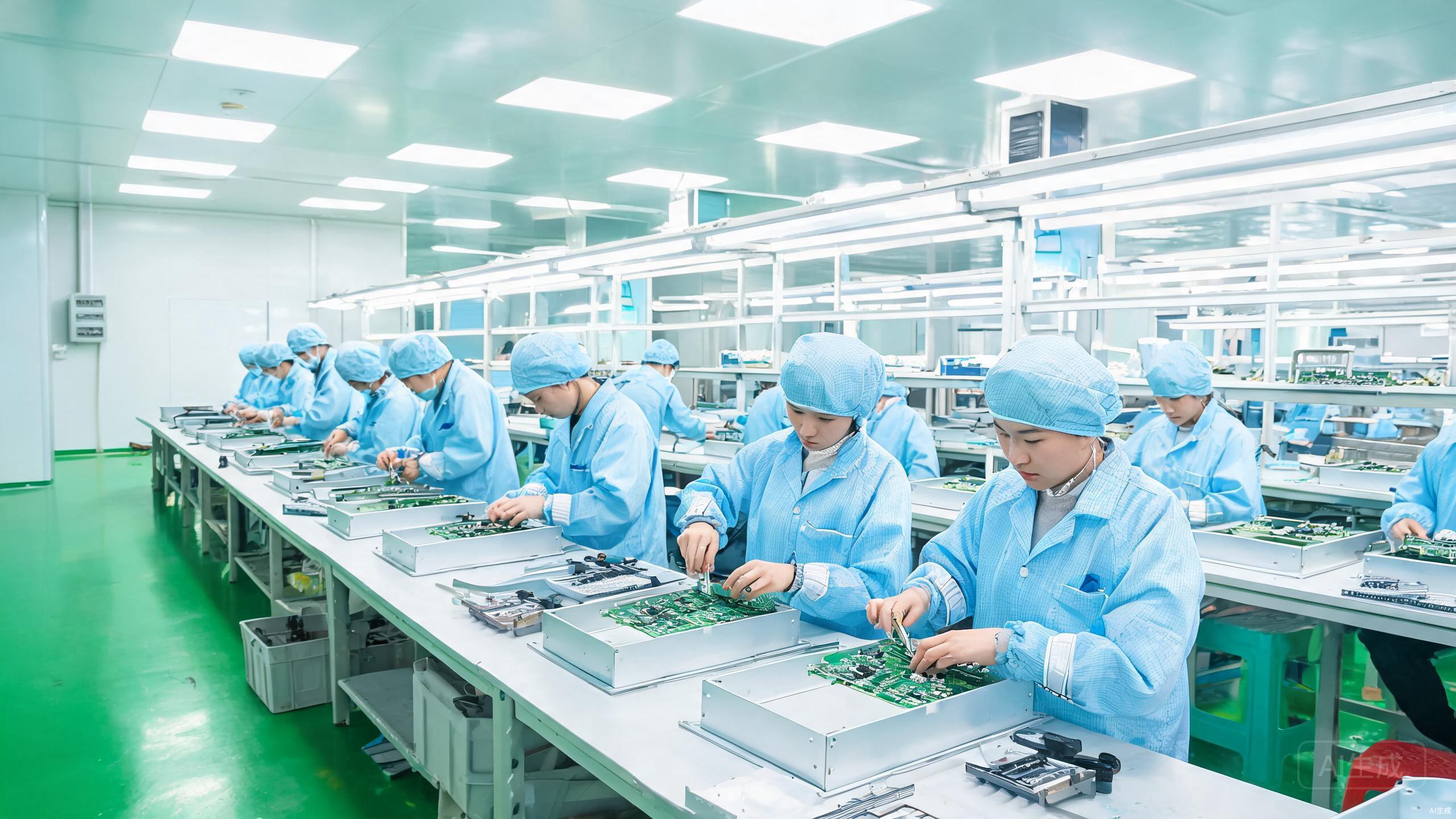
Module assembly workshop — PCBs mounted into frames with precision alignment
Quality check
Each assembled module gets a quick power-on test and visual inspection for frame fit, mask alignment, and connector seating before moving to cabinet assembly.
Cabinet Assembly — Stage 6 of the LED Display Manufacturing Process
What happens
LED modules are installed into aluminum or steel cabinets. Each cabinet receives: (1) one or more receiving cards (Colorlight or NovaStar) mounted and wired, (2) power supply units (Mean Well or equivalent) with redundant configuration where specified, (3) internal wiring harnesses for power distribution and data cascade, (4) signal and power connectors on the cabinet frame for inter-cabinet linking. Modules are magnetically attached or screw-fixed depending on cabinet design (front-service or rear-service).
Flatness check
After all modules are installed, cabinet surface flatness is measured with a digital level. Maximum tolerance: ±0.3mm between adjacent modules. Any gap or step triggers re-seating of that module.
Brightness & Color Calibration — learn about outdoor brightness requirements — — Stage 7 of the LED Display Manufacturing Process
What happens
Each fully assembled cabinet is placed in front of a spectroradiometer (Konica Minolta CA-410 or equivalent). The calibration system: (1) measures brightness and chromaticity of every single LED pixel, (2) computes per-pixel correction coefficients to achieve uniform brightness and a consistent D65 white point across the entire cabinet, (3) uploads correction data to the receiving card’s non-volatile memory. This calibration is factory-level — it stays with the cabinet permanently and works independently of the sender’s video processing.
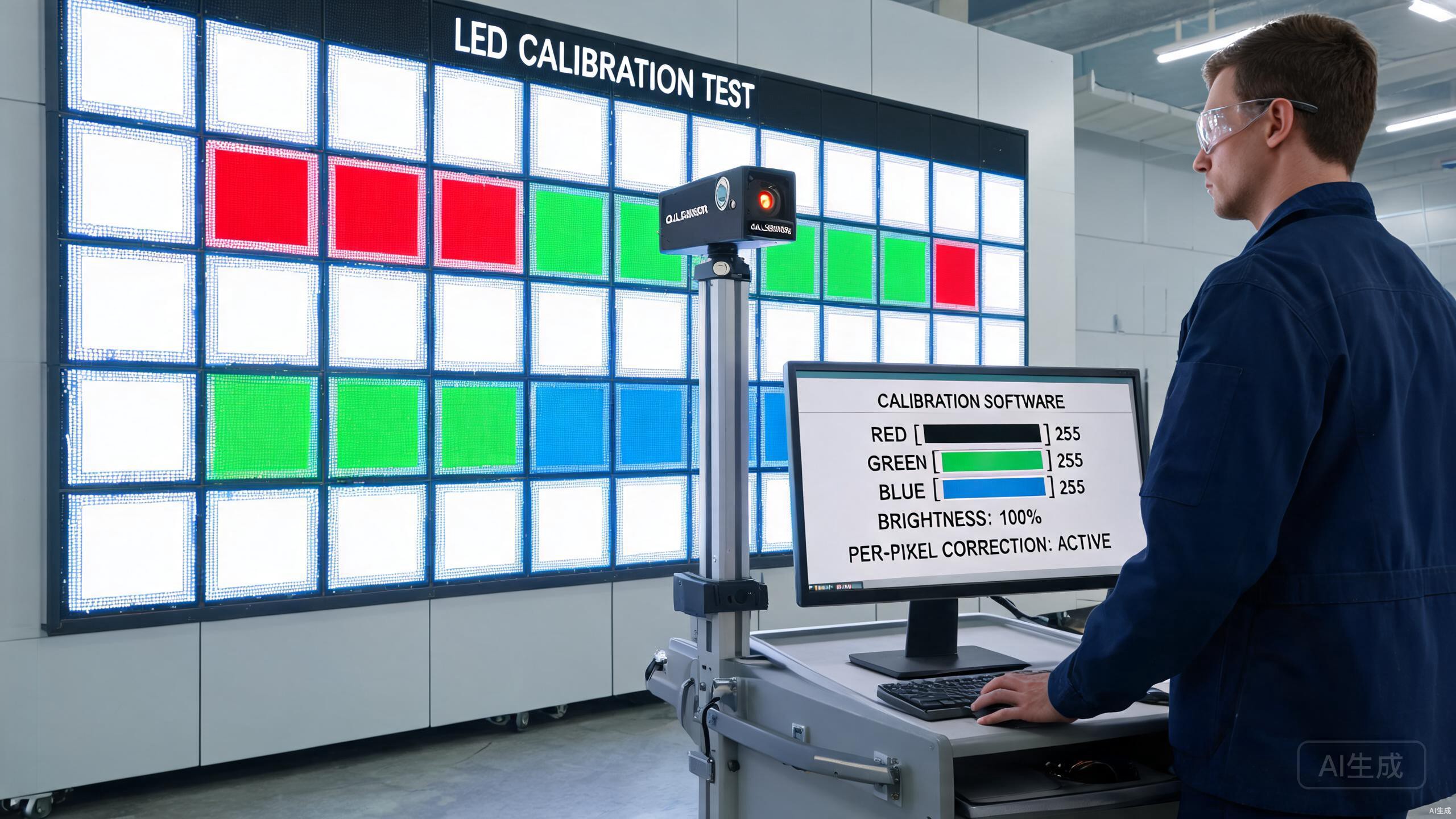
Rigorous calibration process — per-pixel brightness and color correction on every cabinet
Why it matters
Without per-pixel calibration, even LEDs from the same brightness bin will show 5–8% variance due to slight differences in driving current, PCB trace resistance, and thermal conditions. Factory calibration brings this variance below 3%, which is the threshold of human visual perception for uniformity.
72-Hour Aging Test — Stage 8 of the LED Display Manufacturing Process
What happens
Calibrated cabinets are powered on continuously for 72 hours in the dedicated aging room. The test cycles through full-screen patterns: solid white (100% brightness), solid red, solid green, solid blue, horizontal and vertical line grids, and grayscale gradients. Aging room ambient temperature is maintained at 35–40°C to accelerate early-life failure detection. Technicians monitor all cabinets in 8-hour shifts; any pixel anomaly or communication fault is logged and addressed immediately.
Why 72 hours specifically
The bathtub curve of electronic component reliability shows that early-life failures (infant mortality) cluster within the first 48–72 hours of operation. Components that survive 72 hours of continuous powered operation have an extremely high probability of reaching their rated service life. A 24-hour or 48-hour test would miss a significant portion of these early failures.
Waterproof Test for outdoor LED display — — Stage 9 of the LED Display Manufacturing Process
What happens
Every outdoor-rated cabinet (IP65 front / IP54 rear minimum) is placed in a waterproof test chamber. High-pressure water jets spray the cabinet from all angles at 12.5 L/min flow rate for a minimum of 3 minutes per side. After the spray cycle, the cabinet interior is inspected for any sign of moisture ingress. Cabinets are also tested for air pressure differential to verify seal integrity before the water test.
Pass / fail
Any water ingress = immediate fail. The cabinet returns to the assembly team for seal inspection and rework, then re-enters the test queue.
Final QC Inspection is the last quality gate in the LED display manufacturing process — Stage 10 of the LED Display Manufacturing Process
What happens
A senior QC inspector performs a comprehensive final audit on every cabinet before it’s cleared for packing. The 20-point checklist includes: brightness measurement at 9 grid points, color temperature verification, dead pixel count (zero tolerance), module flatness, cabinet frame alignment, connector function, receiving card communication, firmware version check, label verification (model, serial number, date code), and cosmetic inspection (no scratches, no gaps, no loose screws).
Documentation
Each inspected cabinet receives a QC passed sticker with the inspector’s ID and date. This sticker is visible inside the cabinet and is photographed for the shipment record.
Packing — Stage 11 of the LED Display Manufacturing Process
What happens
QC-passed cabinets are packed according to the shipping method and destination:
- Wooden Crate (Standard for Sea Freight) — Custom-built plywood crate with internal foam lining, desiccant packets, and cabinet securely bolted to crate base. Crates are fumigated and stamped per ISPM 15 for international shipping.
- Flight Case (Standard for Air Freight & Rental) — Reinforced aluminum-frame flight case with custom foam cutouts, heavy-duty casters, and recessed latches. Used for rental LED displays and premium air shipments.
- Cardboard + Pallet (Economy for Small Orders) — Double-wall corrugated box with foam padding, strapped to a heat-treated pallet. Used for accessory orders and small module batches.

Packaging & logistics — every shipment packed, photographed, and documented before dispatch
Every packed shipment is photographed from multiple angles. Packing photos are included in the shipping confirmation email sent to the customer.
Shipping & Logistics — Stage 12 of the LED Display Manufacturing Process
What happens
We ship globally from Shenzhen via three standard Incoterms:
- FOB (Free On Board) Shenzhen — we handle production, packing, export clearance, and delivery to the Shenzhen port. The customer manages ocean/air freight and destination clearance. Most popular option for experienced importers.
- CIF (Cost, Insurance & Freight) — we arrange and pay for freight and insurance to the destination port. The customer handles destination clearance and last-mile delivery.
- DDP (Delivered Duty Paid) — we handle everything door-to-door including import duties and taxes. Best for first-time buyers or customers who want a single point of responsibility.
Shipping documentation
Every order includes commercial invoice, packing list, bill of lading (or air waybill), certificate of origin, and product test reports. For EU shipments, we provide CE declaration of conformity and RoHS compliance documentation.
Typical transit times
Sea freight to major ports: 15–35 days depending on destination. Air freight: 3–7 days. Express courier (small orders): 3–5 days.
LED Display Manufacturing Process — Key Takeaways: The 12-stage LED display manufacturing process at Excel LED ensures consistent quality from raw materials to shipping. Each step in the LED display manufacturing process is documented, tested, and optimized for B2B clients worldwide. Our vertically integrated LED display manufacturing process eliminates intermediaries and delivers factory-direct pricing. The LED display manufacturing process at Excel LED is your guarantee of quality.
LED Display Manufacturing Process — Summary
Excel LED’s LED display manufacturing process is a vertically integrated system covering 12+ production stages. Our LED display manufacturing process includes IQC inspection, SMT solder paste printing, pick-and-place assembly, reflow soldering, post-SMT testing, LED module assembly, cabinet assembly, brightness and color calibration, 72-hour aging tests, waterproof testing, and final QC. This comprehensive LED display manufacturing process ensures that every LED screen we produce meets the highest international standards for B2B clients in 80+ countries.
By controlling the entire LED display manufacturing process in-house at our 5,000 m² Shenzhen factory, we offer competitive factory-direct pricing, faster lead times, and consistent quality. Contact us today to learn more about our LED display manufacturing process and request a factory quote.
Take the Next Step
Request Your Factory Quote
Tell us your project requirements by contacting our team directly. Our engineering team will respond with a detailed quotation and LED display manufacturing process timeline within 24 hours.
Response within 24 hours. Your data is confidential and never shared.
FAQ
Our LED Display Projects & Solutions
See how our manufactured LED displays perform in real-world installations across industries: Each unit below completed the full LED display manufacturing process before shipping.
Worship & auditorium installations
Large-venue performance screens
Indoor commercial display installation
Stadium & arena perimeter screens
Terminal information & advertising displays
Hospitality & lobby installations
How long does LED display manufacturing take from order to delivery? +
Standard LED display orders at Excel LED take 15–25 working days from order confirmation to shipment. Large-volume or highly customized orders (e.g., stadium-scale installations, custom cabinet sizes) may require 25–40 working days. The timeline breaks down as: material preparation (2–3 days), SMT production (3–5 days), module assembly (2–4 days), cabinet assembly (2–4 days), 72-hour aging (3 days), and final QC + packing (2–3 days). We provide a detailed production schedule with milestone updates at each phase.
Lead time depends on where your order enters the LED display manufacturing process and on current line capacity.
What quality certifications does Excel LED hold for manufacturing? +
Excel LED is ISO 9001:2015 certified for quality management systems. Our products carry CE (EMC + LVD), FCC Part 15 Class A, RoHS 2.0, and UKCA certifications. Outdoor displays are independently verified to IP65 (front) and IP54 (rear) ingress protection ratings. All certification documents are available for download and are included in the shipping documentation package with every order. Third-party inspection (SGS, TUV, Bureau Veritas) is available upon request.
These certifications audit every stage of our LED display manufacturing process, not just the finished screen.
Can I visit the Excel LED factory before placing an order? +
Yes, absolutely. We encourage prospective buyers to visit our Shenzhen factory. You will walk the full production floor — SMT lines, module assembly workshops, the aging test room, calibration stations, and the packing/shipping dock. You will meet our QC team, inspect production documentation, and see your potential order being built. Cannot travel to Shenzhen? We offer a live video factory tour via WeChat, Zoom, or WhatsApp — our engineer walks you through every production stage in real time, and you can ask questions on the spot.
During a visit you can walk the full LED display manufacturing process from IQC to aging.
How does Excel LED ensure color and brightness consistency across multiple cabinets? +
Every LED module undergoes individual brightness and chroma calibration using a spectroradiometer after assembly. Correction coefficients are calculated per module and uploaded to the receiving card’s non-volatile memory, enabling 14-bit pixel-level correction. The result: brightness variance across the entire display is held to <3% (industry average is 10–15%), and color difference is maintained at ΔE < 3 relative to the D65 white point. This calibration data persists for the life of the display and can be re-applied if modules are ever replaced.
Per-cabinet calibration inside the LED display manufacturing process is what guarantees uniformity across a video wall.
What warranty is included with Excel LED displays? +
All Excel LED displays include a standard 2-year warranty covering LED lamp failure, driver IC defects, power supply malfunction, and receiving card failure. Extended warranties of up to 5 years are available. Every order ships with free spare parts — typically 2–5% of LED modules, plus spare power supplies, receiving cards, and cables — so you can perform field repairs without waiting for replacement parts. Warranty claims are processed within 48 hours with photo/video diagnosis; replacement parts ship by air courier at our expense for covered failures.
Our 3-year warranty covers defects that originate in the LED display manufacturing process.
Does Excel LED provide installation support and technical assistance? +
Yes. Every order includes free remote engineering support — our technical team provides structural calculation reports, CAD layout drawings, control system configuration files, and step-by-step installation guides tailored to your project. On-site commissioning and installation supervision is available at a daily rate plus travel expenses. For complex projects (stadiums, broadcast studios, large-scale events), we recommend including on-site support in your order. Pre-sales engineering support — including display configuration optimization and system architecture design — is provided at no charge.
Engineering support continues after the LED display manufacturing process ends, through commissioning and beyond.
Where is Excel LED display factory located? +
Excel LED’s main factory is located in Shenzhen, Guangdong, China — the global electronics manufacturing hub. We also operate a secondary production workshop in Changsha, Hunan Province. Both facilities operate under ISO 9001:2015 quality management systems. Factory visits are welcome — you can walk the production floor, inspect QC documentation, and meet the team before placing your order.
Our Shenzhen plant runs the complete LED display manufacturing process under one roof.
How many LED screens can your factory produce per month? +
Our factory production capacity is approximately 3,000 square meters per month. Capacity is scalable — we have successfully delivered single projects exceeding 500 m². Production scheduling is managed by our ERP system to ensure on-time delivery for every order, regardless of volume.
Monthly capacity reflects the scale of our LED display manufacturing process across 5 SMT lines.
Do you manufacture LED modules yourself or buy from suppliers? +
We manufacture LED modules in-house. Our 5 SMT production lines handle the complete process: solder paste printing, pick-and-place of LED lamps and ICs, reflow soldering, and automated optical inspection. We source LED lamps directly from Nationstar, Kinglight, and Nichia — and assemble everything on our own PCBs. This vertical integration is what allows us to control quality at every stage.
Building modules in-house lets us control the LED display manufacturing process end to end.
What makes Excel LED different from other LED display manufacturers in China? +
Three things: (1) Vertical integration — we manufacture LED modules, assemble cabinets, calibrate, and test everything in our own factory. (2) 72-hour mandatory aging on every order — many manufacturers reduce this to 24 hours to save time; we don’t. (3) Factory-direct communication — you deal directly with our production and engineering team, not through a trading company. We welcome factory visits — if a manufacturer won’t let you see their production floor, that’s a red flag.
Owning the full LED display manufacturing process is what separates Excel LED from trading companies.
Do you manufacture outdoor LED displays? What waterproof rating do they have? +
Yes. We manufacture outdoor LED displays with IP65 front / IP54 rear ingress protection. Every outdoor cabinet undergoes conformal coating on all PCBs, waterproof seal testing with high-pressure water jets at 12.5 L/min for 3 minutes per side, and air pressure differential testing to verify seal integrity. Outdoor displays include anti-UV mask material, stainless steel screws, and weather-sealed connectors, designed for -20°C to +50°C operation.
Outdoor models add a waterproofing gate within the LED display manufacturing process.
What is the minimum order quantity (MOQ) for LED displays from your factory? +
We do not enforce a strict MOQ. We manufacture from 1 square meter for sample orders and small projects. Sample orders allow you to evaluate build quality, brightness, color accuracy, and packaging before committing to a volume order. For custom cabinet designs or non-standard pixel pitches, MOQ may apply — our sales team will clarify during quotation.
Low MOQ is possible because our LED display manufacturing process is built for mixed-batch production.