
P3.076 Indoor LED Display
3.076 mm pixel pitch · EHONOR 480×320 front-service cabinet · 156×104 resolution · 3,840 Hz
The Excel LED standard-pitch line at 3.076 mm — about 105,700 pixels per square meter, 26S scan with 1515 SMD chips, magnetic full front maintenance on the EHONOR 480×320 cabinet — supplied by Excelled, a trusted LED display manufacturer for global B2B system integrators.
Quick Answer: What Is a P3.076 Indoor LED Display?
A P3.076 indoor LED display is a standard-pitch LED video wall with 3.076 mm between adjacent pixels — about 105,700 pixels per square meter — built on the EHONOR 480×320 mm front-service cabinet.
• Confirmed factory configuration: 320×160 mm module, 104×52 resolution, 26S scan, 42 driver ICs, 1515 lamp beads.
• Cabinet resolution: 156×104 px per 480×320 panel (3 modules, rotated 160×320 arrangement).
• Best viewing distance: about 3.1 m and beyond — the most economical pitch on the EHONOR platform.
• Brightness, refresh and price follow the confirmed BOM — Excel LED quotes per configuration.
One-Stop Solution of P3.076 Indoor LED Display
Excel LED supplies the P3.076 indoor LED display as a complete system — cabinets, modules, power supplies, receiving cards, video processor and steel structure — all from one factory line, so integrators receive a matched wall instead of a pile of parts.
P3.076 is the largest pitch of the EHONOR 480×320 platform, sharing its cabinet with P1.25, P1.53, P1.667, P1.86, P2 and P2.5. Compared with a P2.5 indoor LED display it cuts pixel density by about a third — the cheapest wall you can build on a fully front-serviced cabinet — while staying sharp at auditorium and exhibition seating distances of 3–6 m.
mm Pixel Pitch
About 105,700 px/m² — the economy end of the EHONOR platform.
×320 Front-Service
3 modules per cabinet, 70 mm deep, every part replaceable from the front.
Hz Refresh
Camera-safe refresh for video calls, streaming and broadcast.
S Scan / 42 ICs
Confirmed BOM: 26S scan with 42 driver ICs and 1515 lamp beads per module.
P3.076 LED Display Series: EHONOR, SLS Flexible and EDI
The P3.076 line at Excel LED is organized around the EHONOR platform — designed by LEGIDATECH, see the LEGIDATECH Official Website — with a lightweight 480×320 mm front-service cabinet; SLS flexible soft modules cover curved sections of the same wall; and EDI covers the finer P1.2–P2.5 range for projects that will later step up in density.
| Item | EHONOR ★ | SLS Flexible | EDI |
|---|---|---|---|
| Cabinet / module format | 480×320×70 mm, 3×320×160 | 320×160 soft board | 640×480 mm die-cast (P1.2–P2.5 only) |
| Material & process | CNC Al frame + flame-retardant ABS | Soft PCB, bendable | One-piece die-cast aluminum |
| Cabinet weight | 2.7 kg (confirmed) | Lightweight per m² | ~6.5–8 kg (typical) |
| Resolution (P3.076) | 156×104 px per cabinet | 104×52 px per module | — (not offered at 3.076) |
| Maintenance | Full front — modules, PSU, receiving card | Front / rear | Front (modules) |
| Brightness | 600–800 nits (confirmed) | ≥600 nits | 800 nits |
| Refresh rate | 3,840 Hz (confirmed) | ≥1,920 Hz | 3,840 Hz |
| Best for | Auditoriums, exhibitions, retail, signage | Curved columns, arches | Fine-pitch 4:3 fixed walls |
P3.076 LED Display Cabinet: the 480×320 mm EHONOR Platform
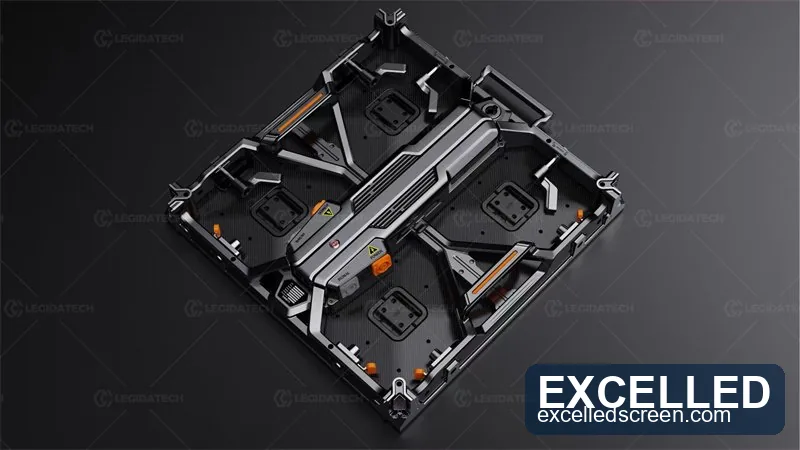
The EHONOR cabinet is the core of the P3.076 system: a 480×320×70 mm panel holding three 320×160 mm modules in a rotated 160×320 arrangement. At 3.076 mm pitch that works out to 156×104 pixels per cabinet (480 ÷ 3.076 × 320 ÷ 3.076), and the light CNC construction keeps the whole wall easy to handle and install.
| Parameter | Specification |
|---|---|
| Cabinet size | 480×320×70 mm (confirmed, EHONOR series) |
| Cabinet weight | 2.7 kg (confirmed, EHONOR user manual) |
| Cabinet resolution (P3.076) | 156×104 px — 3 modules × 52×104 px (rotated 160×320 layout) |
| Modules per cabinet | 3 × 320×160 mm (rotated), magnetic attachment (confirmed, series page) |
| Material & process | CNC aluminum frame + flame-retardant ABS back panel |
| Maintenance | Full front maintenance — modules, power supply and receiving card all front-accessible |
| Mounting | Wall-mount, floor-standing, or hoisted; landscape or portrait without re-routing |
| IP rating | IP31–IP40 (confirmed range, series data) |

Materials and processes behind the P3.076 cabinet
The cabinet is CNC-machined aluminum with a flame-retardant ABS back panel, not a welded steel box. That choice drives three real benefits: the panel stays flat enough for seamless splicing (CNC tolerance keeps module faces aligned), it sheds weight for wall mounting, and the ABS body adds an insulation layer that a bare metal chassis does not provide.
The front frame carries magnetic points that lock each module in place without screws. A vacuum tool removes a module in seconds, and the power supply and receiving card sit behind the same front opening — which is why the wall needs no rear service corridor at all.
P3.076 LED Module: 320×160 (26S) Configuration
The standard P3.076 module is the 320×160 mm format with 104×52 resolution, 26S scan, 42 driver ICs and 1515 lamp beads. The 1515 package is the workhorse of the standard-pitch range — big enough for high drive current and forgiving in dusty retail environments — and a 2020 chip variant is available for customers who push brightness or current headroom.
| Parameter | Specification |
|---|---|
| Module size | 320×160 mm (confirmed) |
| Module resolution | 104×52 px (confirmed) |
| Total pixels | 5,408 per module (104×52) (confirmed) |
| Scan mode | 26S (confirmed) |
| Driver ICs | 42 per module (confirmed) |
| Lamp beads | 1515 SMD, 2020 option (confirmed) |
| Cabinet fit | 3 modules per EHONOR 480×320 cabinet (rotated) |

Front vs rear maintenance on P3.076 modules
The 320×160 P3.076 module is a front-service magnetic module: it is held by magnets, so a dead module is pulled out and a new one pushed in from the face of the wall — no ladder behind the screen, no disassembly of adjacent panels. Because the EHONOR cabinet is designed around this, the power supply and receiving card also come out through the front.
Rear-service modules exist on some fixed-installation walls where a service corridor is already planned. They are slightly cheaper, but every repair then requires walking behind the wall — plan that corridor into the steel structure from day one.
P3.076 LED Display Power Supply and Control System
Every Excel LED P3.076 wall is quoted with a matched power and control chain, so the brightness and refresh numbers in this guide are what the delivered system actually runs.
Power: the EHONOR platform runs at 800 W/m² maximum and 300 W/m² average; at 3.076 mm the module carries the smallest pixel count of the family, so per-module drive current is the lowest on the platform. Power supplies are industry-grade 5 V switching units with over-current and short-circuit protection; brand-level options are confirmed per quotation rather than assumed.
Control: the signal chain is sending card → video processor → receiving cards → modules, and the P3.076 cabinet is compatible with NovaStar, Huidu and Colorlight receiving cards. Excel LED’s standard load is one receiving card per EHONOR cabinet (three 320×160 modules), which keeps every cabinet on its own data feed and simplifies fault isolation.
Features of P3.076 Indoor LED Screen
Standard Pitch
About 105,700 px/m² — crisp text and logos at auditorium and exhibition distance.
Seamless Splicing
CNC-machined cabinets keep module faces flat; no visible mullion grid.
Full Front Service
Modules, PSU and receiving card replaced from the face of the wall.
Aged & Calibrated
Every cabinet runs a 72 h aging test and calibration before packing.
14–16 Bit Gray
68.7 billion colors; smooth gradients without banding.
Portrait or Landscape
Same cabinet, no re-wiring — banner walls and columns both work.

P3.076 LED Display Product Matrix: EHONOR and Flexible
| Item | EHONOR 480×320 ★ | Flexible 320×160 |
|---|---|---|
| Cabinet size | 480×320×70 mm | Module-direct |
| Cabinet resolution | 156×104 px | — |
| Modules per cabinet | 3 | 1 |
| Material | CNC Al + ABS | Soft PCB |
| Weight | 2.7 kg (confirmed) | Light |
| Maintenance | Full front | Front / rear |
| Refresh | 3,840 Hz | ≥1,920 Hz |
| Best for | Auditoriums, exhibitions, retail, signage | Curved creative sections |
P3.076 vs P3 vs P2.5 Indoor LED Display
P3.076 sits between the two most common standard pitches in the market, and the comparison is about more than the pitch number: the P3.076 runs on the EHONOR 480×320 front-service cabinet, while the widely sold P3 uses 192×192 mm modules on conventional cabinets — a real difference in maintenance and weight.
| Item | P2.5 | P3.076 ★ | P3 |
|---|---|---|---|
| Pixel pitch | 2.5 mm | 3.076 mm | 3 mm |
| Module format | 320×160 mm | 320×160 mm | 192×192 mm |
| Module resolution | 128×64 px | 104×52 px | 64×64 px |
| Cabinet format | EHONOR 480×320 | EHONOR 480×320 | 640×480 Al / 500×500 rental (typical) |
| Cabinet resolution | 192×128 px | 156×104 px | — (module-direct) |
| Scan / ICs / chips | 64S or 32S / 24 or 48 / 1515 or 2020 | 26S / 42 / 1515 | 32S / 24 / 1515 or 2020 |
| Pixels per m² | 160,000 | 105,700 | 111,111 |
| Best viewing distance | 2.5 m+ | 3.1 m+ | 3 m+ |
| Typical use | Church, conference, retail | Auditoriums, exhibitions | Conference, retail, church |
Compared with a P3 LED display, the P3.076 wall gives you the EHONOR front-service cabinet and 3,840 Hz at nearly the same pixel density — about 5% fewer pixels per square meter, which rarely matters at 3–6 m viewing distances. Compared with a P2.5 LED display, the P3.076 saves roughly a third of the pixel cost per square meter when nobody sits closer than about 3 m.
Use Scenarios of P3.076 Indoor LED Display
Auditoriums and conference halls
Auditorium staging is the sweet spot for P3.076: seats begin 4–8 m from the wall, so the 3.076 mm grid is invisible from the first row while the wall stays bright enough for presentation content. The 2.7 kg cabinet keeps the wall manageable on a movable stage structure, and indoor fixed LED display planning applies for the rigging points.
Exhibitions and trade-show booths
Exhibitors choose P3.076 for booth backdrops watched from 2–5 m — sharp enough for logos and text, cheap enough to redeploy show after show. The magnetic modules let a crew swap a damaged module between events without a soldering iron.

Churches and community halls
Churches running lyrics and sermons from pews that start beyond 3 m use P3.076 to keep the budget near standard-pitch levels while retaining a professional wall. Combined with church LED screen planning, the front-service cabinet lets volunteers maintain the wall without ladders or rear access.
Retail stores and large-format signage
Retailers use P3.076 for product close-ups and dynamic branding at counter distance. The 1515 chip’s larger package tolerates the dust and humidity of real store environments better than finer chips, and the wall runs bright enough for window-facing displays.
Hotels, event venues and corporate lobbies
Hotels pair P3.076 with indoor LED screen planning for ballroom backdrops and reception walls — sharp at the distances guests actually stand, and economical enough to leave on all day.
How to Choose the Right P3.076 LED Display
- Measure the seating distance first. If the nearest viewer sits closer than about 3 m, P2.5 is the safer call; beyond 5 m, P4 saves cost with little visible loss.
- Confirm the wall’s pixel count, not just its area. A 4.8×3.2 m wall is exactly 10×10 EHONOR cabinets — 1,560×1,040 px. Excel LED quotes the exact resolution per dimension.
- Check access. If there is no rear corridor, the EHONOR full front maintenance configuration is the only sensible choice.
- Match the control system to the content. Live feeds and streaming favor NovaStar-class processors with 3,840 Hz; static signage can run a lighter chain.
- Ask for the BOM. Module scan, IC count and lamp bead brand define price and longevity more than the pitch number alone.
How Much Does a P3.076 LED Display Cost?
P3.076 is the most economical wall on the EHONOR platform, and the price is driven by 1515 lamp beads, 42 driver ICs per module, 26S scan and the CNC cabinet. With the smallest pixel count per module in the EHONOR family, a P3.076 wall typically runs 20–35% lower per square meter than an equivalent P2.5 wall on the same cabinet — the platform saves cost without changing the structure or the spare-part chain. Cost per square meter falls as wall size grows and as the order moves to standard cabinets rather than custom formats. Excel LED publishes no single list price because every wall differs; the quotation splits modules, cabinets, power, control, structure and shipping.
When You Should NOT Choose a P3.076 LED Display
P3.076 Technical Specifications
| Parameter | Specification |
|---|---|
| Product type | Indoor fixed standard-pitch LED display |
| Pixel pitch | 3.076 mm (confirmed) |
| Pixel density | ≈105,700 px/m² |
| Module size | 320×160 mm (confirmed) |
| Module resolution | 104×52 px (confirmed) |
| Cabinet size | 480×320×70 mm (EHONOR) (confirmed) |
| Cabinet resolution | 156×104 px (structural derivation) |
| Cabinet weight | 2.7 kg (confirmed, user manual) |
| Cabinet material | CNC aluminum frame + flame-retardant ABS |
| Scan mode | 26S (confirmed) |
| Driver ICs | 42 per module (confirmed) |
| Lamp beads | 1515 SMD, 2020 option (confirmed) |
| Brightness | 600–800 nits (confirmed, series); 1,200–1,500 nits module typical |
| Refresh rate | ≥3,840 Hz (confirmed) |
| Gray scale | 14–16 bit, 68.7 billion colors |
| Viewing angle | 160°/160° horizontal/vertical |
| Max power | 800 W/m² (confirmed) |
| Average power | 300 W/m² (confirmed) |
| Working voltage | AC 100–240 V, 50/60 Hz |
| IP rating | IP31–IP40 (front) (confirmed range) |
| Maintenance | Full front maintenance — modules, PSU, receiving card |
| Control system | NovaStar / Huidu / Colorlight compatible |
| Lifespan | ≥100,000 hours |
| Warranty | 2 years (Excel LED standard) |
P3.076 LED Display: Pitch, Resolution and Viewing Distance
Resolution on an LED wall is always screen size ÷ pixel pitch, per dimension:
Illustrative: a 4.8×3.2 m wall = 10×10 EHONOR cabinets → 1,560×1,040 px ≈ 1.6 megapixels. A 9.6×3.2 m banner = 20×10 cabinets → 3,120×1,040 px.
Viewing distance follows the same number: minimum comfortable distance is about 1× the pitch in meters — roughly 3.1 m for P3.076 (the EHONOR series guide rates P3.076 for 3.0–6.0 m seating). Beyond about 6 m, the human eye stops resolving the 3.076 mm grid, which is exactly why P4 takes over the rest of the price curve.
P3.076 Indoor LED Display
Why choose P3.076 pitch
P3.076 is the price-performance sweet spot of the EHONOR platform: the coarsest pitch in the family, with the cheapest chip set (1515), the lowest per-module pixel count (5,408) and the smallest drive-electronics load — all on the same front-serviced 480×320 cabinet as the finer pitches. For auditorium, exhibition, retail and church walls watched at 3–6 m, it delivers standard-pitch economy with fine-pitch-grade structure and maintenance.
Maintenance method
Front maintenance
Every EHONOR component — module, power supply, receiving card — is removed and replaced from the front with magnets and a vacuum tool. No rear corridor, no ladder team behind the wall.
Rear maintenance
On module-direct or conventional-cabinet walls, rear access is still an option where the structure allows it; Excel LED can quote either, but the standard P3.076 system is front-service.
Packaging of P3.076 indoor LED display screens
Cabinets ship vacuum-sealed in foam-cradled cartons, with modules pre-installed and calibrated; the receiving cards, power supplies and spare module set travel in a separate accessories carton with the manual.
Which Module Sizes Does a P3.076 Indoor LED Display Use?
This pitch is quoted in 2 module formats in our production list. All of them produce the same 105,688 px/m² wall — they differ in board size, how many fit a cabinet, drive scheme and serviceability. Pixel figures below are exact arithmetic from the pitch (1,000 ÷ 3.076 mm = 325.1 px per metre), cross-checked against the factory module list.
| Module size | Resolution & dots | Per cabinet | Boards per m² | LED & drive | Notes & service |
|---|---|---|---|---|---|
| 320×160 mm | 104×52 px 5,408 dots |
3 | 19.54 | 1515 SMD, 2020 option · 42 ICs · 26S scan | front-service magnetic module |
| 320×160 mm (flexible board) | 104×52 px 5,408 dots |
— | 19.54 | — | module count per cabinet as stated does not fit the 480×320×70 cabinet grid — confirmed per order |
Which Cabinet Sizes Does a P3.076 Indoor LED Display Ship In?
480×320×70 mm is the standard carrier for this pitch: 3 × 320×160 mm (rotated), resolving to 156×104 — 16,224 px. Every further format below is built for a specific layout problem rather than for a better picture.
| Cabinet (W×H) | Modules inside | Resolution | Weight / body | Service access |
|---|---|---|---|---|
| 480×320×70 mm | 3 × 320×160 mm (rotated) | 156×104 16,224 px |
2.7 kg · CNC aluminum frame + flame-retardant ABS back panel | Full front maintenance — modules, power supply and receiving card all front-accessible |
Why this cabinet size became the standard grid
The standard carrier wins on three counts. Module arithmetic: the cabinet divides into whole 320×160 mm boards with no cut strips. Handling: size and weight stay within what two installers can lift and align without lifting gear. Interchangeability: a replacement cabinet years later still bolts onto the same holes and takes the same modules.
Industry-standard cabinet grids for this module size (on request)
These grids are the ones the industry builds around this module size, and each one is arithmetic-clean — the modules tile with no cut strip. They are quoted on request rather than stocked, and the pixel figures are pure arithmetic from the pitch.
| Cabinet (W×H) | Modules inside | Resolution & pixels | Grid status |
|---|---|---|---|
| 640×480 mm on request |
2 × 3 × 320×160 mm modules (2 × 3) | 208×156 32,448 px |
standard indoor grid |
| 960×480 mm on request |
3 × 3 × 320×160 mm modules (3 × 3) | 312×156 48,672 px |
standard indoor grid |
| 960×960 mm on request |
3 × 6 × 320×160 mm modules (3 × 6) | 312×312 97,344 px |
standard indoor grid |
Which cabinet form should you pick?
- Standard indoor wall (conference, retail, church) → the standard cabinet: best price, best lead time, spares on the shelf.
- Wall with a strict structural or lift limit → the smallest cabinet class: lighter per piece, easier to carry into a finished room.
- Very large single wall → the larger cabinet class: fewer splices, faster assembly, flatter result.
- Front-service-only site (no rear access) → confirm the magnetic front-service module and quick-lock frame on your quotation.
- Curved, corner or creative shape → a bendable-board pitch or a small-pitch creative module, not a flat cabinet grid.
Which Control Systems Work With a P3.076 Indoor LED Display?
A P3.076 Indoor LED Display is electrically ordinary: standard HUB75 module interface, conventional indoor scan, low-voltage module rails. That is why it accepts essentially every mainstream control ecosystem — the real decision is not “which system is compatible” but which family your operators already run, because sending cards and receiving cards must come from the same family.
The signal chain, end to end
- 1. Video source — media player, PC, camera or streaming decoder.
- 2. Video processor / sending card — scales, switches and packetises: HDMI / DVI / SDI in, gigabit Ethernet out.
- 3. Transport — Cat6 for normal runs, fibre where the distance or the lightning risk demands it.
- 4. Receiving card — one receiving card per cabinet is the standard loading (16,224 px per cabinet).
- 5. Modules — 3 × 320×160 mm (rotated) per cabinet, daisy-chained POWER IN/OUT and SIGNAL IN/OUT.
| Ecosystem | Typical hardware | Best for |
|---|---|---|
| NovaStar page-confirmed |
MRV336 receiving card · MCTRL660 controller · MCTRL4K 4K sender | Large fixed walls that need remote diagnostics and per-pixel calibration |
| Colorlight page-confirmed |
i9+ receiving card · X16 video processor | Billboard and signage budgets; sites already running Colorlight |
| Huidu page-confirmed |
HD-C16C async control card · VP620 video processor | Single-screen ad sites scheduled from a phone, no PC on site |
| Linsn factory-confirmed on this line — mature mapping for very large walls |
DH7512 receiving card | City-scale walls and centralised control rooms |
| Mooncell budget sending, 2-in-1 processing and player hardware we stock |
MVB20E-G 2-in-1 processor | Cost-controlled fixed installs and second-source spares |
| VDWALL video processing line we stock |
LVP605 video processor | Stadium, broadcast and multi-source control rooms |
| RGBlink switcher-processor hybrids we stock |
X2 modular video wall processor | Live production and event broadcast workflows |
How many receiving cards does a P3.076 Indoor LED Display need?
Two limits decide the card count, and the smaller one wins. Pixel capacity: one 480×320×70 cabinet carries 16,224 px, and a mid-range card such as the MRV336 loads 256×256 = 65,536 px at 60 Hz — that is 4 cabinets per card. Port loading: the same card has 12 HUB75 outputs, and a cabinet here needs 3 module feeds, so the ports allow 4 cabinets. The binding limit is 4 cabinets per card (the pixel capacity).
- Redundancy — on revenue-critical walls add a second sending card in hot standby; a failed cabinet still does not take the wall down.
- Remote management — NovaStar and Colorlight sending platforms report cabinet temperature and voltage and support scheduled brightness by time of day.
- The one rule that saves the most money — sending card and receiving cards from the same family. Mixing families is the most common commissioning failure we get called about.
- Documentation — the port map, receiving-card loading sheet and configuration file ship with every order.
The architecture of each role — sender, processor, receiving card, async player — is compared in our LED control system collection.
Frequently Asked Questions About P3.076 LED Displays
Q1 What is a P3.076 indoor LED display?
A P3.076 indoor LED display is a standard-pitch LED video wall with 3.076 mm between adjacent pixels, about 105,700 pixels per square meter. It is built on the EHONOR 480×320 mm front-service cabinet with 320×160 mm 26S modules, giving 156×104 pixels per cabinet. It is the economy end of the Excel LED EHONOR platform.
Q2 What is the resolution of a P3.076 LED display?
A 320×160 mm P3.076 module resolves 104×52 pixels, and an EHONOR 480×320 mm cabinet resolves 156×104 pixels. A wall’s resolution equals its size in millimeters divided by 3.076 in each direction — for example a 4.8×3.2 m wall gives 1,560×1,040 pixels.
Q3 What is the best viewing distance for a P3.076 LED display?
The minimum comfortable viewing distance is about 3.1 m, matching the 3.076 mm pitch, and the EHONOR series rates P3.076 for 3.0–6.0 m seating. Text and graphics stay sharp across that band, which is why P3.076 is chosen for auditoriums, exhibitions and church halls.
Q4 What are the specifications of a P3.076 LED module?
The confirmed P3.076 module is 320×160 mm with 104×52 pixels, 26S scan, 42 driver ICs and 1515 lamp beads, with a 2020 chip variant available. Three modules fill an EHONOR 480×320 cabinet in a rotated layout, and the same cabinet accepts P1.25 through P2.5 modules.
Q5 Is P3.076 the same as P3?
No. Both are about 3 mm pitch, but P3.076 runs on 320×160 mm modules and the EHONOR 480×320 front-service cabinet, while the most common P3 uses 192×192 mm modules on conventional cabinets. The two are not module-compatible — match the format when extending an existing wall.
Q6 Can a P3.076 LED display be front-maintained?
Yes. The EHONOR configuration gives full front maintenance: modules are magnetic and pull out with a vacuum tool, and the power supply and receiving card are also accessible from the front. The wall needs no rear service corridor, which matters in auditoriums and exhibition halls where access is tight.
Q7 What brightness does an indoor P3.076 LED display have?
The EHONOR series rates 600–800 nits for the P3.076 platform, while the 320×160 indoor module is typically run at 1,200–1,500 nits. For auditoriums, exhibitions and church use, 600–1,000 nits is ample; the higher figure matters in bright lobbies and window-facing displays.
Q8 What refresh rate should a P3.076 LED screen have?
The confirmed standard is 3,840 Hz with 14–16 bit gray scale. At this refresh the screen shows no scan lines or water-ripple in camera shots, which is essential for conference staging, live streaming and broadcast applications. Lower-refresh configurations exist for budget projects and must be specified explicitly.
Q9 Which control systems work with a P3.076 wall?
The EHONOR cabinet is compatible with NovaStar, Huidu and Colorlight receiving cards. The standard Excel LED load is one receiving card per 480×320 cabinet — three modules per feed — which isolates faults and simplifies spare-part stock. The video processor is matched to the wall’s pixel count.
Q10 How many pixels per square meter does P3.076 have?
P3.076 delivers about 105,700 pixels per square meter (1 ÷ 0.003076²). A 4.8×3.2 m wall therefore carries about 1.6 million pixels — an easy load for a mid-range processor — and the full signal chain is included in the Excel LED system quote.
Q11 Is P3.076 cheaper than P2.5?
Yes. P3.076 carries the smallest pixel count per module on the EHONOR platform — 5,408 versus 8,192 on P2.5 — with fewer driver ICs per module (42 versus 48) and the cheapest chip set. Typical wall pricing runs 20–35% lower per square meter than an equivalent P2.5 wall on the same cabinet.
Q12 What is the lifespan of a P3.076 LED display?
The EHONOR platform is rated for 100,000+ hours with factory aging and calibration on every cabinet. Excel LED’s standard warranty is 2 years covering LED failures, driver IC defects and power supply issues, with spare modules kept in stock for the wall’s expected service life.
Get Factory-Direct Pricing for Your P3.076 Indoor LED Display
Send Excel LED four details and receive a BOM-level quotation: 1. Screen size · 2. Viewing distance · 3. Installation environment · 4. Maintenance preference. Every quote lists modules, cabinets, power, control, structure and shipping separately.
P3.076 Indoor LED Display — 480×320 Cabinet, 26S, Front Maintenance
Excel LED supplies the P3.076 indoor LED display as a complete, factory-matched system: 320×160 26S modules with 1515 lamp beads, the 2.7 kg EHONOR 480×320 front-service cabinet, 3,840 Hz refresh and a 2-year warranty — quoted per project, not per square meter.
Related reading: P2.5 Indoor LED Display · P3 Indoor LED Display · P2 Indoor LED Display · P1.86 Indoor LED Display · P4 Indoor LED Display · Indoor LED Screen