
P2.976 Rental LED Display
250×250 mm Epround panel · indoor 54S with 2020 lamps & outdoor 72S with 1415 lamps · 7,056 pixels per panel · 112,896 px/m² · dual-weather touring
The P2.976 rental LED display is the value-density band of Excel LED’s 250 mm touring platform — 250×250 mm panels, 84×84 = 7,056 pixels per board, a 54S indoor build on 2020 lamps and a 72S outdoor build on 1415 lamps — for stages, festivals and open-air shows that want mid-pitch sharpness without paying fine-pitch pixel budgets. Supplied by Excelled, a trusted LED display manufacturer for global B2B rental houses and integrators.
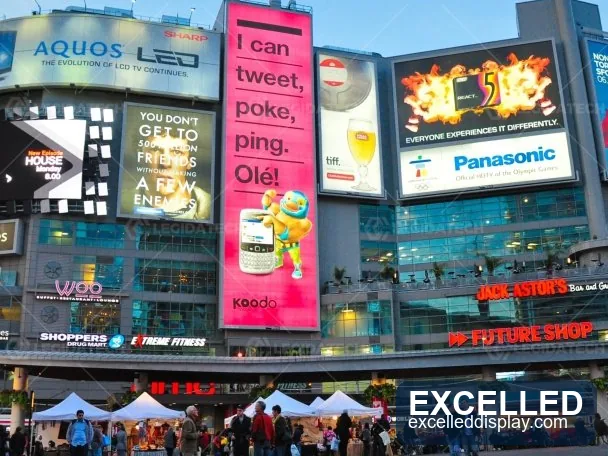
Quick Answer: What Is a P2.976 Rental LED Display?
A P2.976 rental LED display is a 2.976 mm pixel pitch video wall built from 250×250 mm touring panels with quick-lock frames and flight-case travel.
• Module data (confirmed): 250×250 mm panel · 84×84 = 7,056 pixels · indoor build 54S with 54 driver ICs and 2020 lamps · outdoor build 72S with 72 driver ICs and 1415 lamps.
• Resolution: 112,896 pixels per m² — the value band of the 250 platform, tuned for walls viewed from about 3.5 m.
• Dual use: one panel family covers indoor stages and weather-exposed outdoor stages, each with its own lamp and drive configuration.
• Rental engineering: die-cast quick-lock panels, front service, flight cases, and control matched by one factory.
One-Stop Solution
One-Stop Solution for P2.976 Rental LED Display Walls
Excel LED (LEGIDATECH) supplies the P2.976 rental LED display family end-to-end: the 250×250 mm Epround platform in two factory configurations — indoor 54S with 54 driver ICs on 2020 lamps for stages and studios, and outdoor 72S with 72 driver ICs on 1415 lamps for weather-exposed shows — plus quick-lock aluminum frames, flight cases, receiving cards and the rigging plan.
Both builds share the same 250×250 footprint and locking hardware, so a rental fleet runs indoor and outdoor walls from one panel stock: the outdoor boards swap into the same frames and cases as the indoor boards, and the control topology stays identical. One BOM covers the whole fleet — the same hardware philosophy that runs across the fine end of the platform on the P1.953 rental LED display page and the mid band on the P2.604 rental LED display page.
Rental buyers usually reach 2.976 mm by stepping down from fine pitch for budget, or up from coarse outdoor rental for sharper stage graphics. If you are still mapping the family, the indoor fine-pitch LED display hub explains the pitch ladder above 2.5 mm, and this page covers the 2.976 mm value row of the same touring platform.
One footprint
Indoor and outdoor builds share the 250×250 mm Epround quick-lock panel.
Pixels per panel
84×84 px per board — 112,896 px/m² of stage detail at 2.976 mm.
Dual configuration
54S indoor on 2020 lamps; 72S outdoor on 1415 lamps — confirmed per build.
Single BOM
Panels, cases, spares, control and rigging quoted by one factory.
Series & Formats
P2.976 LED Display Formats: Rental Panels vs Fixed Walls
P2.976-class pixels exist in rental and fixed formats, and the price follows the format, not the pitch. The rental P2.976 panel (this page) is a 250×250 mm self-contained touring unit with indoor and outdoor builds; a fixed indoor wall builds from larger cabinets and never comes down. Both read similarly from typical stage distances — the difference is teardown, transport and rebuild speed.
| Format | P2.976 rental panel ★ | Fixed indoor wall |
|---|---|---|
| Panel / module | 250×250 mm touring panel (confirmed) | 320×160 / 480×320 platform |
| Builds | Indoor 54S · outdoor 72S (confirmed) | Indoor only |
| Structure | Die-cast aluminum quick-lock (typical) | Permanent aluminum cabinet |
| Weather | Outdoor build for stage exposure | Not weather-rated |
| Transport | Flight cases, stackable (typical) | Forklift / pallet only |
| Use | Festival, tour, event | Lobbies, studios, retail |
Inside the rental family, the Epround-style 250 platform spans several pitches with identical hardware — same cases, same locks, same flying frames. P2.976 is the value band of that platform: one row coarser than the mid P2.604, one row finer than the budget outdoor rental rows, and the stepping point where a touring fleet saves its pixel budget without leaving the 250 ecosystem.
Model Data
P2.976 Rental LED Display Panel Data: Indoor 54S on 2020 Lamps and Outdoor 72S on 1415
The rows below come from the factory module price list — panel pixels, scan, driver IC and lamp rows are confirmed; structure figures marked typical follow industry touring practice.
| Parameter | Indoor build | Outdoor build |
|---|---|---|
| Pixel pitch | 2.976 mm (confirmed) | 2.976 mm (confirmed) |
| Panel size | 250×250 mm (confirmed) | 250×250 mm (confirmed) |
| Panel pixels | 84×84 = 7,056 (confirmed) | 84×84 = 7,056 (confirmed) |
| Pixels per m² | 112,896 (derived) | |
| Scan | 54S (confirmed) | 72S (confirmed) |
| Driver ICs | 54 per panel (confirmed) | 72 per panel (confirmed) |
| Lamp beads | 2020 SMD (confirmed) | 1415 SMD (confirmed) |
| Weather rating | Indoor use | Weather-exposed stage use (typical) |
| Frame type | Die-cast aluminum quick-lock frame, front service (typical) | |
| Block build | 4 panels = 500×500 mm block; walls stack by flying frame (typical) | |
| Control | NovaStar / Colorlight receiving cards, matched per BOM | |
| QC | 72-hour aging and brightness calibration before packing | |
| Warranty | 2-year standard site warranty, parts & workmanship | |
Outdoor Build
The P2.976 Outdoor Rental LED Screen: 72S, 1415 Lamps, Stage Weather
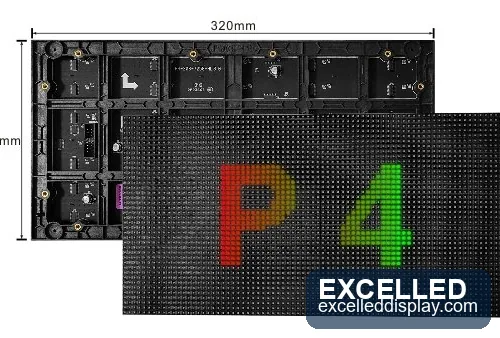
Outdoor touring is where 2.976 mm earns its keep at festival scale. The outdoor P2.976 rental LED screen runs 72S scan with 72 driver ICs on 1415 lamp beads — the brighter, sturdier lamp family used across the factory’s outdoor rack — so open-air main stages hold their image under daylight, stage wash and afternoon haze.
Weather exposure on a tour is handled at the system level: sealed module faces and treated frames keep moisture off the drive electronics, while tails and locks stay protected in cases between shows. Outdoor panels on this platform are rigged under stage roofs or on weather-tolerant truss positions; the factory confirms the sealing class on each outdoor BOM.
Cabinet & Rigging
Rental Cabinet Engineering: Quick Locks, Cases and Flying Frames
A P2.976 rental wall lives or dies by its hardware, because the wall is dismantled and rebuilt every show. The 250×250 panel mounts into die-cast quick-lock frames with captive locks on all four sides — panels pull from the front, connect power/data tails, and lock into neighbors in seconds. Structure figures below follow standard touring practice and are confirmed on each BOM.
| Item | Standard rental build ★ | Fixed-wall equivalent |
|---|---|---|
| Unit | 250×250 mm panel + frame (confirmed) | 480×320 mm cabinet |
| Locking | 4-side quick-lock, no tools (typical) | Screw-mounted modules |
| Service | Front: pull panel, swap on site | Front or rear per design |
| Transport | Flight cases, panels face-in (typical) | Pallet + foam |
| Hang method | Truss flying frames / ground stack | Wall brackets or frame steel |
Case and spare ratios that keep tours alive
Rental houses typically order one wall plus 5–10% spare panels, a spare power supply per 10 m² and a spare receiving card per 16 panels. For outdoor fleets, add spare tails and lamp-seal spares per truck — outdoor panels wear connectors and seals before they wear lamps.
Weight and rigging planning
Because every square meter carries 16 quick-lock panels plus frame, rigging plans are drawn per wall: truss flying needs the load spread across the frame rails, and outdoor ground stacks need wind restraint even on calm days. Excel LED ships the stacking and flying drawing with each rental order so load-in crews rig the first time.
Technology
P2.976 LED Screen Quality: Scan, ICs and the Lamp Difference
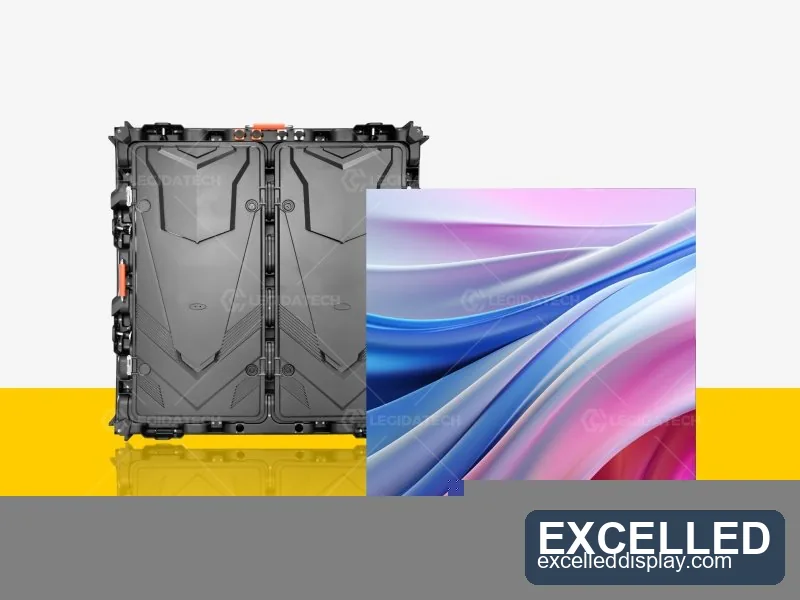
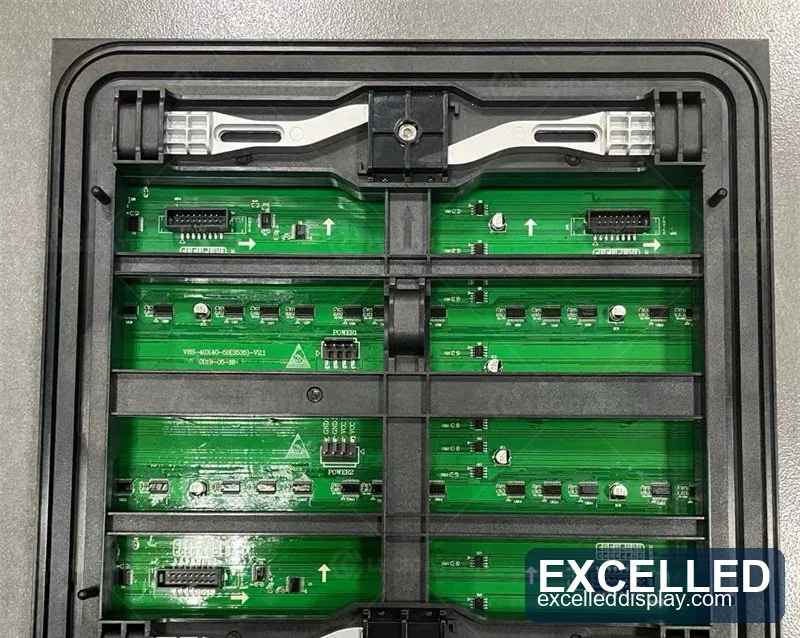
Image quality at 2.976 mm is set by three parts working together: 2020 indoor lamps or 1415 outdoor lamps, the 54S or 72S scan boards that time-share the 84 pixel rows, and 54 or 72 driver ICs per panel holding current accuracy across the board. When the lamp, scan and IC counts match the build, the wall reads cleanly from 3.5 m and photographs without scan banding.
Why the indoor P2.976 uses 2020 lamps while finer panels use 1515
At 2.976 mm the pixel cell is wide enough for a larger package, so the indoor build steps up to 2020 SMD lamps — the same lamp family the factory pairs with its fixed P4-class indoor modules. The bigger cavity carries more current per pixel with lower current density, which gives the indoor wall brightness headroom under stage wash and extra thermal margin on long shows. The finer rows of the 250 platform (P1.953, P2.604) keep 1515 packages because their pixel cells are too tight for 2020.
Why outdoor uses a different lamp at the same pitch
The 1415 package used on the outdoor build trades some black ratio for brightness and weather margin — exactly what a daylight stage needs. The 2020 package on the indoor build keeps deep contrast under stage light. This is why the same 250 platform carries two confirmed lamp rows instead of one compromise.
Scan 54S vs 72S: drive density follows the lamp load
More pixels per group means less simultaneous current per driver, so the outdoor build spreads its 84 rows across 72 groups while the indoor build uses 54. Each scan figure pairs with its IC count in the factory list — 54S/54 ICs indoor, 72S/72 ICs outdoor — and both stay smooth on camera with high-refresh receiving cards from the NovaStar control family matched to the BOM.
Repair philosophy for touring panels
Fixed walls are repaired in place; touring panels are repaired in the shop between shows. A damaged P2.976 rental module pulls from its frame at the bench, and because the lamp/scan/IC board is a self-contained unit, the workshop swaps it in minutes while the spare carries the next show.
Use Scenarios
Where the P2.976 Rental LED Display Earns Its Place
Festival and stadium stages (outdoor build)
Open-air shows need brightness the indoor build cannot deliver and rebuild speed fixed walls cannot offer. The outdoor P2.976 wall flies in truss frames, survives a festival weekend in the open, and its 2.976 mm density keeps logos, lyrics and sponsor text sharp from the front rows to the lawn — at a lower pixel budget than the finer rows of the same platform.
Indoor tours and award shows
Arena interiors, corporate roadshows and award ceremonies run the indoor 54S build: bright 2020 lamps with camera-clean scan, and the same 250 panels that pack into cases for the next city. Walls this size are usually watched from 3.5 m or more, which is exactly where 2.976 mm stops giving away sharpness.
Hybrid fleets: one panel family, two weather classes
Because both builds share footprint, locks and cases, a rental house can stage indoor events and outdoor festivals from the same inventory. The indoor and outdoor boards are factory-distinct — confirmed scan, IC and lamp rows — but the hardware platform never changes.
Conference and exhibition backdrops
Large keynote walls, expo booths and product-launch stages run the same panels for weeks, not years — rental panels give producers a reconfigurable wall without structural work, then pack away when the season ends. At 2.976 mm, an 8 m wide backdrop still holds readable 1080p-class detail without the fine-pitch invoice.
Buying Guide
How to Choose a P2.976 Rental LED Display: Indoor or Outdoor, Panels, Cases
- Decide the weather class first. Roof always → indoor 54S/2020 build. Any open-air exposure → outdoor 72S/1415 build. Mixing the two boards on one wall is possible but keep builds to separate walls for clean brightness and color.
- Size the wall in 500×500 blocks. Panels build in 2×2 blocks on the standard frame, so wall dimensions snap to 500 mm increments — plan width and height to the block grid.
- Match pitch to audience distance. P2.976 serves walls viewed from about 3.5 m. Closer viewers and camera work favor the P1.953/P2.604 end of the 250 platform; viewers beyond about 6 m can step down to the coarse outdoor rental rows and save budget.
- Check the touring spec, not the pixel spec. Lock quality, tail connectors, case packing density and frame stiffness decide how many seasons a rental fleet lasts — ask for the panel+case build sheet, not just brightness.
- Order spares with the fleet. Standard rental practice is 5–10% spare panels, spare power per 10 m² and spare receiving cards — outdoor fleets add tail and seal spares.
What drives P2.976 rental LED display price
Four levers move the quote: build class (the outdoor 72S configuration costs more per square meter than the indoor 54S), lamp and IC grade, hardware scope (cases, frames and spares are a large share of a rental order) and control density. P2.976 undercuts the finer rows of the same platform on pixels per square meter — 7,056 per panel against 9,216 on P2.604 — while keeping identical frames, cases and rigging, so the saving is real and the ecosystem unchanged.
Technical Specifications
P2.976 Rental LED Display Full Specifications
| Parameter | Specification |
|---|---|
| Product | P2.976 rental LED display — Epround-class 250 platform, indoor & outdoor builds |
| Pixel pitch | 2.976 mm (confirmed) |
| Panel size | 250×250 mm, quick-lock touring panel (confirmed) |
| Panel resolution | 84×84 = 7,056 pixels (confirmed) |
| Density | 112,896 px/m² (derived) |
| Indoor build | 54S · 54 driver ICs · 2020 SMD lamps (confirmed) |
| Outdoor build | 72S · 72 driver ICs · 1415 SMD lamps (confirmed) |
| Application | Indoor stages, conferences and exhibitions; outdoor festival and stadium stages |
| Frame | Die-cast aluminum, captive quick locks, front service (typical) |
| Build | 500×500 mm blocks on truss flying frame or ground stack (typical) |
| Control | NovaStar / Colorlight receiving cards; configurable high refresh (typical) |
| Power | Matched PSU class per panel load, surge protection (typical) |
| QC | 72-hour aging and brightness calibration before packing |
| Warranty | 2-year standard site warranty, parts & workmanship |
Values marked (confirmed) come from the factory module list; (derived) is arithmetic; (typical) marks industry-standard touring configurations confirmed per BOM.
Resolution & Viewing Distance
P2.976 LED Display: Resolution and Viewing Distance Math
Resolution on a P2.976 wall is always screen size ÷ 2.976 mm, per dimension. Each 250×250 mm panel resolves 84×84 = 7,056 pixels (confirmed), which puts the platform at 112,896 pixels per m² (derived) — enough density for camera-facing stage content at mid viewing distances, at lower per-panel cost than the 96×96 rows of the same 250 platform.
Illustrative: a 5×3 m indoor stage wall (20×12 panels of 0.25 m) resolves ≈1,680×1,008 px. A 3×3 m outdoor video column (12×12 panels) resolves 1,008×1,008 px — the numbers a rigging plan needs before it orders cases.
Viewing distance follows the pitch: the minimum comfortable distance is about 1× the pitch in meters — roughly 3 m for P2.976, which is why the build notes above quote a clean read from 3.5 m. Beyond about 7–9 m the eye stops resolving the 2.976 mm grid and a coarser pitch carries the same picture for less money — the crossover that decides indoor 54S versus outdoor 72S versus a fixed wall.
Need module counts for a specific layout? The site’s LED screen size and resolution guide walks through total pixels for common stage and wall formats.
Closing Note
P2.976 Rental LED Display — Value-Density Panels That Tour Indoors and Out
Why choose an Excel LED P2.976 rental LED display
One factory owns the whole touring unit in both weather classes: confirmed 250×250 panels with 84×84 pixels at 2.976 mm, 54S/54-IC indoor on 2020 lamps and 72S/72-IC outdoor on 1415 lamps, quick-lock aluminum frames, flight cases, matched NovaStar/Colorlight control and a 72-hour aging pass before packing. From lamp to rigging plan, one supplier carries the liability — and the same frames and cases fit the finer rows of the platform if the fleet grows.
Maintenance method for P2.976 rental LED displays
Between shows
Check locks, tails and power connectors on every panel as it comes out of the case; reseat any loose tail and re-torque quick locks. On outdoor panels, inspect lamp-face seals and connector covers before every open-air show, and wipe lamp faces with a soft dry cloth.
Component-level
Pull the failed panel from its frame at the bench, swap the module/board and fit a spare into the fleet. Keep the 5–10% panel spare ratio plus spare power and receiving cards matched to the calibration batch; store pulled panels in cases with tails protected.
Packaging of P2.976 rental LED displays
Panels ship face-in in flight cases with foam rails, 8–16 panels per case depending on frame; locks and tails are protected during travel. Excel LED ships the packing list, spare kit and rigging drawing with each order so load-in crews rebuild the wall without guesswork.
Which Module Sizes Does a P2.976 Rental LED Display Use?
This pitch is quoted in 2 module formats in our production list. All of them produce the same 112,910 px/m² wall — they differ in board size, how many fit a cabinet, drive scheme and serviceability. Pixel figures below are exact arithmetic from the pitch (1,000 ÷ 2.976 mm = 336.0 px per metre), cross-checked against the factory module list.
| Module size | Resolution & dots | Per cabinet | Boards per m² | LED & drive | Notes & service |
|---|---|---|---|---|---|
| 250×250 mm | 84×84 px 7,056 dots |
4 | 16.00 | 2020 SMD · 54 ICs · 54S scan | front service |
| 250×250 mm | 84×84 px 7,056 dots |
4 | 16.00 | 1415 SMD · 72 ICs · 72S scan | front service |
Which Cabinet Sizes Does a P2.976 Rental LED Display Ship In?
500×500 mm is the standard carrier for this pitch: 4 panels = 500×500 mm block, resolving to 168×168 — 28,224 px. Every further format below is built for a specific layout problem rather than for a better picture.
| Cabinet (W×H) | Modules inside | Resolution | Weight / body | Service access |
|---|---|---|---|---|
| 500×500 mm | 4 panels = 500×500 mm block | 168×168 28,224 px |
Die-cast aluminum quick-lock frame (typical) | Front: pull panel, swap on site |
Why 500×500 mm became the rental standard grid
Rental geometry is driven by touring, not by the building. Four cabinets make a square metre, so stage arithmetic stays mental. One cabinet size fits every pitch in the 250×250 mm module family, so a rental house stocks one chassis and swaps modules. Flight cases and rigging bars are dimensioned around it, and the same cabinet hangs on a truss or stacks on a stage lip.
Industry-standard cabinet grids for this module size (on request)
These grids are the ones the industry builds around this module size, and each one is arithmetic-clean — the modules tile with no cut strip. They are quoted on request rather than stocked, and the pixel figures are pure arithmetic from the pitch.
| Cabinet (W×H) | Modules inside | Resolution & pixels | Grid status |
|---|---|---|---|
| 500×1000 mm on request |
2 × 4 × 250×250 mm modules (2 × 4) | 168×336 56,448 px |
standard indoor rental grid |
| 1000×1000 mm on request |
4 × 4 × 250×250 mm modules (4 × 4) | 336×336 112,896 px |
standard indoor rental grid |
Which cabinet form should you pick?
- Touring stage and event walls → 500×500 mm cabinets on quick-lock frames; curved-corner and angled options available.
- Tall scenic walls and LED banners → 500×1000 mm cabinets: half the horizontal seams per metre of height.
- Screen that must be built and struck in hours → air or quick-lock frame plus flight cases, not a fixed die-cast grid.
- Mixed inventory with other pitches → keep to the 250×250 mm module family so one chassis serves several pitches.
- Permanent indoor install with no touring → a fixed cabinet is cheaper per square metre than a rental chassis.
Which Control Systems Work With a P2.976 Rental LED Display?
A P2.976 Rental LED Display is electrically ordinary: standard HUB75 module interface, conventional indoor scan, low-voltage module rails. That is why it accepts essentially every mainstream control ecosystem — the real decision is not “which system is compatible” but which family your operators already run, because sending cards and receiving cards must come from the same family.
The signal chain, end to end
- 1. Video source — media player, PC, camera or streaming decoder.
- 2. Video processor / sending card — scales, switches and packetises: HDMI / DVI / SDI in, gigabit Ethernet out.
- 3. Transport — Cat6 for normal runs, fibre where the distance or the lightning risk demands it.
- 4. Receiving card — one receiving card per cabinet is the standard loading (28,224 px per cabinet).
- 5. Modules — 4 panels = 500×500 mm block per cabinet, daisy-chained POWER IN/OUT and SIGNAL IN/OUT.
| Ecosystem | Typical hardware | Best for |
|---|---|---|
| NovaStar page-confirmed |
MRV336 receiving card · MCTRL660 controller · MCTRL4K 4K sender | Large fixed walls that need remote diagnostics and per-pixel calibration |
| Colorlight page-confirmed |
i9+ receiving card · X16 video processor | Billboard and signage budgets; sites already running Colorlight |
| Huidu factory-confirmed on this line — the asynchronous specialist |
HD-C16C async control card · VP620 video processor | Single-screen ad sites scheduled from a phone, no PC on site |
| Linsn factory-confirmed on this line — mature mapping for very large walls |
DH7512 receiving card | City-scale walls and centralised control rooms |
| Mooncell budget sending, 2-in-1 processing and player hardware we stock |
MVB20E-G 2-in-1 processor | Cost-controlled fixed installs and second-source spares |
| VDWALL video processing line we stock |
LVP605 video processor | Stadium, broadcast and multi-source control rooms |
| RGBlink switcher-processor hybrids we stock |
X2 modular video wall processor | Live production and event broadcast workflows |
How many receiving cards does a P2.976 Rental LED Display need?
Two limits decide the card count, and the smaller one wins. Pixel capacity: one 500×500 cabinet carries 28,224 px, and a mid-range card such as the MRV336 loads 256×256 = 65,536 px at 60 Hz — that is 2 cabinets per card. Port loading: the same card has 12 HUB75 outputs, and a cabinet here needs 4 module feeds, so the ports allow 3 cabinets. The binding limit is 2 cabinets per card (the pixel capacity).
- Redundancy — on revenue-critical walls add a second sending card in hot standby; a failed cabinet still does not take the wall down.
- Remote management — NovaStar and Colorlight sending platforms report cabinet temperature and voltage and support scheduled brightness by time of day.
- The one rule that saves the most money — sending card and receiving cards from the same family. Mixing families is the most common commissioning failure we get called about.
- Documentation — the port map, receiving-card loading sheet and configuration file ship with every order.
The architecture of each role — sender, processor, receiving card, async player — is compared in our LED control system collection.
FAQ
Frequently Asked Questions About P2.976 Rental LED Displays
Q1 What is a P2.976 rental LED display?
A P2.976 rental LED display is a 2.976 mm pixel pitch video wall built from 250×250 mm touring panels. Each panel carries 84×84 pixels — 7,056 per board — and comes in an indoor 54S build with 2020 lamps or an outdoor 72S build with 1415 lamps, both on quick-lock frames that pack into flight cases.
Q2 How many pixels does a P2.976 rental LED panel have?
Each 250×250 mm panel has 84×84 pixels = 7,056 pixels, which is 112,896 pixels per square meter. A 500×500 mm block of four panels carries 28,224 pixels — detail enough for most stage content at 2.976 mm pitch, at a lower pixel budget than the finer rows of the same 250 platform.
Q3 What is the difference between the indoor and outdoor P2.976 LED display builds?
Both builds share the 250×250 mm panel with 84×84 pixels. The indoor build runs 54S scan with 54 driver ICs on 2020 lamps for brightness headroom and deep contrast under stage light; the outdoor build runs 72S with 72 driver ICs on 1415 lamps for the brightness and weather margin an open-air stage needs.
Q4 Can a P2.976 LED display be used outdoors?
Yes — in its outdoor configuration. The outdoor P2.976 build uses 1415 lamp beads with 72S scan and 72 driver ICs, plus sealed module faces and treated frames for stage weather. Specify the outdoor build on the BOM; the indoor 54S build is not rated for open-air exposure.
Q5 What does 54S or 72S scan mean on a P2.976 rental LED display?
54S and 72S describe how the drive ICs time-share the panel’s pixel rows. The indoor build runs 54 scan groups through 54 driver ICs; the outdoor build spreads the same rows across 72 groups through 72 driver ICs to manage the brighter 1415 lamp load on open-air stages.
Q6 Is P2.976 the same as a P2.9 or P3 LED display?
P2.976 is an exact 2.976 mm panel on the Epround 250 rental platform; P2.9 and P3 are loose market labels that cover panels from roughly 2.9 to 3.1 mm from many factories. Specs on this page — 250×250 mm, 84×84 pixels, 54S/72S builds — are the confirmed factory numbers for this exact panel.
Q7 How much does a P2.976 rental LED display cost?
P2.976 is the value band of the mid-pitch touring range: 7,056 pixels per panel against 9,216 on P2.604 means less pixel cost per square meter, while frames, cases and rigging stay identical. The outdoor 72S build costs more than the indoor 54S build per square meter; lamp grade, hardware scope and control density set the exact BOM.
Q8 What is the best viewing distance for a P2.976 LED screen?
At 2.976 mm pitch, a sharp image needs roughly 3.5 m of viewing distance for typical stage content, with comfortable legibility much further out. The practical band is 3.5–6 m — closer viewers and camera work belong on the finer rows of the same platform.
Q9 What is the difference between P2.976 and P2.604 rental LED displays?
Both are Epround-class 250×250 mm touring panels with indoor and outdoor builds. P2.976 is one row coarser: 84×84 = 7,056 pixels per panel versus 96×96 = 9,216 on P2.604, so it costs less per square meter and suits viewing from about 3.5 m. Its indoor build also uses 2020 lamps where P2.604 uses 1515.
Q10 How long does it take to assemble a P2.976 rental LED wall?
A crew builds rental walls in hours, not days: panels lock front-side into neighbors and hang on flying frames. A typical 6×3 m wall assembles in roughly half a day with four riggers, including cabling and calibration, and comes down at the same pace after the show.
Q11 What maintenance does a P2.976 rental LED display need?
Between shows: check quick locks, data tails and power connectors as panels come out of cases, and sweep the wall at low brightness for dead rows. Outdoor panels additionally need lamp-face seal and connector-cover checks before every open-air show; store boards face-in with tails protected.
Q12 What warranty comes with a P2.976 rental LED display?
Excel LED backs P2.976 rental LED displays with a standard 2-year warranty on parts and workmanship covering lamp failures, driver ICs, power supplies and frame locks under normal touring use, plus remote diagnosis and spare dispatch support.
Get Factory-Direct Pricing for Your P2.976 Rental LED Display
Send us 4 things and receive a fleet BOM: 1. Wall size in 500 mm blocks · 2. Indoor or outdoor build · 3. Closest audience distance · 4. Case & spare ratios needed.
P2.976 Rental LED Display — Value-Density Panels for Indoor and Outdoor Tours
Excel LED (LEGIDATECH) supplies P2.976 rental LED displays factory-direct: confirmed 250×250 mm panels with 84×84 pixels at 2.976 mm — 112,896 px/m² — in an indoor 54S/54-IC/2020 build and an outdoor 72S/72-IC/1415 build, with quick-lock frames, flight cases and a 2-year warranty. When your wall needs to read from mid-court to the back row without a fine-pitch invoice, this panel family carries the value band of the 250 touring platform.
Related reading: P1.953 Rental LED Display · P2.604 Rental LED Display · Indoor Fine Pitch LED Display Hub · P2 Indoor LED Display · P2.5 LED Display · How to Identify LED Module Scan Mode