

Magnesium Alloy LED Cabinet: The Lightweight High-End Option
960×960 · 640×480 · 512×512 · 500×500 / 500×1000 mm · IP65 · P2.5-P10
Magnesium is about one-third lighter than aluminum at equal volume, and that density advantage is engineered into every magnesium alloy LED cabinet we build — down to a 28 kg 960x960mm outdoor chassis with IP65 protection — supplied by Excelled, a trusted LED display manufacturer for global B2B system integrators.

Magnesium Alloy LED Cabinet at a Glance
What it is: a cabinet chassis cast from magnesium-aluminum alloy, available in five formats — 960x960mm outdoor, 640x480mm fine pitch, 512x512mm ultra-light rental, and 500x500mm / 500x1000mm premium rental.
Confirmed benchmark: the B series 960x960mm cabinet weighs 28 kg at 120 mm deep (confirmed), with IP65 protection, 6000 nits brightness and P2.5 to P10 module support.
Why lightweight: magnesium density is about 1.8 g/cm³ versus about 2.7 g/cm³ for aluminum — roughly one-third lighter at equal volume.
Honest caveat: at 960x960mm our magnesium and die-cast aluminum cabinets both weigh 28 kg (confirmed); magnesium earns its premium through multi-function conversions and weight savings in smaller formats, not through automatic weight wins.
Next step: send your structure’s load limit and target screen size — our engineers return cabinet count, weight budget and a material recommendation.
What Is a Magnesium Alloy LED Cabinet?
A magnesium alloy LED cabinet is a display chassis whose frame and rear covers are cast from a magnesium-aluminum alloy rather than pure aluminum or sheet steel. Magnesium casts almost as well as aluminum, so the geometry rental buyers expect — quick-lock corners, module frames, handle recesses — carries over directly. The difference shows up on the scale: magnesium’s density is about 1.8 g/cm³ against about 2.7 g/cm³ for aluminum, roughly one-third lighter at equal volume (standard material reference).
Inside our range, magnesium alloy sits above die-cast aluminum on price and above iron on weight performance. It is the material we reach for when a project’s structure — an aging rooftop, a facade-attached frame, a rigging point schedule — caps the kilograms before it caps the budget. For the full picture of every material and size, browse the LED display cabinet collection.
Low Density
About 1.8 g/cm³ versus aluminum’s 2.7 g/cm³ — the physics behind every lightweight LED cabinet claim in this range.
Precision Casting
B series cabinets are CNC-machined to ±0.1 mm contour tolerance with planeness under 0.5 mm (confirmed).
Multi-Function
One cabinet platform converts between fixed billboard, rental and stadium perimeter use with add-on kits.
Outdoor Ready
The 960x960mm B series carries an IP65 rating with 6000 nits brightness (confirmed) for billboard duty.
Available Sizes: 960x960mm, 640x480mm, 512x512mm and Rental Formats
The magnesium alloy range covers the four jobs lightweight cabinets get specified for: outdoor weight-saving billboards, fine-pitch indoor walls, ultra-light rental grids and premium rental formats that share the 500mm grid. The table below lists every format with cabinets-per-square-meter math; weights appear only where our official spec sheets state them.
| Cabinet Size | Per m² | Typical Application | Weight |
|---|---|---|---|
| 960 x 960 mm | 1.08 | Outdoor billboards, weight-saving fixed installs | 28 kg (120 mm deep) (confirmed) |
| 640 x 480 mm | 3.26 | Fine pitch indoor fixed | Per configuration |
| 512 x 512 mm | 3.81 | Ultra-light rental | Per configuration |
| 500 x 500 mm | 4.00 | Premium rental | Per configuration |
| 500 x 1000 mm | 2.00 | Premium rental, wide-format stage | Per configuration |
(confirmed) figures come from the official B series specification sheet. “Per configuration” weights vary with module type and pixel pitch, so request the exact number for your build. If you are comparing materials rather than sizes, the density arithmetic above is Illustrative context — the per-cabinet figures in the next sections are the ones to quote.
The 960x960mm Magnesium Alloy Cabinet in Detail (B Series)
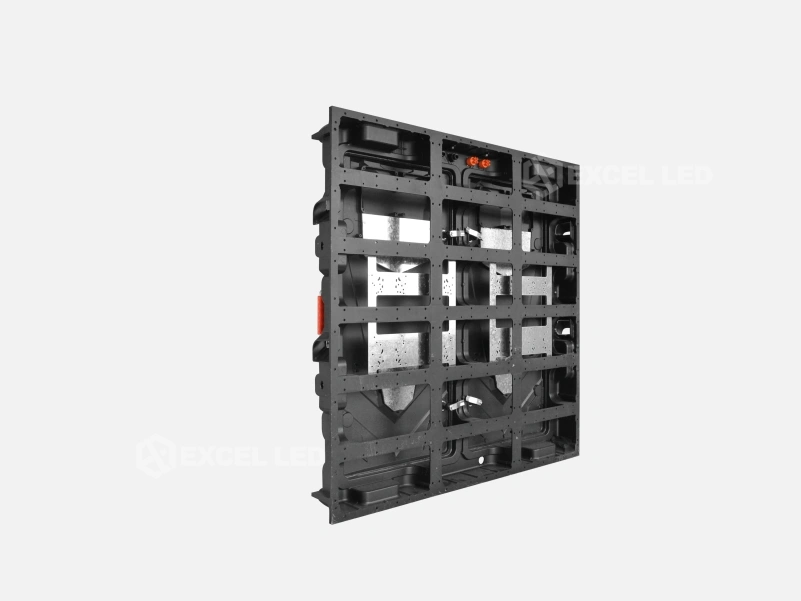
The B series is the reference chassis of our magnesium alloy range. It covers pixel pitches P2.5 through P10 on the universal 320x160mm module, and at P6.667 one cabinet carries 144 x 144 pixels (about 22,498 dots per square meter). Brightness is rated at 6000 nits with an IP65 rating and 800 W maximum / 300 W average power draw per cabinet (all confirmed).
| Parameter | Specification |
|---|---|
| Cabinet size | 960 x 960 x 120 mm (confirmed) |
| Cabinet weight | 28 kg (confirmed) |
| Material | Magnesium alloy (confirmed) |
| Pixel pitch options | P2.5 / P3 / P4 / P5 / P6 / P8 / P10 |
| P6.667 resolution | 144 x 144 px per cabinet (22,498 dots/m²) |
| Module size | 320 x 160 mm (universal) |
| Brightness / IP rating | 6000 nits / IP65 (confirmed) |
| Power (max / avg) | 800 W / 300 W per cabinet |
| Viewing angle / refresh | 140°/140° / ≥1920 Hz |
| Operating temperature | -20 to +60 °C · voltage 100-240 V |
Precision comes from the process: cabinets are integrally moulded and CNC-machined to a contour tolerance of ±0.1 mm with planeness under 0.5 mm (confirmed), which is what keeps seams invisible on close-viewing billboards. Fast locks and waterproof power and signal connectors let crews assemble walls without tools.
The same platform converts between three jobs. As standard it is a fixed billboard; add a flying bar, connectors and fast locks and it becomes a rental cabinet; add a rubber cushion and mounting bracket and it serves as a stadium perimeter display (all confirmed). See the finished product on our 960x960mm B series outdoor display page.
Magnesium vs Aluminum LED Cabinet: Where the Weight Actually Goes
Density tables say magnesium should always win, and per cubic centimeter it does. But you buy cabinets, not cubic centimeters — so the honest comparison is the confirmed per-cabinet figure. At 960x960mm, our magnesium B series weighs 28 kg at 120 mm depth and our die-cast aluminum OK series weighs 28 kg at 77 mm depth (both confirmed): the same weight, spent differently.
| Factor | Magnesium Alloy (B series) | Die-Cast Aluminum (OK series) |
|---|---|---|
| Material density | ~1.8 g/cm³ | ~2.7 g/cm³ |
| Verified 960x960mm weight | 28 kg at 120 mm deep (confirmed) | 28 kg at 77 mm deep (confirmed) |
| What the design trades | Depth (120 mm) for multi-function conversions | Depth (77 mm) for slim profile and front service |
| Corrosion handling | Surface protection and fastener isolation practice | Naturally corrosion-resistant |
| Relative cost | Highest | Mid |
| Best for | Weight-limited structures, premium multi-function fleets | Rental fleets, fine pitch, premium outdoor |
Where does magnesium’s density advantage actually land? In the smaller rental formats and in stiffness per gram — a magnesium casting can match an aluminum part’s rigidity with less material, which matters on 512x512mm and 500x500mm fleet tiles where every kilogram of rig weight compounds. For the aluminum side of this decision in depth, see our die-cast aluminum LED cabinet family page.
Iron vs Magnesium at the Same 960x960mm Footprint
Iron remains the budget route for permanent billboards, and our confirmed iron benchmarks are 22 kg at 640x960mm and 45 kg at 1280x960mm, both 95 mm deep (confirmed). The 960x960mm iron footprint sits in the same thickness band — 95 to 120 mm across our iron and magnesium designs — and its exact weight varies by design, confirmed on request.
Our B series spec sheet describes the magnesium cabinet as about 20% thinner than the equivalent iron cabinet — a manufacturer claim worth testing against your own drawings, but directionally consistent with the 95-120 mm depth band. What the spec sheet does not need to claim is the cost gap: magnesium alloy cabinets carry the highest material price in the range, and the premium buys kilograms back.
That trade pays off on rooftops, facade-attached frames and crane-limited sites where steel structure and lifting capacity are the constraint. When the screen never moves and the budget leads, iron still wins — see our iron LED cabinet family page for the cost case.
Fine Pitch and Rental Formats: 640x480mm, 512x512mm, 500x500mm / 500x1000mm
The 640x480mm magnesium alloy format targets fine-pitch indoor walls in the P1.2 to P2.5 class, where cabinet weight adds up fast on flush-mounted control-room and broadcast walls. Four cabinets stack into a 1.28 x 0.96 m block. Weight and depth are per configuration — request the figure for your pitch — and a typical fine-pitch build on this grid is shown on our P2.5 indoor LED display page.
The 512x512mm format is the ultra-light rental tile of the range: four cabinets to a square meter plus a little margin, aimed at fleets where rig load and crew count dominate. Its rear frame, corner locks and top carry handle are visible below, with the 512mm grid marked on the drawing.

The 500x500mm and 500x1000mm formats exist as premium rental alternatives on the industry-standard 500mm grid — the same geometry as our die-cast rental cabinets, including the 500x500mm rental LED screen platform. Fleets that mix the two materials keep one module, lock and handling standard; only the chassis material changes. All formats run on the same control chain as the rest of our range — see the LED control system collection for the matching sending and receiving hardware.
Safety, Corrosion and Handling of Magnesium Alloy Cabinets
Corrosion. Magnesium alloy does not rust the way steel does — there is no iron in it to form red oxide. What it does is oxidize in wet conditions and corrode galvanically where it touches dissimilar metals, so our practice is protective surface treatment, isolation of steel fasteners from the cast body, and scheduled inspection on coastal or high-humidity sites.
Fire safety. The B series operates between -20 and +60 °C (confirmed), while bulk magnesium alloys ignite several hundred degrees higher. The fire videos you may have seen involve magnesium shavings or powder — machining waste — not solid cast housings. For projects under strict fire codes, we supply material certificates on request, and we recommend filing them with your venue’s safety documentation.
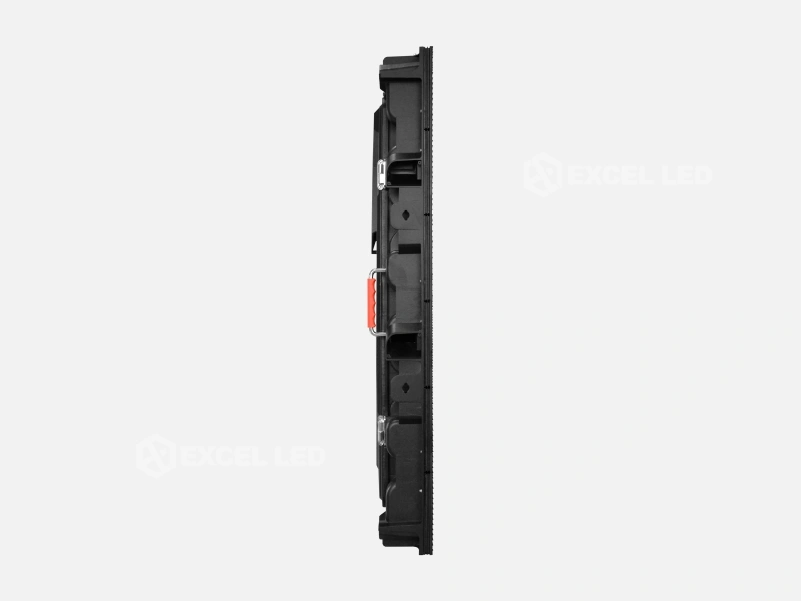
Handling. At 28 kg, the 960x960mm cabinet is a deliberate two-person lift; smaller formats scale down from there. Fast locks keep assembly tool-less, and folding and horizontal handles give crews secure grip points without reaching behind panels.

When a Magnesium Alloy LED Cabinet Is NOT the Right Choice
We would rather lose a line item than sell you the wrong chassis. Magnesium alloy is the wrong answer in three common situations:
- Tightest budget on a permanent billboard: iron delivers the same footprint at the lowest cost per square meter. The weight saving buys you nothing if the screen never moves — choose iron for cost-driven fixed installs.
- Standard rental fleets bought on price: die-cast aluminum rental cabinets already weigh 7.2-7.5 kg at 500x500mm (confirmed) and cost less than magnesium. If your rigs are not load-limited, the magnesium premium is hard to justify.
- Minimum-depth requirements: where the wall must sit closest to the structure, our die-cast aluminum OK series reaches 77 mm deep (confirmed) against the B series’ 120 mm — see the die-cast aluminum LED cabinet page for the slim-depth case.
Uncertain which side your project falls on? Send the structure data — load limits, mounting depth, rigging schedule — and we will recommend a material in writing before you commit.
Frequently Asked Questions About Magnesium Alloy LED Cabinets
Q1Does magnesium alloy rust?
Magnesium alloy does not rust the way steel does, because rust is iron oxide and magnesium contains no iron. It can corrode, though: surface oxidation appears in wet conditions, and contact with dissimilar metals drives galvanic corrosion. Our cabinets use protective surface treatments and isolate fasteners from the cast body, and we recommend periodic inspection in coastal or high-humidity sites.
Q2Can magnesium alloy be welded?
Yes, but only with specialized processes — magnesium welding needs inert gas shielding, dedicated filler rods and experienced welders. That is why our LED cabinets are not designed around welded repairs: panels and cast parts join through mechanical fast locks and bolted connections, so a damaged component is replaced instead of welded on site. For fleets, we recommend ordering spare cast parts with the original shipment.
Q3Does magnesium alloy burn?
Solid magnesium alloy components do not ignite at LED display operating temperatures. Our B series cabinet is rated for -20 to +60 degrees Celsius operation (confirmed), while bulk magnesium alloys ignite several hundred degrees higher; the fire scenarios you may have read about involve fine shavings or powder, not cast housings. For projects under strict fire codes, we provide material certificates on request.
Q4Can magnesium alloy replace aluminum in an LED cabinet?
It can, but not automatically. Magnesium makes sense when structural load limits dominate and the budget accepts a premium — for example rooftop or facade-attached walls. Aluminum remains the better choice when you need minimum depth, standard rental economics or the lowest maintenance. Compare confirmed cabinet weights and depths side by side, then decide per project.
Q5How much does a 960x960mm magnesium alloy LED cabinet weigh?
Our B series 960x960mm magnesium alloy cabinet weighs 28 kg at 120 mm depth (confirmed per the official specification sheet). Notably, our die-cast aluminum 960x960mm OK series cabinet also weighs 28 kg at a slimmer 77 mm depth — so at this footprint, choose magnesium for its multi-function conversions rather than for a lighter per-cabinet figure.
Q6What pixel pitches does the magnesium alloy cabinet support?
The B series 960x960mm cabinet covers P2.5, P3, P4, P5, P6, P8 and P10. At P6.667, one cabinet carries 144 x 144 pixels, about 22,498 dots per square meter. All pitches use the universal 320x160mm module, so module stock stays interchangeable across the range.
Q7What does IP65 mean on a magnesium alloy cabinet?
IP65 means the enclosure is fully dust-tight (first digit 6) and protected against water jets from any direction (second digit 5). The B series magnesium alloy cabinet carries an IP65 rating (confirmed), which covers outdoor billboard duty in rain and dust. Check seals and gaskets during scheduled maintenance to keep the rating effective over the years.
Q8Is the 512x512mm magnesium alloy cabinet available?
Yes. The 512x512mm format is part of our range, positioned as an ultra-light rental cabinet where every kilogram of rig weight counts. Final weight and specification depend on the module and pitch configuration, so request the confirmed figure for your setup when you ask for a quote.
Q9Can one cabinet switch between fixed, rental and perimeter use?
Yes — that is the core of the B series multi-function design. The 960x960mm magnesium alloy cabinet works as a fixed billboard as standard; add a flying bar, connectors and fast locks and it becomes a rental cabinet; add a rubber cushion and bracket and it serves as a stadium perimeter display, all confirmed in our specification sheet.
Q10How many magnesium alloy cabinets do I need per square meter?
Divide one square meter by the cabinet area: 960x960mm gives about 1.08 per square meter, 640x480mm about 3.26, 512x512mm about 3.81, 500x500mm exactly 4, and 500x1000mm exactly 2. Multiply your screen area by the figure and round to a whole tile grid — or send us the target size and we will return the exact array.
Q11Can I order custom magnesium alloy cabinet sizes?
Yes, within the module grid. Because the range uses universal 320x160mm modules, custom wall dimensions are calculated from whole modules; formats such as 500x500mm and 500x1000mm already exist for premium rental builds. Custom sizes cost more and take longer than standard formats, so send us your drawing and we will confirm the closest efficient grid.
Q12How are magnesium alloy cabinets packed and shipped?
Fixed-installation cabinets ship in individual cartons on pallets; rental fleets ship in wheeled flight cases. Cabinet weight drives freight cost, and magnesium’s low density helps here — but confirm the per-configuration weight of your chosen size before budgeting freight. We can quote door-to-door delivery for many destination countries.
Magnesium Alloy LED Cabinets, Summarized
The magnesium alloy LED cabinet range gives weight-limited projects a premium path: a 28 kg 960x960mm outdoor chassis (confirmed) with IP65, P2.5-P10 flexibility and three-job multi-function conversions, plus fine-pitch and ultra-light rental formats on the same module standard. Check the confirmed weights against your structure, shortlist a format, and our engineers will confirm the rest.
Related reading: LED Display Cabinet Collection · 960x960mm B Series Outdoor Display · Modular LED Display System Guide · LED Control System Collection