

Iron LED Cabinet: The Cost-Effective Outdoor Fixed Installation Standard
960×960 · 1024×1024 · 1280×960 · 640×960 · 800×900 mm Cabinet Range
Sheet-steel chassis, double rear doors, the lowest cabinet cost per square meter — the iron LED cabinet is how billboards, advertising walls and stadium fences get built on a budget. Supplied by Excelled, a trusted LED display manufacturer for global B2B system integrators.

Iron LED Cabinet Quick Answer
Standard iron cabinet sizes: 960x960mm and 1024x1024mm for outdoor fixed walls, 1280x960mm for large-format billboards, 640x960mm for compact billboard sites, and 800x900mm for stadium perimeter fencing.
Confirmed weights: our B10 PRO DIP iron cabinets weigh 22 kg at 640x960x95 mm and 45 kg at 1280x960x95 mm (confirmed). The 960x960mm iron cabinet varies by design — we confirm the exact figure per project.
Protection and service: IP65 front / IP55 rear on the DIP billboard series, fully sealed modules, rear service through one-side or double access doors.
Cost position: the lowest cabinet cost per square meter of the four materials; the trade-off is higher weight than aluminum at the same footprint.
Next step: send your screen size, viewing distance and site conditions — our engineers return the cabinet grid, total weight and factory-direct pricing.
What Is an Iron LED Cabinet?
An iron LED cabinet is a display chassis fabricated from sheet steel — cut, bent, welded and powder coated — rather than cast in a mold like a die-cast aluminum LED cabinet. The fabrication route is the root of almost everything else: it keeps tooling cost out of the price, allows thick-gauge reinforcement anywhere the design needs it, and makes features such as double rear maintenance doors cheap to add.
The trade-offs are equally structural. Steel weighs more than aluminum at the same footprint, and bare steel corrodes, so the coating system does real work in outdoor service (more on that below). What you buy with those trade-offs is budget headroom: for a screen that gets installed once and runs for years in one place, iron is commonly the most economical cabinet choice.
Cabinets are one layer of the build. How modules, cabinets and configuration fit together is explained step by step in our modular LED display system guide, and the full material landscape is mapped in the LED display cabinet collection.
Iron LED Cabinet Sizes: 960x960mm, 1024x1024mm and Beyond
Excel LED produces iron cabinets in five standard footprints. Weights below are stated from our official specification sheets where confirmed; the remaining sizes are quoted per configuration because module layout and steel gauge change the figure.
| Cabinet Size | Per m² | Typical Application | Weight |
|---|---|---|---|
| 960 x 960 mm | 1.08 | Outdoor fixed, billboards, advertising walls | Varies by design — confirmed per project |
| 1024 x 1024 mm | 0.95 | Outdoor fixed, large advertising walls | Per configuration |
| 1280 x 960 mm | 0.81 | Large-format billboard | 45 kg at 95 mm deep (confirmed, B10 PRO) |
| 640 x 960 mm | 1.63 | Outdoor fixed, compact billboard sites | 22 kg at 95 mm deep (confirmed, B10 PRO) |
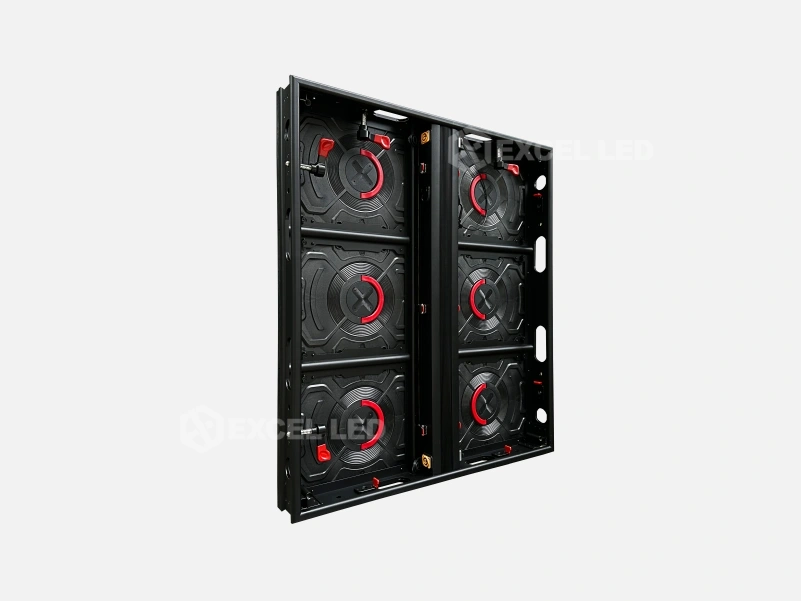
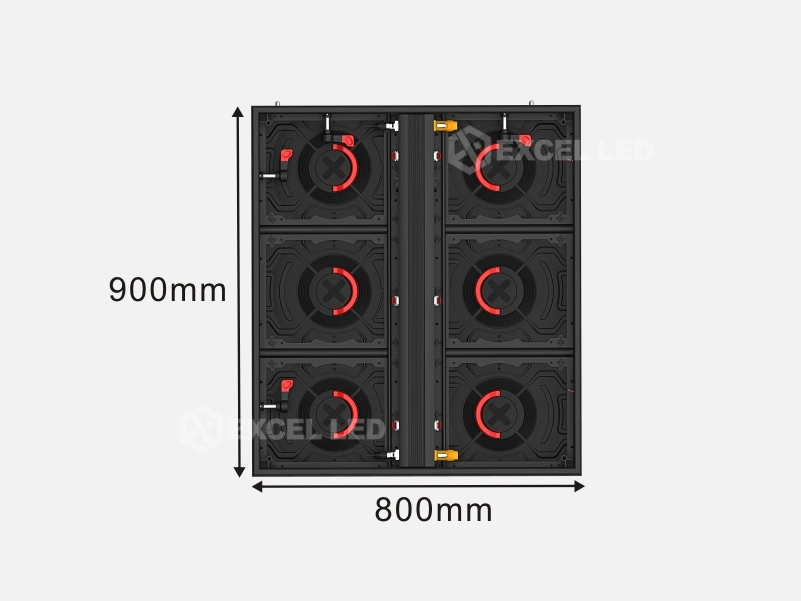
| 800 x 900 mm | 1.39 | Stadium perimeter fencing | Per configuration |
(confirmed) values come from the B10 PRO series specification sheet, the DIP billboard line built on these two iron footprints. For the 960x960mm and 1024x1024mm sizes we confirm weight, depth and pitch options against your module selection before order — ask during quoting so your structural calculations use the right number.
960x960mm Iron Cabinet: The Outdoor Billboard Workhorse
The 960x960mm grid is the billboard industry’s default for a practical reason: one tile covers about 0.92 m², so a 3.84 x 2.88 m advertising wall takes just twelve cabinets, twelve data runs and twelve power drops. Fewer joints also mean fewer potential water paths — on an iron cabinet, every seam is a place the coating and gasket system has to hold.
Our 960x960mm iron design follows the pattern the photos show: a double rear door layout that opens the full power and data compartment, with cooling fans and wiring looms serviceable from ground level or a walk-in corridor. Service direction is rear, which keeps the front face clean and the cost down — the trade is that the installation needs clearance behind the wall.

Finished screens on this footprint exist in all three castable materials in our range: compare the 960x960mm B series outdoor display or the 960x960mm energy-saving A960 outdoor display before deciding — pitch options and module selection on the iron version are confirmed per project.
640x960mm and 1280x960mm: The B10 PRO DIP Billboard Format
The B10 PRO series is our reference design for high-brightness DIP billboards on iron cabinets, and it is where this material’s numbers are officially on the table. Two footprints share one chassis design: 640 x 960 x 95 mm at 22 kg and 1280 x 960 x 95 mm at 45 kg (both confirmed), running P10.667 DIP lamps — roughly 8,790 dots per square meter — at 8000+ nits.
DIP is the right lamp technology at this pitch class: the through-hole LED package handles sunlight load and dissipates heat well, and our B10 PRO build pairs it with a 4-layer PCB and self-encapsulated lamps rated for a 100,000-hour lifetime (confirmed). Power draw is specified at 440 W/m² maximum and 130 W/m² average, with IP65 front / IP55 rear protection and fully sealed modules for humid sites (confirmed).


Two structural details matter for the crew that maintains the screen. Rear service comes through an ultra-narrow one-side door (confirmed) — narrower than a conventional billboard door, so the wall sits closer to its steel frame while technicians still reach every power box. And because 640x960mm and 1280x960mm share the same module grid, spare cabinets cover both sizes in a mixed-wall installation.
DIP walls are also the easiest walls to control: 8,790 dots per square meter keeps pixel counts low, so one mid-range controller drives a large billboard. Match the wall to a sending unit from our LED control system collection — we size the controller against the exact cabinet count.
800x900mm Iron Cabinets for Stadium Perimeter Fencing
Perimeter fencing is its own engineering problem: the screen runs in long, low strips around the pitch, takes ball impact, and gets installed on fence rails rather than a building facade. The 800x900mm iron cabinet is dimensioned for that duty — one tile covers 0.72 m², and a 24-meter touchline run takes 30 cabinets in a row (Illustrative arithmetic).
Fencing screens prioritize a protected face and serviceable rear: module surfaces are specified with the project (soft masked faces are quoted per application), while the steel chassis provides the stiffness that keeps a low-mounted, publicly reachable screen true over a season. Our ST960 stadium LED display page shows the complete perimeter package, including the padding and assembly options around the cabinet.
Why Iron LED Cabinets Still Win on Cost
Iron survives in the LED market for one dominant reason: per square meter of finished screen, nothing else gets to a working outdoor wall for less. The saving comes from four compounding places:
Cheaper Raw Material
Steel coil costs a fraction of aluminum ingot per kilo. On a 45 kg cabinet, the material line item alone moves the price meaningfully.
Simple Fabrication
Bending and welding sheet needs no casting molds and no die maintenance — low tooling cost, fast design changes, easy small batches.
Simple Rear Service
Steel doors, hinges and latches are commodity hardware. Rear access costs far less to build than front-service mechanisms.
Rigid at Large Formats
Sheet gauge can be added exactly where needed, so large spans such as 1280x960mm hold flatness without exotic engineering.
Iron vs Die-Cast Aluminum vs Magnesium Alloy LED Cabinet
All three materials build outdoor cabinets at Excel LED; they are not interchangeable. The table compares them on the rows that actually decide projects, using verified figures where our spec sheets state them:
| Factor | Iron | Die-Cast Aluminum | Magnesium Alloy |
|---|---|---|---|
| Verified weight benchmark | 22 kg (640×960) / 45 kg (1280×960), 95 mm deep (confirmed) | 28 kg at 960×960, 77 mm deep (confirmed) | 28 kg at 960×960, 120 mm deep (confirmed) |
| Corrosion behavior | Depends on coating — needs protection | Naturally corrosion-resistant | Needs surface protection |
| Seam precision | Moderate (sheet fabrication) | High (precision casting) | High |
| Service access | Rear doors / walk-in corridor | Front or rear per series | Per series |
| Relative cabinet cost | Lowest | Mid | Highest |
| Weight vs aluminum at same footprint | Heavier | Baseline | Comparable to aluminum |
| Best for | Budget billboards, fixed advertising, fencing | Rental fleets, fine pitch, premium outdoor | Weight-critical structures, premium rental |
Full specifications live on the family pages: the die-cast aluminum LED cabinet range covers rental and fine-pitch formats, while the magnesium alloy LED cabinet range covers weight-critical builds. For a screen that never moves and a budget that does, iron stays the rational default.
Corrosion Protection and Outdoor Lifespan of Iron LED Cabinets
Bare steel and outdoor service do not mix, so on a well-built iron LED cabinet the coating system is part of the engineering, not an afterthought. Cabinet bodies are powder coated or painted over pre-treated steel; cut edges, door frames and mounting points get the same attention, because coating breaks start at edges. A fully sealed module design (confirmed on the B10 PRO) keeps the weather-sensitive side of the display out of the equation entirely.
Protection ratings tell you where the water stops. IP65 on the front face means dust-tight and protected against water jets from any direction; IP55 on the rear means the compartment behind the wall tolerates dust and low-pressure water from any direction — one grade below, which is the normal design point for a ventilated rear compartment that also has to shed service heat.

Our engineering practice for long-life iron installations: inspect the coating and door gaskets at annual maintenance, touch up scratches before rust starts, and keep drainage paths around the structure clear. For installation structure and loads, hand the final cabinet weights and wall area to your structural engineer — AVIXA published standards are a useful reference for display installation practice. Complete outdoor fixed screens built this way — cabinet, modules, steel structure, control — are documented by our sister factory as the LEGIDATECH Official Website.
When an Iron LED Cabinet Is NOT the Right Choice
We sell iron cabinets, and there are projects we steer away from them. Saying no early is cheaper for everyone:
- Touring and rental fleets. Weekly handling punishes weight. A 45 kg cabinet needs two hands or a rigging point where a 7.2 kg die-cast rental cabinet needs one pair of hands — over hundreds of builds, that difference becomes labor cost and damaged corners. Rental fleets belong on die-cast aluminum.
- Coastal and high-salt environments. Aluminum passivates naturally; steel relies on its coating. On a seafront facade where a scratched panel is hard to reach for touch-up, the aluminum cabinet pays back its higher price in avoided maintenance.
- Fine-pitch indoor walls. At P1.2 to P2.5, seams and weight both matter more than cost, and slim die-cast formats such as 480x320mm or 640x480mm exist precisely for that job.
- Weight-limited structures. When the supporting structure is already at its limit — rooftop trusses, aging facades — specify magnesium alloy or die-cast aluminum and put the budget into engineering instead.
If none of these apply — the screen is fixed, the budget is real, and the site is ordinary outdoor — iron is usually the correct answer, and we will say so in the quote.
Frequently Asked Questions About Iron LED Cabinets
Q1How much does a 960x960mm iron LED cabinet weigh?
It varies by design — module layout, steel gauge and IP treatment all move the figure, so we confirm the exact weight per project. For reference points from our official spec sheets: the B10 PRO iron cabinet weighs 22 kg at 640x960x95 mm and 45 kg at 1280x960x95 mm (confirmed). Ask for the 960x960mm figure with your pitch selection.
Q2Does an iron LED cabinet rust?
Bare steel corrodes, so an iron LED cabinet relies on its powder-coated or painted finish plus sealed module design for outdoor protection. With the coating intact, door gaskets maintained and scratches touched up during annual inspection, iron cabinets serve for many years outdoors — that maintenance discipline is the honest condition of the low price.
Q3Iron vs aluminum LED cabinet: which should I choose?
Choose iron for permanently installed screens where budget leads — it is the lowest-cost cabinet per square meter. Choose die-cast aluminum when cabinets are handled often, when corrosion resistance matters more than price, or when seam precision is critical, as in rental fleets and fine-pitch walls. Mixed projects can also combine both by zone.
Q4What is DIP P10.667 and when should I use it?
DIP P10.667 means the display uses through-hole DIP lamps on a 10.667 mm pixel pitch, about 8,790 dots per square meter. It is the classic long-distance billboard format: 8000+ nits brightness beats sunlight, DIP lamps dissipate heat well, and lamp lifetime is rated at 100,000 hours. Best for viewers tens of meters away — not for close-range walls.
Q5What do IP65 and IP55 mean on an iron LED cabinet?
IP65 (front face) means dust-tight and protected against water jets from any direction. IP55 (rear compartment) means dust-protected and protected against low-pressure water jets. On our B10 PRO iron cabinet this split is the confirmed design point: display face fully sealed, ventilated rear compartment still weather-protected.
Q6How are iron LED cabinets maintained?
Rear service is the norm: open the access doors and every power supply, receiving card and module wiring loom is reachable without removing the screen face. Maintenance practice is an annual coating and gasket inspection, touch-up of any paint damage, fan and filter cleaning, and cable checks. Rear service needs clearance behind the wall — plan the corridor into the structure.
Q7How many iron LED cabinets do I need per square meter?
Divide one square meter by the cabinet area: 960x960mm gives about 1.08 per m², 1024x1024mm about 0.95, 1280x960mm about 0.81, 640x960mm about 1.63, and 800x900mm about 1.39. Multiply your wall area by the figure, then round to a whole tile grid — the final screen size follows the grid, not the other way round.
Q8Can I order custom iron cabinet sizes?
Yes, within module geometry — custom widths or heights are quoted against the module grid your pitch requires. Sheet-steel fabrication adapts to size changes more easily than casting, which is one of iron’s quieter advantages. For slim signage depths of 40-80 mm, though, extruded aluminum profile frames are the better route than any cast or folded cabinet.
Q9How are iron LED cabinets packed and shipped?
Fixed-installation iron cabinets ship in individual cartons on pallets; larger billboard orders are packed per installation sequence on request. Iron weighs more than aluminum per wall, so freight is a bigger line item — we quote both EXW and DDP terms for many destination countries so the landed cost is visible before you order.
Q10What structure does an iron LED cabinet screen need?
A steel support frame engineered for the total wall weight, wind load for the site’s exposure, and rear maintenance clearance. As an Illustrative example: twelve 1280x960mm cabinets add 540 kg of cabinet weight alone before structure and modules’ share. Pass the confirmed cabinet weights and wall area to your structural engineer for the final frame design.
Q11What is the lead time for iron LED cabinets?
It depends on pitch mix, order volume and the season, so we confirm lead time per order rather than quoting a blanket number. One structural advantage helps: sheet-steel fabrication needs no casting molds, so standard-size iron runs avoid the tooling queue that large custom die-cast orders can face. Confirm the schedule with our team when you request the quote.
Q12Are iron cabinets suitable for stadium perimeter fencing?
Yes — the 800x900mm stadium series is dimensioned for fence-rail mounting in long, low runs, and the steel chassis gives a publicly reachable screen the stiffness to stay true over a season. Face protection options are specified per application. Ask us for the perimeter package including padding and assembly accessories.
Iron LED Cabinets, Summarized
Iron is the rational choice when the screen never moves and the budget leads: five standard footprints from 640x960mm to 1280x960mm, confirmed DIP billboard weights of 22 kg and 45 kg, and rear-service doors that keep lifetime maintenance simple. Excel LED manufactures the cabinet, assembles the modules and configures the control system as one matched system.
Related reading: LED Display Cabinet Collection · ST960 Stadium LED Display · Magnesium Alloy LED Cabinet · 960x960mm A960 Outdoor Display · 960x960mm B Series Outdoor Display · Modular LED Display System Guide