
Selecting the right visual technology for a professional environment has become one of the most significant capital investments for modern enterprises. As we move into 2026, the debate over indoor LED display vs LCD video wall has shifted from basic “brightness” talk to deep discussions about long-term ROI, visual health, and integration stability.
At Excel LED (LEGIDATECH), we’ve seen hundreds of clients struggle with this decision. Whether you are outfitting a high-end corporate lobby or a mission-critical [Control Room LED Video Wall], the choice you make today will impact your operational efficiency for the next decade. This guide moves beyond the surface-level marketing to help you make a data-driven decision at https://ledscreenfactory.com/.
If your comparison is on the cinema side instead — whether a premium ticket is worth it — our 3D vs IMAX breakdown explains the same decision logic for movie formats.
H2-1: Indoor LED Display vs LCD Video Wall: What Buyers Really Care About in 2026
In the current market, buyers are no longer satisfied with “just a big screen.” They are looking for Seamless Display performance and technology that doesn’t become obsolete in three years. While a samsung lcd video wall might seem like a safe, familiar bet, the rising demand for [Fine Pitch LED] technology (P1.2 to P1.8) is proving that the gap in clarity is closing fast.
Today’s buyers care about “visual comfort” (eye strain), “camera-readiness” (for hybrid meetings), and “scalability.” The indoor led screen display has moved from being a luxury item to a standard [Conference Room LED Screen] solution, primarily because it offers a bezel-free experience that LCD simply cannot replicate.

H2-2: Key Differences Between Indoor LED Walls and LCD Video Walls (Quick Comparison Table)
To help you visualize the led vs lcd video wall landscape, we have prepared this authoritative comparison table based on the latest 2026 industry standards.
Table 1: Technical Showdown – LED vs. LCD
|
Feature |
Indoor LED Display (Fine Pitch) |
Professional LCD Video Wall |
|
Bezel Gaps |
Truly Seamless (0.0mm) |
Visible Bezels (0.88mm – 3.5mm) |
|
Brightness |
600 – 1500+ nits (High) |
4500 – 700 nits (Low/Medium) |
|
Lifespan |
100,000 Hours (Grade A) |
50,000 Hours (Standard) |
|
Repairability |
Module-level (Low Cost) |
Whole Panel (High Cost) |
|
Color Uniformity |
Excellent (Pixel Calibration) |
Moderate (Edge bleeding over time) |
|
Refresh Rate |
Up to 3840Hz+ |
Fixed 60Hz |
H2-3: Total Cost of Ownership (TCO): indoor led video wall vs LCD Over 5 Years
This is the biggest content gap in most [Indoor LED Display Price Guide] articles. Buyers often only look at the initial indoor led display price per square meter, but the maintenance cost of lcd video wall vs led tells a different story over a 5-year cycle.
- Initial Purchase: LCD is generally 30-50% cheaper upfront for 1080p resolutions. However, for a [P1.5 Indoor LED Display], the price gap has narrowed significantly in 2026.
- Maintenance Costs: If one pixel dies on an LCD, you must replace the entire 55-inch panel, which is expensive and often leads to color mismatch with older panels. With an indoor led video wall, you only replace a small, low-cost module.
- Electricity (The Hidden Bill): Modern indoor signage screens from Excel LED (LEGIDATECH) use Common Cathode technology, which reduces power consumption by 30%. While LCDs are efficient, the heat generated by large LCD arrays often requires additional HVAC cooling costs.
- Replacement Cycle: An LCD wall usually requires a full refresh after 4-5 years as the backlights dim and colors shift unevenly. A high-quality [Indoor Fixed LED Display] easily lasts 8-10 years.
H2-4: Brightness & Ambient Light Performance: Why LCD Fails in Bright Rooms
In the brightness led vs lcd video wall battle, the winner is clear. A professional led display indoor unit typically starts at 800 nits and can go up to 1500 nits. In contrast, even a “high-brightness” LCD usually caps at 700 nits.
Why does this matter? Most modern [Retail Store LED Display] setups and offices have large glass windows. Direct or even ambient sunlight “washes out” LCD images, making them look gray and dull. Because the indoor led screen display is self-emissive, it “punches” through the ambient light, maintaining high contrast and vibrant colors even at high noon.
H2-5: Seamless Display vs Bezel Gaps: Visual Impact Comparison
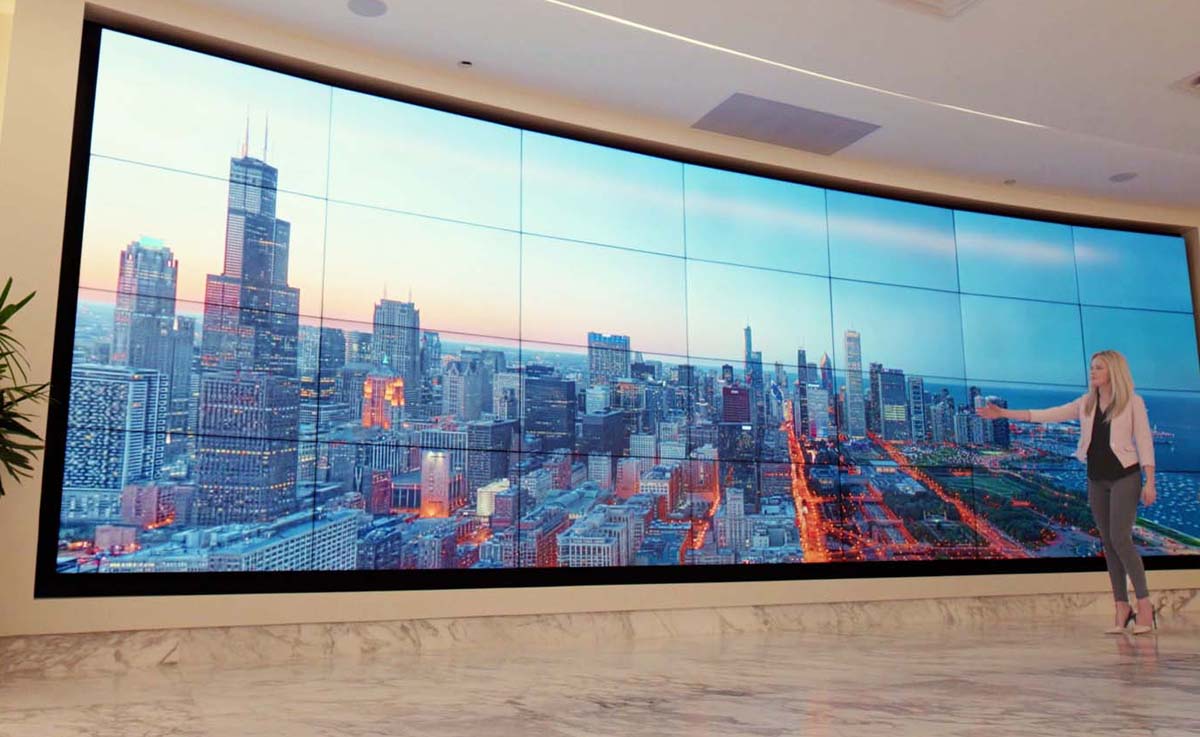
The “Bezel” is the black line between panels. In a seamless lcd video wall vs led comparison, “seamless” LCD is actually a marketing myth—there is always a 0.88mm to 3.5mm gap.
When viewing data on a [Control Room LED Video Wall], these bezels can cut through critical information like numbers or fine lines on a map. An indoor led display wall is truly seamless. The modules are calibrated to fit perfectly, creating a single, continuous digital canvas. For premium brands, the “bezel-free” look is essential for maintaining an upscale [Retail Store LED Display] aesthetic.
H2-6: Moiré Effect in Video Conferencing:Indoor LED Display vs LCD on Camera
This is a “killer pain point” for the hybrid work era. The moire effect led vs lcd performance is a critical factor for any [Conference Room LED Screen].
LCD panels have a glossy or semi-glossy finish that reflects room lights like a mirror, which looks terrible on a Zoom or Teams call. More importantly, the fixed 60Hz refresh rate of LCDs often clashes with camera shutter speeds.
By choosing an indoor led display with a 3840Hz [LED Display Refresh Rate Explained], you eliminate flickering and the moiré effect (wavy rainbow lines) on camera. This ensures your executive presentations look professional for both in-person and remote audiences.

H2-7: Control System Complexity: LED Controllers vs HDMI Matrix
Understanding the led display controller vs lcd video wall system is vital for your IT department.
- LCD Walls: Require a complex HDMI matrix, splitters, and signal distributors to “stretch” a 4K image across multiple monitors. Each connection is a potential failure point.
- LED Walls: Utilize a centralized controller like NovaStar, Linsn , or Colorlight
At Excel LED (LEGIDATECH), we provide pre-configured RCFG files for these controllers, ensuring that signal mapping is handled by a single “brain.” This simplifies the user experience and allows for much higher resolution management (up to 8K and beyond) with far fewer cables.
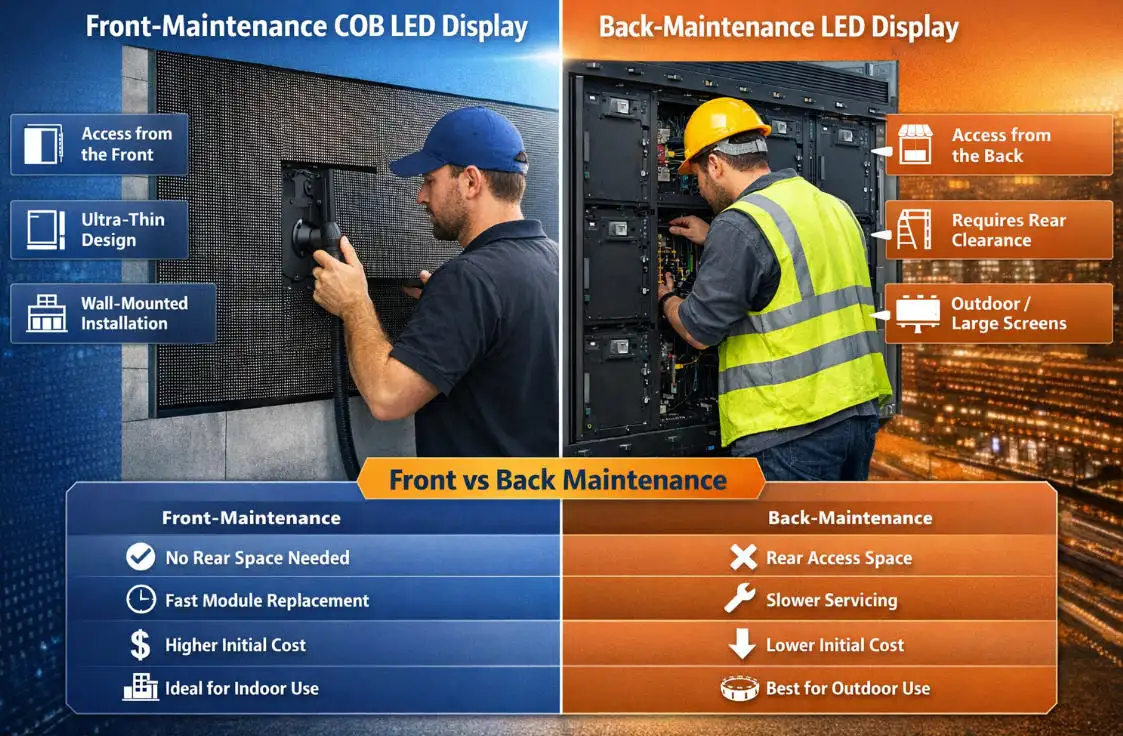
H2-8: Installation & Maintenance: Front Service LED vs LCD Wall Mount
The front maintenance led vs lcd video wall factor determines your room design.
- LCD: Most LCD mounts require the wall to be “pushed out” or leave a gap behind the screen for technicians to access cables. This wastes valuable office square footage.
- LED: Our [Indoor Fixed LED Display] panels are designed for 100% front service. You can mount them directly onto a flat wall like a piece of art.
Using a vacuum tool, a technician can replace a module in 30 seconds. This design also helps to Avoid LED bead damage because the modules are only handled during the final stage of installation. Check our [Indoor LED Display Installation Guide] for detailed structure requirements.
H2-9: Resolution & Pixel Pitch: When LED Matches LCD Clarity
Historically, LCD won on resolution. But with the rise of ultra fine pitch LED, that advantage is gone.
- P1.2 / P1.5: These pitches allow a 165-inch indoor led display to achieve native 4K resolution.
- [Fine Pitch LED] (P0.9): Can match the clarity of an LCD even at very close range.
If you are using the screen for a [Conference Room LED Screen] where people stand 2 meters away, a [P1.8 Indoor LED Display] is usually the perfect balance of clarity and price. Use our guide on [How to Choose Indoor LED Display Pixel Pitch] to find your specific “visual sweet spot.”
H2-10: Best Use Cases: When to Choose indoor signage screens vs LCD
Choosing led vs lcd video wall for conference room or other venues depends on the priority of the project:
- [Conference Room LED Screen]: Choose LED if you do frequent video calls and need a “wow” factor for clients.
- [Retail Store LED Display]: Choose LED for high-brightness windows and seamless branding.
- [Control Room LED Video Wall]: Choose LED for 24/7 reliability and bezel-free data visualization.
- Broadcast Studio: Choose LED for high refresh rates and perfect [LED Display Grayscale Explained] under studio lights.
- Budget Education Rooms: LCD might still be a viable option for simple, low-cost static displays in classrooms.
H2-11: Indoor LED Display vs LCD: Which One Should You Choose?
So, how to choose between led and lcd video wall? At Excel LED (LEGIDATECH), we recommend this decision tree:
- Choose LED if: You want a seamless look, your room has windows, you film your presentations, or you want the lowest 5-year maintenance cost.
- Choose LCD if: Your budget is extremely tight, you only need the screen for 2-3 years, and you don’t mind the black lines (bezels) between panels.
If you are leaning toward LED, we suggest starting with our [Indoor LED Display Manufacturer Guide] to understand how to vet quality suppliers who use gold-wire SMD and high-end driver ICs.
H2-12: FAQ: Indoor LED Display vs LCD Video Wall
1. What is the difference between LED and LCD video wall?
LED video walls are made of thousands of tiny self-emitting light diodes (SMD or COB), creating a seamless image. LCD video walls are made of several liquid crystal display monitors (like a TV) tiled together, resulting in visible bezel gaps.
2. Is LED better than LCD for conference rooms?
Yes, in 2026, LED is considered superior for premium conference rooms because it offers a bezel-free display, better camera performance (no moiré effect), and much higher brightness.
3. How much does an indoor LED display cost per square meter?
Prices vary based on pixel pitch. A high-quality indoor led display price per square meter can range from  3,000+ for ultra-fine P1.2. Consult our [Indoor LED Display Price Guide] for current rates.
4. What is the lifespan of LED vs LCD video wall?
LED walls typically last 100,000 hours (10+ years), while professional LCD panels usually have a backlight life of 50,000 hours (5 years).
5. Does LCD video wall have bezels?
Yes. Even “extreme narrow bezel” LCDs still have a visible black line between the screens, usually ranging from 0.88mm to 3.5mm total.
6. What is moiré effect in LED display?
It is a visual interference pattern that appears as wavy lines when a camera films an LED screen. This is solved by using a high [LED Display Refresh Rate Explained] of 3840Hz.
7. Which is more energy efficient: LED or LCD?
For the same brightness, LED is more energy-efficient. Using Excel LED (LEGIDATECH) Common Cathode technology can further reduce energy use by 30% compared to standard LED displays.
8. Can I maintain an LED wall from the front?
Yes. Most modern indoor signage screens use magnetic modules, allowing for 100% front maintenance, which is much easier than removing a large LCD panel from a wall mount.
In-Depth Content Overview
- [P1.5 Indoor LED Display] – High-density solutions.
- [P2 Indoor LED Display] – The balanced choice for retail.
- [COB vs SMD indoor LED Display] – Understanding durability.


