

Aluminum Profile LED Display Cabinet: Slim Frames, Double-Sided Walls & Custom Sizes
Slim 40/60/80 mm Frames · Double-Sided · 1000×1000 · 960×960 · 500×500 / 500×1000 · PS Long-Strip
Not every screen is a tiled cabinet wall. An aluminum profile LED display mounts standard LED modules inside extruded frame lines — reaching slim depths, double-sided faces and custom dimensions that cast cabinets cannot — supplied by Excelled, a trusted LED display manufacturer for global B2B system integrators.

Aluminum Profile LED Displays at a Glance
What it is: an LED wall built by mounting standard LED modules inside extruded aluminum frame sections — the same modules our cabinets carry, held in a slimmer, purpose-extruded chassis.
Available formats (product range): slim frames in 40, 60 and 80 mm depths, double-sided frames, 1000x1000mm, 960x960mm, 500x500mm and 500x1000mm panels, plus PS long-strip formats of 1000x250mm, 750x250mm and 500x250mm.
Why specify one: flush wall signage, pillars and corridors, window-adjacent advertising, and any custom width x height that fits the module grid.
Weight, IP rating and pitch: depend on module selection and frame design, so we quote them per configuration instead of publishing a single figure.
Next step: send your target size and mounting surface — our engineers return the format, frame depth and module layout.
What Is an Aluminum Profile LED Display Cabinet? Extrusion Construction Explained
A die-cast aluminum cabinet is a molded tile, cast in one piece and locked side by side into a wall. An aluminum profile LED display takes the other route: aluminum is extruded into frame sections, machined, and assembled around standard LED modules. Same display electronics, different structure.
Because the frame is drawn rather than cast, wall depth follows the extrusion design instead of a mold — which is how 40 and 60 mm slim LED display frames become possible, while cast cabinets in our range run from 70 to 120 mm deep (verified across our cabinet series).
Modules, receiving cards, power supplies and cabling all live inside the frame exactly as in a cabinet wall, so the difference is structural, not electronic. How modules and cabinets fit together is covered step by step in the modular LED display system guide.
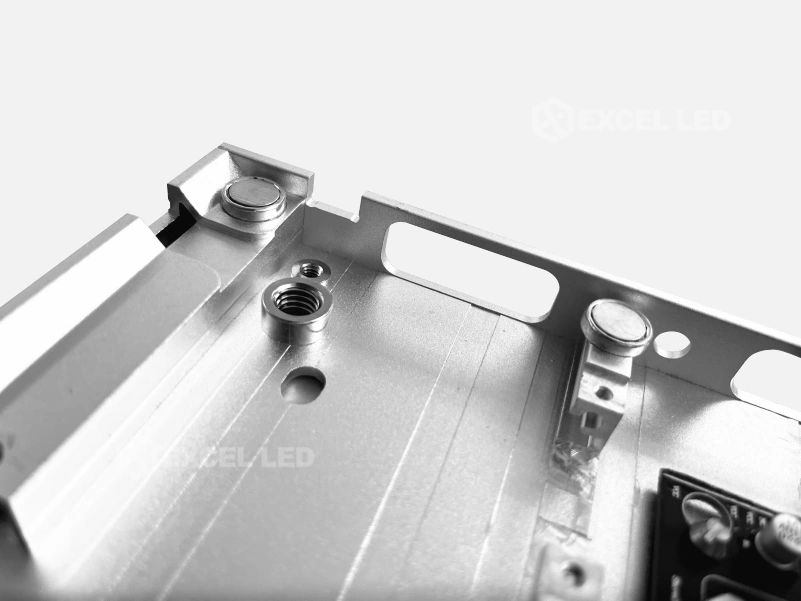
Available Aluminum Profile Formats: From 250mm-Class Strips to 1000x1000mm
The formats below come from the Excel LED product range. Every format accepts standard module sizes, so resolution follows the pixel pitch you choose, and each panel is machined to the module grid rather than trimmed to fit.
| Format | Orientation | Typical Application | Frame Depth |
|---|---|---|---|
| 500 x 250 mm | Horizontal strip (rotatable to 250 x 500 vertical) | Door-side columns, shelf-adjacent signage, letterbox bands | 40, 60 or 80 mm per project |
| 750 x 250 mm | Strip (rotatable to 250 x 750 vertical) | Mid-span bands, entrance fascia | 40, 60 or 80 mm per project |
| 1000 x 250 mm | Long strip | Storefront headers, ticker bands, corridor ceiling lines | 40, 60 or 80 mm per project |
| 500 x 500 mm | Square | Compact custom walls, kiosk faces | 40, 60 or 80 mm per project |
| 500 x 1000 mm | Wide | Storefront walls, lift-lobby panels | 40, 60 or 80 mm per project |
| 960 x 960 mm | Square | Large custom walls matching the standard cabinet footprint | 40, 60 or 80 mm per project |
| 1000 x 1000 mm | Square | Large-format signage on a metric grid | 40, 60 or 80 mm per project |
| Double-sided frame | Two display faces | Pillars, glass atriums, corridor mid-walls | Paired frames back-to-back |
As a common planning rule, larger spans call for deeper frames, and the final depth is confirmed by our engineers against your wall drawing and module layout. For the cast-cabinet side of the range — tiled rental and outdoor structures — see the full LED display cabinet collection.
Slim LED Display Frames: 40mm, 60mm and 80mm Depths
The 40 mm class is the shallowest frame we extrude, specified where the wall should nearly disappear: retail shelving edges, lift lobbies and reception backdrops where every millimeter of projection counts.
The 60 mm class is the mid-depth workhorse for corridor walls and meeting-room fascia, balancing a slim silhouette with room for cable turns behind the modules.
The 80 mm class suits wider spans and semi-sheltered positions such as canopy entrances, where module sealing and drainage are engineered per environment rather than assumed from a datasheet figure.
Double-Sided Aluminum Profile LED Displays for Pillars and Corridors
Where foot traffic passes on both sides, one double-sided LED display does the work of two walls: paired display faces share a single frame, one power run and one data line, cutting structure and installation cost against two back-to-back screens.
Typical placements include structural pillars, glass atriums and corridor mid-walls in shopping malls and exhibition halls — positions where a conventional rear-access cabinet has nowhere to breathe.
Both faces are driven through the same control chain: play identical content, split a face into zones, or schedule different content per side. Browse the LED control system collection for sending equipment and receiving cards matched to a two-face build.
PS Long-Strip Formats: 1000x250mm, 750x250mm and 500x250mm
The PS series covers the letterbox range that tile-style cabinets handle awkwardly. Strips mount horizontally as storefront headers and ticker bands, or rotate 90 degrees into vertical columns beside doors and windows.


Because strips follow the same module grid as panels, they also tile into larger surfaces. The mixes below are pure arithmetic (Illustrative examples):
| Target Area | Strip Used | Array (W x H) | Strips Needed |
|---|---|---|---|
| 2.00 x 0.50 m band | 1000 x 250 mm | 2 x 2 | 4 |
| 1.50 x 0.50 m band | 750 x 250 mm | 2 x 2 | 4 |
| 0.50 x 2.00 m column | 500 x 250 mm rotated | 1 x 4 | 4 |
| 1.00 x 1.00 m panel | 1000 x 250 mm | 1 x 4 | 4 |
The final dimension is always the strip grid multiplied by the strip size — never the other way round. Send the target area and we will return the mix that hits it with the fewest seams.
Square and Wide Formats: 1000x1000mm Down to 500x500mm
For full custom walls, square and wide profile panels build metric-grid surfaces from 500x500mm up to 1000x1000mm. Panels join on machined edges, so a wall of any module-grid size assembles without the fixed tile rhythm of a cast cabinet.
The 500x1000mm footprint also exists as a die-cast rental cabinet — same tile logic, different tool. If the wall travels show to show, the 500x1000mm rental LED display route with quick locks and flight cases wins; if it is fixed architecture, the profile route integrates with the building.
Custom width x height is quoted the same way: any multiple of the module grid. Send the drawing and we confirm the panel split, frame depth and module layout in one pass.
Front Maintenance: Why Aluminum Profile LED Walls Favor Front Service
Profile walls usually mount flush against masonry, glass or cladding, so a rear service corridor often does not exist. Front service resolves this: modules — and typically the power and receiving units — come out through the display face.

The trade-off is working space in front of the wall during service. In tight corridors, plan ladder or lift access into the maintenance schedule rather than discovering the constraint on site.
Aluminum Profile vs Die-Cast Aluminum Cabinet: Which Structure Fits?
Both structures carry the same modules and the same control chain — the choice is about how the screen meets the building. Here is how they differ in practice:
| Factor | Aluminum Profile LED Display | Die-Cast Aluminum Cabinet |
|---|---|---|
| Construction | Extruded frame assembled around modules | Cast tile locked into a wall |
| Depth range | Reaches 40-60 mm slim class | 70-120 mm across our verified cabinet series |
| Screen dimensions | Any module-grid multiple | Cabinet-grid multiples |
| Double-sided faces | Native (paired frames) | Not typical |
| Weight character | Light per area, varies with frame design | Stated per verified cabinet model |
| Typical service | Front | Front or rear per model |
| Best for | Flush signage, pillars, strips, custom architecture | Rental fleets, fine-pitch walls, outdoor fixed installs |
When an Aluminum Profile LED Display Is NOT the Right Choice
Honesty about fit saves budgets. Three situations call for a different structure:
- High-frequency touring rental. Weekly build-and-break punishes machined frames; rental fleets live on die-cast rental cabinets with quick locks and flight cases designed for the abuse.
- Large outdoor billboards. Unsheltered, full-weather walls should ride on cabinets with verified IP ratings and engineered waterproofing — see our iron LED cabinet range for the fixed-installation route.
- Fine-pitch control rooms and broadcast walls. Sub-2.5 mm walls favor precision cabinet formats with magnetic front service — the territory of our P2.5 indoor LED display class.
Frequently Asked Questions About Aluminum Profile LED Displays
Q1What is the difference between an aluminum profile LED display and a die-cast aluminum LED cabinet?
The profile display is built from extruded frame sections assembled around standard LED modules, while the die-cast cabinet is a one-piece molded tile that locks side by side into a wall. Profiles reach slimmer depths and freer dimensions; cast cabinets offer per-model verified weights and fast-lock tiling for rental and outdoor use.
Q2What frame depths are available for aluminum profile LED displays?
Our product range covers custom slim frames in 40, 60 and 80 mm depths. Depth is selected per format and project — larger spans typically call for deeper frames — and the final value is confirmed by our engineers against your wall drawing and module layout before production.
Q3Can an aluminum profile LED display be double-sided?
Yes. Paired display faces share one frame structure, one power run and one data line, which suits pillars, glass atriums and corridor mid-walls. Each face can show the same content, split into zones, or follow a separate schedule through the shared control system.
Q4Can aluminum profile LED displays be used outdoors?
They can be engineered for sheltered and semi-outdoor positions, and outdoor suitability depends on module sealing, frame drainage and the mounting environment. Because ratings vary per configuration rather than per series, send us the installation environment and we will confirm what your project requires before quoting.
Q5What screen sizes can you build with aluminum profile frames?
Any width and height that is a multiple of the chosen module grid. Standard panel formats include 500x500mm, 500x1000mm, 960x960mm and 1000x1000mm, plus 1000x250mm, 750x250mm and 500x250mm strips. Send your target dimensions and we will return the closest tile-perfect grid.
Q6Where can I buy aluminum profile LED displays?
Excel LED manufactures aluminum profile LED displays factory-direct and ships worldwide. The practical buying path: send your target size, viewing distance and environment, receive a format and frame-depth recommendation with pricing, then confirm a sample or pilot panel before volume production.
Q7Do profile LED walls use front service or rear service?
Front service is the typical choice because profile walls usually mount flush against a wall or pillar with no corridor behind. Modules and serviceable electronics are accessed through the display face. Rear service can be engineered where the installation provides access space.
Q8How do you maintain an aluminum profile LED display?
Routine care is module-level: a faulty module is released from the front and replaced without disturbing its neighbors, and ventilation paths are checked during scheduled service visits. Clean the front face without abrasives and follow the supplied service manual for torque values on frame fasteners.
Q9What control setup does a double-sided or custom profile wall need?
The same signal chain as any LED wall — sending equipment, receiving cards per panel and configuration software — sized to the total pixel load of both faces on a double-sided build. We configure the control system to match the final panel count as part of the project quote.
Q10How many LED modules fit in one square meter?
With 250x250mm-class modules, one square meter carries 16 modules regardless of frame style (Illustrative arithmetic); other module sizes change the count. The frame holds modules at a fixed grid, so resolution per square meter follows from the pixel pitch you select.
Q11Can you build curved or custom shapes with aluminum profile frames?
Custom rectangles are routine, and column wraps or simple segmented angles are engineered per project. Because each frame is machined to the drawing, irregular shapes cost more than standard grids — send the sketch early so we can confirm feasibility and budget together.
Q12How are aluminum profile LED displays packed and shipped?
Panels ship in protective cartons with foam-separated frames and modules; larger orders travel on pallets or in wooden crates. Because frames are slimmer than cast cabinets, freight volume per square meter is typically lower. Packing is quoted per destination port and can include DDP terms.
Aluminum Profile LED Displays, Summarized
Extruded frames answer the brief cast cabinets cannot: near-flush walls, double-sided pillars, letterbox strips and any module-grid dimension. Define the surface, confirm the depth, and Excel LED extrudes, assembles and configures the wall as one matched system.
Related reading: LED Display Cabinet Collection · Modular LED Display System Guide · 500x1000mm Rental LED Display · P2.5 Indoor LED Display