
In the high-stakes environment of a global trade show, you have approximately 3 seconds to capture a visitor’s attention before they walk past your booth. Traditional pull-up banners and static posters are no longer enough to compete in a crowded exhibition hall. This is why the trade show rental LED display has become the ultimate “visual magnet” for brands looking to stand out, tell their story, and maximize booth traffic.
A premium LED video wall does more than just play video; it creates an immersive brand environment that communicates authority and innovation. However, choosing the right screen for a 3-way open booth or a compact 10×10 space requires strategic planning. This guide will walk you through everything from technical specs to ROI-driven booth design.
New to the world of temporary screens? Check out our foundational Rental LED Display pillar page to understand the core technology.
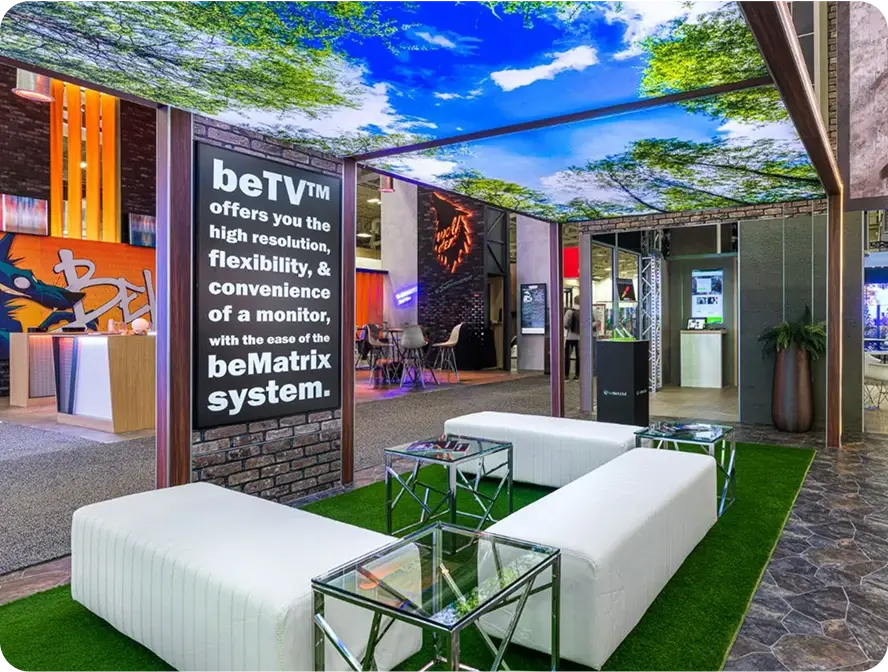
1. Why LED Displays are the Future of Trade Show Booth Design
Unlike traditional projection or LCD monitors, a trade show rental LED display offers seamless scalability. You can build a screen that wraps around a corner, covers a pillar, or spans the entire back wall of your exhibit without any distracting bezels (gaps).
Exhibition halls are notoriously bright, often filled with harsh overhead fluorescent lighting. LED technology is self-emissive, meaning it produces enough brightness (typically 800-1200 nits for indoors) to remain vibrant and high-contrast even under the most demanding hall lighting. This ensures your branding is visible from across the convention center.
2. Choosing the Perfect Pixel Pitch: P1.9 vs. P2.6
In a trade show setting, your audience is often standing just 1–3 meters away from your screen. This proximity makes “Pixel Pitch” your most critical technical decision.
-
P1.9 Rental LED Display: The premium choice for high-end booths. It provides “Retina” level clarity, making it ideal for displaying fine text, intricate product details, or luxury branding.
-
P2.6 Rental LED Display: The industry standard for most 20×20 booths. It offers an excellent balance of high resolution and cost-effectiveness for a 2-3 meter viewing distance.
For most professional exhibitions, a P2.6 Rental LED Display provides the perfect sharp image that captures wandering eyes without breaking your budget.
3. Modular Creativity: Beyond the Flat Video Wall
One of the greatest advantages of rental LED panels is their modularity. Because exhibition spaces vary, your screen should too.
-
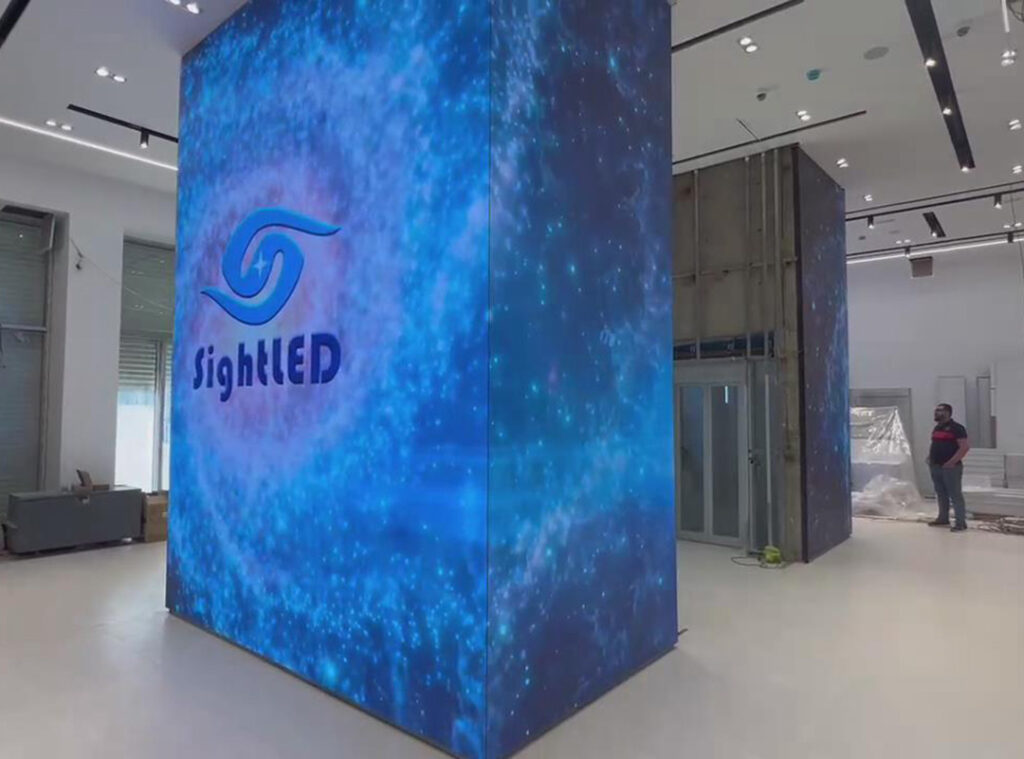
Corner Screens: Use 45-degree mitered cabinets to create seamless 90-degree corners. This is perfect for wrapping LED panels around booth pillars.
-
Curved Designs: High-quality rental frames allow for ±5 or ±10 degrees of curving, enabling you to create concave “wave” walls that draw visitors into your space.
-
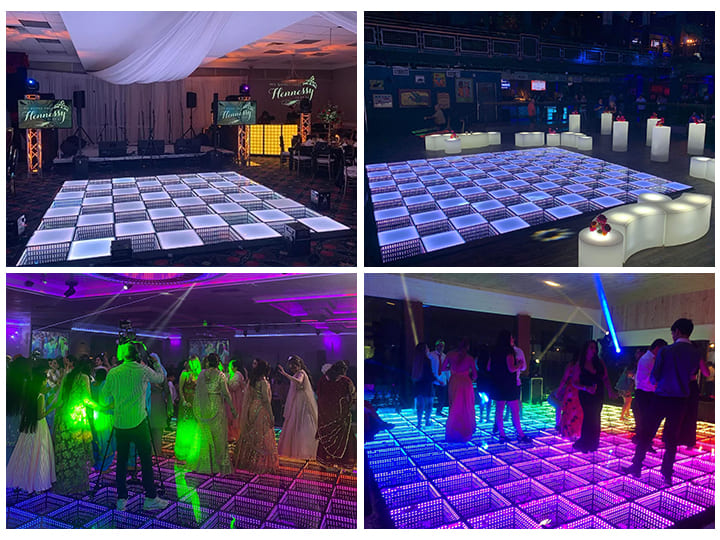
LED Floors: Combine your wall with a reinforced LED floor to create a fully immersive 3D environment for product walkthroughs.
4. Brightness and Refresh Rate: The “Camera-Ready” Factor
Today, every trade show visitor is a potential social media influencer. If your screen has a low refresh rate, it will appear with flickering lines in photos and videos taken on smartphones.
To ensure your booth is “Instagram-ready,” insist on a refresh rate of 3840Hz or higher. Additionally, ensure the screen has high-quality grayscale processing (14-16 bit) so that your brand colors are reproduced accurately, even when the brightness is turned down for comfortable close-range viewing.
5. Ease of Installation: Saving Time and Labor Costs
At a trade show, move-in times are strictly regulated and labor costs (especially union labor in the US and Europe) can be exorbitant. A professional trade show rental LED display should feature:
-
Fast-Lock Systems: Allowing two people to assemble a large wall in under two hours.
-
Front-Serviceability: If a module fails mid-show, you shouldn’t have to tear down the whole wall. Magnetic modules allow for a 10-second replacement from the front.
Tight on setup time? Learn the professional shortcuts in our guide on How to Install a Rental LED Wall.

6. Content Strategy: Making the Most of Your Rental
A common mistake is renting a high-end screen but playing low-resolution content. For a trade show, your content should be:
-
Bold and High-Contrast: Use bright colors and large motion graphics to catch eyes from a distance.
-
Silent but Effective: Convention halls are loud. Don’t rely on audio; use captions or text overlays to deliver your message.
-
Looping & Short: Most visitors spend less than 30 seconds looking at a screen while walking. Put your most impactful branding at the start of the loop.
7. Price Comparison: Buying vs. Renting for Exhibitors
The rental LED display price per square meter can vary significantly. If your company attends more than 4 or 5 major trade shows a year, the ROI of buying your own panels and hiring a local crew to install them might be higher than renting locally every time.
For a deep dive into budgeting and cost-per-square-meter, see our updated Rental LED Display Price Guide.
8. LED Walls vs. LCD Video Walls for Booths
Why choose LED over a 3×3 LCD TV matrix?
-
No Bezels: LED is truly seamless. LCD walls have black lines that cut through your logo and faces.
-
No Glare: LCD screens have glass fronts that reflect the hall’s lights like a mirror. LED masks are matte and anti-glare.
-
Custom Shapes: LCDs are always rectangles. LEDs can be long strips, “L” shapes, or giant cubes.
9. Logistics and Booth Integration: The “Flush Mount” Look
For a premium look, integrate the LED screen into your booth’s wooden or fabric structure. This “flush mount” design hides the cables and the metal frame, making the video look like part of the architecture. Ensure your booth builder coordinates with the LED supplier regarding heat dissipation—even indoor screens need airflow to prevent overheating in enclosed booth closets.
10. Reliability and On-Site Support
At a live event, there is no “undo” button. When renting an LED wall, you aren’t just paying for hardware; you are paying for a technical backup. Ensure your supplier provides:
-
Signal Redundancy: Two data paths so the screen stays on if one cable fails.
-
Spare Parts: Extra modules, power cables, and receiving cards kept on-site.
-
On-Site Engineer: For large-scale booths, having a technician on standby during the show’s opening hours is a must.
Trade shows are high-pressure. Discover how we support large-scale productions in our Rental LED for Corporate Events section.
11. Impact on Lead Generation and Brand Authority
Statistical data shows that booths with motion video generate up to 40% more leads than those with static graphics. A trade show rental LED display signals to the market that your company is a “tier-one” player. It builds immediate trust with potential distributors and partners who are looking for stable, professional suppliers.
12. Sustainability in Exhibition Design
In an era of “Green Exhibiting,” LED screens are a sustainable choice. Instead of printing thousands of square feet of vinyl banners that end up in a landfill after three days, an LED screen is a reusable digital canvas. You can update your marketing message in real-time via USB or cloud management without wasting physical materials.

FAQ: Trade Show LED Rental Professional Insights
1. How do I decide on the best screen size for my booth?
A good rule of thumb is that the screen should cover at least 30-50% of your back wall to have a dominant presence. For a standard 10x20ft booth, a 3.5m x 2m LED wall is highly effective.
2. Can I run interactive content or games on a rental LED wall?
Absolutely. By connecting a media server or a high-end PC with a touch-frame or motion sensor, you can turn your LED wall into an interactive game or a product configurator, which is a massive lead-generation tool.
3. What happens if an LED bulb “dies” during my trade show?
With front-service magnetic modules, a technician can swap out the faulty 250x250mm module in under 30 seconds without turning off the rest of the screen. This is why you should always have 5% spare modules on-site.
4. How much power does a typical trade show LED wall require?
An average P2.6 indoor wall consumes about 300W per square meter. A 10sqm wall would require about 3kW of power. Always confirm your venue’s power drop capabilities before the show.
5. Is P1.5 too high of a resolution for a trade show?
P1.5 is excellent for very small booths where visitors are literally touching the screen. However, for most displays, the cost increase from P2.6 to P1.5 is better spent on a larger screen area rather than higher density.
6. Do I need to provide my own video processor?
Most rental packages include a processor (like a NovaStar VX series). You simply provide your content via an HDMI cable from your laptop, just like connecting to a TV or projector.
Final Thoughts
A trade show rental LED display is more than an expense—it is a strategic asset. By choosing the right pixel pitch, ensuring high refresh rates for social media, and integrating the screen into your booth’s architecture, you transform your exhibition space into a high-converting marketing machine. In the battle for the attendee’s attention, the brand with the brightest, clearest, and most creative visuals usually wins the most leads.


