

62,500 px/m²
6,000 nits
IP65 Double Barriers
28 kg Magnesium Cabinet
800 / 300 W per m²
Front + Rear Service
What Is a P4 960x960mm Outdoor LED Display?
A P4 960x960mm outdoor LED display is a fixed-installation advertising screen that combines two industry standards: a 4 mm-class pixel pitch (the distance from the center of one LED to the next) and the 960×960 mm cabinet (the structural tile most of the world’s outdoor billboards are built on). In buyer language, P4 is shorthand for that whole 4 mm class: exact P4.00 walls built from universal 320×160 mm modules at 62,500 px/m², and P4.44 walls built from 480×320 mm / 320×480 mm modules at 50,625 px/m². Both land on the same cabinet grid — the product cards below map which Excel LED series runs which line. The pitch decides how sharp the image is; the cabinet decides how fast and how cheap the wall goes up. Because the 960x960mm outdoor LED display B Series frame accepts modules from P3 through P10, a wall built today can also be re-lamped at a coarser or finer pitch later without buying new steel.
The number that anchors every decision on this page is 62,500 pixels per square meter — the exact-P4.00 figure. One 960×960 mm cabinet resolves 240×240 = 57,600 pixels over 0.92 m². A 4.8×2.88 m billboard built from fifteen cabinets resolves 1,200×720 — enough for full-motion video that reads comfortably from 4 m to 40 m. If you are still comparing pitches, our outdoor P4 LED display guide covers the whole 4 mm line, and the P3 outdoor LED display and P6.67 outdoor LED display pages bracket it on both sides.

Which Products Ship as a P4 960x960mm Outdoor LED Display?
Four Excel LED platforms answer a P4-class brief on the 960×960 mm grid — two on the exact P4.00 module line, two on the P4.44 line. These are the actual product pages; the cards carry the one spec line that usually decides between them.

B Series P4 — Magnesium Flagship (This Page)
4.00 mm · 62,500 px/m² · 28 kg magnesium · IP65 · 6,000 nits
The featured build of this page: universal 320×160 mm modules, front + rear service, curved and 3D-corner capable — the general-purpose advertising wall of the range.
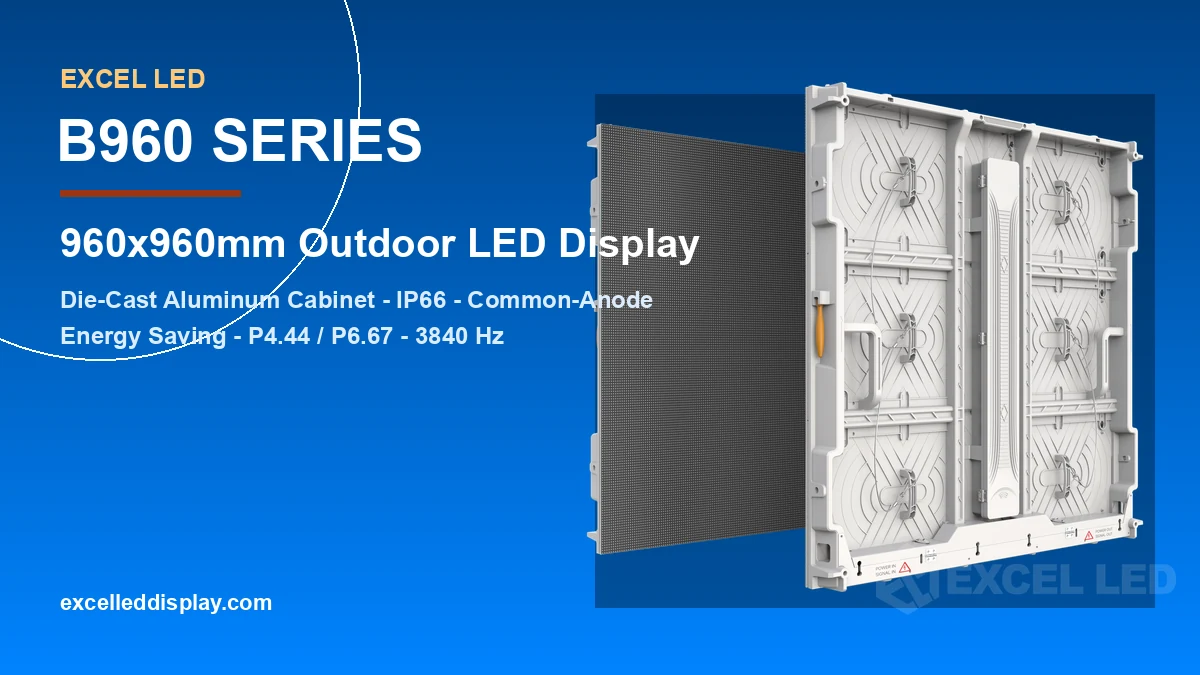
4.44 mm · 50,625 px/m² · 25 kg die-cast · IP66 · ≥5,000 nits
480×320 mm modules on the thinnest body in the range (85 mm) with common-anode power at ≤200 W/m² average — the premium fixed wall where every kilo and millimeter counts.

A960 — Energy-Saving High-Brightness
4.44 mm class · up to 10,000 nits · IP66 · ~60% lower power bills
320×480 mm modules at up to 10,000 nits with an energy-saving drive — built for sun-belt billboards and long daily duty where the electricity line dominates the P&L.

Iron Cabinet P4 — Budget Fixed Line
4.00 mm · 62,500 px/m² · steel body · IP65 front · ≈5,500 nits and up
The factory price-list workhorse: welded steel 960×960 mm cabinets carrying the same confirmed 320×160 mm modules — the lowest upfront cabinet cost for standard billboard frames.
Why Does the 960x960mm Cabinet Matter for a P4 Outdoor LED Display?
Billboard structures are priced by welding hours and crane days, and both scale with cabinet count. The 960 mm module survived as the world’s default outdoor grid for three practical reasons:
1 · Clean structural multiples. Standard billboard faces land on whole cabinet counts with no cutting: 2.88 m, 4.80 m, 9.60 m widths are all exact multiples of 0.96 m, so your steel designer orders beams on 960 mm centers and nothing gets trimmed on site.
2 · Predictable spares. Every cabinet in the wall is identical — same 18 modules, same power bay, same connector layout. A iron LED cabinet needs a warehouse of odd sizes; a 960 grid needs one SKU.
3 · Service without scaffolding redesign. With front service on wall mounts and rear service on island structures, one cabinet opens without disturbing its neighbors — the whole wall never comes down for a single dead module.
Whole-cabinet billboard sizes at P4 resolution
| Screen size (W×H) | Cabinets (W×H) | Cabinet count | Resolution | Area |
|---|---|---|---|---|
| 1.92 × 1.92 m | 2 × 2 | 4 | 480×480 px | 3.69 m² |
| 2.88 × 1.92 m | 3 × 2 | 6 | 720×480 px | 5.53 m² |
| 4.80 × 2.88 m | 5 × 3 | 15 | 1,200×720 px | 13.82 m² |
| 9.60 × 4.80 m | 10 × 5 | 50 | 2,400×1,200 px | 46.08 m² |
| 9.60 × 9.60 m | 10 × 10 | 100 | 2,400×2,400 px | 92.16 m² |
Each row resolves the same 62,500 px/m². Pick the row that matches your structure, and the cabinet count — the number your steel quote and freight quote are built from — is decided before anyone touches a welding torch.

What Advantages Does a P4 960x960mm Outdoor LED Display Bring to Your Site?
Every item below is a specification choice in the B Series platform, followed by what it changes on site — frame weight, power draw, service access or picture quality. The numbers are the ones you can put straight into a structural quote or an operating budget.

01A 28 kg magnesium cabinet lightens the steel frame and the crane bill
The B Series cabinet weighs 28 kg — about 30.4 kg/m² of wall and roughly 20% lighter than the same 960×960 mm body in iron. On rooftop and unipole builds the frame, footings and crane plan are sized from that number, so a lighter cabinet takes one beam size off the drawing and one lift off the schedule.
02Magnesium body and double waterproofing keep seams flat through rainy seasons
A powder-coated magnesium-alloy body does not rust from cut edges the way unprotected iron does, and the IP65 double waterproof barrier — reinforced rubber rings plus a sealed module face — keeps water out of the cabinet. The same sealing layer that blocks rain also holds every 960×960 mm seam on the same plane, so the ad stays one picture instead of a visible lattice.

036,000 nits keeps the picture readable in direct noon sun
6,000 nits is confirmed on the B Series spec sheet, above the 5,000-nit floor most marketplace listings treat as the outdoor readability threshold. A light sensor dims the wall after dark, so the same cabinet that holds contrast at midday does not blind the street at night.
04800 / 300 W per m² keeps the monthly power line under control
The B Series is rated 800 W/m² maximum and 300 W/m² average on mixed content — about 276 W per cabinet on typical playback, or roughly 5 kWh a day for one 0.92 m² cabinet on an 18-hour schedule. The auto-dim curve trims the nightly load further.
05Front and rear dual service on every cabinet
Every cabinet opens from the front and the back. Flush facade mounts use front service; island and rooftop structures with a walkway use rear service. The same cabinet works in either layout, so the mounting decision never locks the maintenance plan into scaffolding.

061,920 Hz standard, 3,840 Hz optional — the wall films clean
Refresh is 1,920 Hz on the standard build and 3,840 Hz on the high-refresh option. Phone cameras and broadcast units see a steady image rather than dark scanning bands, which matters when the screen appears in a livestream, a slow-motion replay or a paid sponsorship clip.
07Universal 320×160 mm modules keep every repair a same-day job
Every cabinet in the wall carries the same 320×160 mm module, so one SKU covers the whole screen and a mixed-batch spare problem never starts. The series stocking rule is 2–4 spare modules per 100 m², and a module swaps from the front or the rear in minutes.

08Curved and 3D corner builds on the same 960×960 mm platform
The magnesium cabinet supports curved and 3D corner builds, so an L-shaped building corner or a cylindrical tower wraps in the same 960×960 mm platform as a flat billboard — no custom welded steel and no second cabinet family for the corner section.
What Are the Full Specifications of the P4 960x960mm Outdoor LED Display?
The table below is the B Series P4 column, quoted from our own production sheets and the published series spec table (960x960mm outdoor LED display B Series). Fields marked typical are order-confirmed configurations rather than fixed factory constants.
| Parameter | Specification |
|---|---|
| Pixel pitch | 4 mm |
| Module size / resolution | 320×160 mm / 80×40 = 3,200 px |
| Module count per cabinet | 18 (3 wide × 6 tall) |
| Cabinet size | 960×960 mm |
| Cabinet resolution | 240×240 = 57,600 px |
| Pixel density | 62,500 px/m² |
| Lamp | SMD1921 black-face lamps (1921 lamp beads per the factory module price list) |
| Driver ICs | 60 per module (factory module price list) |
| Scan mode | 1/10 scan typical (order-confirmed; 1/8 optional on request) |
| Brightness | 6,000 nits |
| Refresh rate | 1,920 Hz standard; 3,840 Hz high-refresh option (typical) |
| Cabinet material / weight | Magnesium alloy / 28 kg (≈30.4 kg/m²) |
| IP rating | IP65, double waterproof barriers + reinforced rubber rings |
| Power (max / avg) | 800 / 300 W per m² (≈740 / 276 W per cabinet) |
| Service access | Front + rear dual service |
| Control compatibility | Novastar / Linsn / Colorlight receiving cards and sending cards |
| Operating temp | Outdoor fixed-installation range with sealed modules (project-confirmed) |
| Installation methods | Pole / unipole, rooftop, wall-mount, pillar, curved, 3D corner |
| Lifespan | ≈100,000 hours to half-brightness (industry service-life benchmark) |
Module-level data (320×160 mm, 80×40, 60 ICs, SMD1921) is the confirmed line item from our factory module price list for outdoor 4 mm boards — the same module family documented on our outdoor P4 LED display guide. Scan and refresh figures are the typical outdoor configurations for this module class and are locked at order confirmation.
How Bright Is a P4 960x960mm Outdoor LED Display in Direct Sunlight?
Marketplace listings for P4 960×960 mm cabinets cluster between 4,500 and 6,000 nits, and the 5,000-nit mark is where most buyers draw the outdoor readability line. The B Series P4 is rated 6,000 nits — the top of that listing band — which is what keeps a 2,400×1,200 px highway screen legible when the sun is directly behind the viewer’s shoulder.
Brightness alone is only half the daylight equation; the other half is contrast. The SMD1921 lamps on this module use black-face bodies that reflect less sunlight than white-body lamps, so the pixels that are “off” stay dark instead of glowing grey. On a billboard viewed against a bright sky, that contrast gain is what keeps text edges crisp — two walls at the same nits rating can read very differently at noon.
After dark, the same 6,000-nit ceiling becomes a liability, which is why the wall pairs with an automatic brightness sensor: the screen tracks ambient light on a curve, running full output at midday and stepping down through the evening. That is both a neighbor-relations feature and a running-cost feature — the power section below shows what the dimming curve does to the bill.

How Much Power Does a P4 960x960mm Outdoor LED Display Use?
The confirmed B Series figure is 800 W/m² maximum / 300 W/m² average. The two numbers describe different moments: 800 W/m² is the full-white, full-brightness worst case that sizes your power feed and cabling; 300 W/m² is what the wall actually draws on mixed content — the advertising reels that make up real playback.
| Screen size | Cabinets | Avg draw (mixed content) | Max draw (full white) |
|---|---|---|---|
| 2.88 × 1.92 m (5.53 m²) | 6 | ≈1.66 kW | ≈4.42 kW |
| 4.80 × 2.88 m (13.82 m²) | 15 | ≈4.15 kW | ≈11.1 kW |
| 9.60 × 4.80 m (46.08 m²) | 50 | ≈13.8 kW | ≈36.9 kW |
Per cabinet the arithmetic is 0.92 m² × 300 W = ≈276 W average, ≈740 W peak — which is why one 960×960 mm cabinet ships with its own sealed power bay rather than sharing a feed across four cabinets. Budget the distribution board on the max column, budget the electricity contract on the average column, and let the night dimming curve pull the real average below it: a wall that drops to 40% brightness after sunset cuts its 14-hour daily consumption by roughly a quarter.
How Weatherproof Is the P4 960x960mm Outdoor LED Display?
The rating is IP65 — total dust ingress protection and protection against water jets from any direction — but the rating on the label matters less than how the cabinet earns it. The B Series builds it in two layers:
Layer 1 — the module face. Each 320×160 mm module is sealed with a weather-grade mask and potting around the lamp openings, so the first line of defense is at the LED surface where rain actually hits.
Layer 2 — the cabinet shell. Reinforced rubber rings seat between every mating surface, and the magnesium-alloy body carries a corrosion-resistant coating rated for outdoor duty cycles. The double-barrier design is why the series holds its seal through monsoon seasons and coastal salt air — the failure mode of single-barrier cabinets is that one compromised gasket exposes the whole interior.
The practical test is not the lab rating but the condensation cycle: a sealed cabinet that breathes daily between hot afternoons and cool nights pumps humid air across its own electronics. The B Series gasket layout is pressure-balanced so the seal survives that pumping instead of working itself loose — the reason a five-year-old wall keeps its IP65 behavior instead of quietly becoming IP42.
Where Does a P4 960x960mm Outdoor LED Display Fit Best?
A 4 mm pitch on a 960 mm grid covers the outdoor viewing band from about 4 m to 40 m — the range where most city and highway advertising actually happens. These eight placements account for the majority of B Series P4 deployments.

Highway unipole billboard
The classic P4 application: a 9.6×4.8 m face on a single pole, read at 20–60 m by traffic moving at speed. 2,400×1,200 px resolves broadcast-quality motion at that distance.
10×5 cabinets · rear service

Rooftop building sign
City-center rooftops where structural load decides feasibility. 28 kg cabinets cut dead load roughly 20% versus iron, often keeping the project inside the roof’s existing rating.
5×3 to 10×5 · front+rear

Commercial plaza facade
Flush-mounted screens on shopping centers and office towers where no rear walkway exists — front-service cabinets make every repair a ladder job, not a scaffolding contract.
Grid per facade · front service

Roadside and community pole screens
Small-format pole screens (2.88×1.92 m, six cabinets) for retail parks, fuel stations and community entrances where the viewer stands 5–20 m away.
3×2 cabinets · 720×480 px

Stadium and event surrounds
Perimeter and scoreboardside positions that film on broadcast cameras — the 3,840 Hz high-refresh build keeps slow-motion replays free of scanning bands.
3,840 Hz option · curved able

Fuel station and car-dealership pylons
Tall narrow pylons built from 2×4 or 2×6 cabinet columns; price boards and brand reels rotate through the day, and the auto-dim sensor keeps night output neighborly.
2-wide columns · auto-dim

Naked-eye 3D corner screens
L-shaped building corners where two P4 walls meet at an angle; magnesium cabinets support the curved and folded builds that make 3D content work from the sidewalk.
curved / 3D corner build

Civic and transport information boards
Municipality notice boards and transport hubs running schedules and public messaging on a 960 grid — standardized cabinets keep multi-site fleets on one spare-part SKU.
one SKU fleet-wide
Who Buys a P4 960x960mm Outdoor LED Display?
Outdoor fixed-installation buyers arrive from six directions, and each one cares about a different line of the same spec sheet. Find your row — the quotation you get back is framed around it.
LED Distributors
Resell the B Series P4 across a regional market with one cabinet SKU, one module SKU and factory-direct pricing that protects margin on every re-order. Priority-S channel with volume pricing and stocking support.
Advertising Agencies
Sell campaign space on a screen that films clean (3,840 Hz option) and reads at highway speed; quote per-campaign on a 62,500 px/m² wall without explaining resolution compromises to creative teams.
DOOH Media Owners
Operate billboard networks where uptime and power cost are the P&L. Front+rear service, 2–4 spares per 100 m², and a 300 W/m² average draw are the three numbers that decide network ROI.
LED & Sign Contractors
Install and maintain screens for clients: 960 mm beam centers, 28 kg two-person cabinet handling, aviation fast locks and a sealed power bay that trades wiring hours for plug-in connectors.
Government Project Contractors
Deliver tendered civic and transport boards on a documented spec (IP65, SMD1921, 1/10 scan typical) with consistent cabinet batches across multiple sites and inspection-friendly test reports.
Brand & Facility Owners
Buy a screen for your own plaza, dealership or fuel station: one factory contact, auto-dim for night compliance, and a wall that can be re-pitched years later instead of rebuilt.
Which Countries Deploy the P4 960x960mm Outdoor LED Display?
These six deployment profiles describe how P4 960×960 mm walls are bought and run in our core export markets. Each card is a market pattern — configuration logic drawn from real project types, not named-client claims.

United States — Roadside Digital Billboard Networks
P4 on 960×960 mm cabinets is the workhorse format of independent US billboard operators converting static faces to digital: 14×48 ft faces map onto the 960 grid with minor beam adaptation, and front+rear service suits both monopole and build-to-suit sites.
conversion builds · rear service

Germany — City-Center Facade Advertising
German city councils keep night brightness on a short leash; the auto-dim sensor plus 6,000-nit daytime ceiling is the pairing that passes both the noon readability test and the evening curfew rules on downtown walls.
auto-dim · flush mount

United Kingdom — Retail Park Large-Format Screens
UK retail parks run P4 large-format totems and gateway screens where viewers stand 10–25 m away; 62,500 px/m² carries brand video that P6-class faces would pixelate at that distance.
totem + gateway · front service

Spain — Shopping Mall Exterior Media Facades
Mall exterior walls mix advertising with mall branding playlists; the universal 320×160 mm module means the media wall and the directory boards share one spare-part pool across the property.
media facade · mixed content

Saudi Arabia — Highway Unipole Networks
Gulf highway unipoles face dust, heat and 24/7 duty; IP65 double barriers plus sealed power bays are specified for exactly this climate, and rear service matches the walkway behind standard unipole frames.
highway duty · rear service

United Arab Emirates — Rooftop Skyline Screens
Dubai rooftops combine wind load with strict structural approvals; the 28 kg magnesium cabinet is routinely the difference between a roof that qualifies and a roof that needs re-certification.
rooftop · low dead load
What Reference Configurations Can You Build With P4 960x960mm Cabinets?
Four standard builds cover most quotations. All figures are arithmetic from the confirmed cabinet data (0.92 m², 57,600 px, 28 kg per cabinet) — no rounding tricks, and every size is a whole-cabinet count your steel shop can detail directly.

2.88 × 1.92 m — Storefront & Pole Screen
6 cabinets (3×2) · 720×480 px · 5.53 m² · ≈168 kg wall weight
The entry configuration: retail fronts, community entrances and fuel-station pylons. Readable from 4 m, ships as a single freight pallet set.

4.80 × 2.88 m — Community Billboard
15 cabinets (5×3) · 1,200×720 px · 13.82 m² · ≈420 kg
The most-quoted mid format: roadside sites with 10–30 m sightlines. True 16:9 pixels for full-motion content.

9.60 × 4.80 m — Highway Unipole
50 cabinets (10×5) · 2,400×1,200 px · 46.08 m² · ≈1,400 kg
The classic 14×48 ft-class digital billboard. Broadcast-resolution motion at 20–60 m; power feed sized on the 800 W/m² max column.

9.60 × 9.60 m — Landmark Double-Face Screen
100 cabinets (10×10) · 2,400×2,400 px · 92.16 m² · ≈2,800 kg per face
Landmark and gateway structures where both traffic directions get a full square face. Steel design runs on 960 mm centers end to end.
How Do You Install and Maintain a P4 960x960mm Outdoor LED Display?
The B Series ships six installation methods off the same cabinet: pole/unipole, rooftop, wall-mount, pillar, curved and 3D corner. Whichever your site uses, the cabinet-side routine is the same: hang the frame, hang the cabinet, engage the aviation-grade fast locks, and land the power and data connectors on the centralized hub inside the cabinet — no on-site drilling, no field welding on the screen side of the job.
Maintenance is a two-door design. Front service covers flush wall mounts where nothing exists behind the wall: modules and power bays come out toward the street with hand tools. Rear service covers island structures with a walkway, where the whole rear cover opens and the technician never works over traffic. On both paths, a dead module swaps in minutes and the 2–4 spare modules per 100 m² stocking rule turns most repairs into a same-day visit instead of a wait on parts.
Every wall is aged and calibrated at the factory before packing — a 72-hour burn-in with luminance and color calibration, then re-verification before shipment — so site commissioning is alignment and playback setup, not first-light debugging.
Field records from our own channel
Two 3×2 m P4 outdoor units installed in Liberia — daylight field footage of the finished walls playing advertising content. (Excel LED Display channel)
OK Series outdoor LED billboard running high-brightness SMD modules — field record of the cost-effective 960×960 mm billboard line. (Excel LED Display channel)
Wall-mounted outdoor advertising LED screen on a building facade — the flush front-service mount in daily use. (Excel LED Display channel)
What Does a P4 960x960mm Outdoor LED Display Cost?
Marketplace listings for generic P4 960×960 mm outdoor cabinets (Alibaba/Made-in-China, October 2026 market listing scan) cluster around $161–165 per cabinet FOB China — roughly $175–180 per m² at the 0.92 m² cabinet area. Treat those as commodity-tier reference points: they buy you the cabinet arithmetic, not the engineering around it.
| Cost layer | What moves it |
|---|---|
| Cabinet + modules (FOB) | Lamp grade, driver IC count, scan mode, magnesium vs iron body |
| High-refresh build | 3,840 Hz option adds receiving-card cost per cabinet |
| Structure & install | Steel tonnage (lighter cabinets shrink it), crane days, site height |
| Running cost | 300 W/m² average draw, night dimming curve, local tariff |
A factory quotation on the B Series P4 is priced per project because three of those four layers are site decisions. Send the screen size and the install type and the quote itemizes cabinets, structure load, control and freight as separate lines — request the itemized version.
How Does the P4 960x960mm Outdoor LED Display Compare With B960, A960 and Iron Cabinets?
Excel LED runs several 960×960 mm outdoor platforms, and they answer different briefs. This table puts the four you will actually be quoted side by side.
| Item | B Series P4 (this page) | B960 Die-Cast | A960 Energy-Saving | Iron Cabinet P4 |
|---|---|---|---|---|
| Pixel pitch | 4.00 mm | 4.44 mm / 6.67 mm | 4.44 / 5.7 / 6.67 / 8 / 10 mm | 4.00 mm |
| Pixel density | 62,500 px/m² | 50,625 px/m² | varies by pitch | 62,500 px/m² |
| Cabinet body | Magnesium alloy | Die-cast aluminum | Die-cast aluminum | Welded iron |
| Cabinet weight | 28 kg | 25 kg | see A960 spec page | Heavier than alloy builds |
| IP rating | IP65 double barriers | IP66 both faces | IP66 | IP65-class front (typical) |
| Brightness | 6,000 nits | ≥5,000 nits (4.44) | up to 10,000 nits | ≈5,500 nits and up (typical) |
| Power (max/avg) | 800 / 300 W/m² | ≤600 / ≤200 W/m² (common-anode) | cuts power bills ~60% | higher running draw |
| Module | 320×160 mm universal | 480×320 mm | 320×480 mm | 320×160 mm universal |
| Best for | General advertising on the 4 mm sweet spot | Slimmest premium fixed walls | Lowest long-term power bill | Lowest upfront cabinet cost |
Skip this page if: viewers stand closer than 4 m — that is a job for the P3 outdoor LED display or an indoor build (P4 indoor LED display); your electricity tariff dominates the P&L — the A960 energy-saving 960×960 outdoor LED display common-anode line exists for that brief; you need the thinnest possible cabinet on a premium facade — the B960 die-cast 960×960 outdoor LED display die-cast platform is the lighter, slimmer body; you are renting rather than fixing — start at the P4.81 outdoor rental LED display.
Frequently Asked Questions About the P4 960x960mm Outdoor LED Display
How far away can viewers read a P4 960x960mm outdoor LED display?
Use the rule of thumb that the minimum comfortable viewing distance in meters roughly equals the pitch in millimeters: about 4 m for P4. The comfortable band runs from that 4 m floor out to roughly 40 m, where a 2,400×1,200 px highway face still resolves clean motion. Closer than 4 m, step down to a P3 outdoor build; beyond 60 m, coarser pitches turn cheaper without any visible loss.
Is 6,000 nits bright enough for direct sunlight?
Marketplace listings for P4 960×960 mm cabinets cluster between 4,500 and 6,000 nits, and 5,000 nits is the commonly cited outdoor readability floor. At 6,000 nits the B Series P4 sits above that floor with margin, and the black-face SMD1921 lamps hold contrast against bright skies — the pairing that keeps content readable at noon, not just bright on a spec sheet.
How much power does one cabinet draw?
The confirmed series rating is 800 W/m² max / 300 W/m² average. One 960×960 mm cabinet covers 0.92 m², so plan ≈740 W peak and ≈276 W average per cabinet on mixed content. Size the power feed on the max figure; budget the electricity contract on the average, and expect the night dimming curve to pull real consumption below it.
What is the difference between P4 and P4.44?
P4 works as buyer shorthand for the whole 4 mm class, and under that shorthand sit two module lines. Exact P4.00 (this page’s flagship build) uses 320×160 mm modules for 62,500 px/m²; P4.44 uses 480×320 mm modules for 50,625 px/m² — about 19% fewer pixels — and rides the B960 die-cast and A960 platforms. Both land on the same 960×960 mm cabinet grid, so the structure does not change the choice: match the line to your nearest viewer and budget using the product cards and comparison table above.
How many people does it take to install one cabinet?
One 960×960 mm B Series cabinet weighs 28 kg — a two-person lift by standard manual-handling practice, or one person with a light hoist. Aviation-grade fast locks and the centralized power/data hub mean the cabinet lands, locks and connects in minutes without on-site drilling.
Should I choose front service or rear service?
Choose front service when nothing exists behind the wall — flush facade and wall mounts. Choose rear service when a walkway exists behind the structure — island billboards and unipoles. The B Series supports both on every cabinet, so the site decides, not the product; you can also mix zones on one wall.
Which control systems work with the P4 960x960mm outdoor LED display?
The line runs Novastar, Linsn and Colorlight receiving and sending cards. Plan roughly one receiving card per cabinet: 57,600 px per cabinet sits within the capacity of mid-range receiving cards, so a 15-cabinet wall is a 15-card layout plus spares, and any content processor you already own on those platforms carries over.
How long does the screen last, and what about spares?
Plan on the industry benchmark of about 100,000 hours to half-brightness — a decade or more at typical outdoor daily runtimes. Every wall is 72-hour aged and luminance-calibrated before packing, and the stocking rule that keeps repairs same-day is 2–4 spare modules per 100 m² plus one spare receiving card per ten cabinets.
What billboard sizes can I build without cutting cabinets?
Any multiple of 0.96 m in both directions: 1.92×1.92 m (4 cabinets), 2.88×1.92 m (6), 4.80×2.88 m (15), 9.60×4.80 m (50) and 9.60×9.60 m (100) are the standard rungs, all whole-cabinet counts — your steel designer works on 960 mm beam centers and nothing gets trimmed on site.
How Far Away Can Viewers Read a P4 960x960mm Outdoor LED Display?
Distance rules for outdoor screens are blunt instruments, but they prevent expensive mistakes. The two numbers worth memorizing for P4 are 4 m and 40 m. The 4 m floor comes from pixel geometry: at 4 mm pitch, the individual lamps stop resolving into dots for an average eye at roughly one meter per millimeter of pitch, so a viewer closer than 4 m starts seeing structure instead of content. The 40 m ceiling is an advertising judgment, not a physics one — beyond it, a 62,500 px/m² wall carries no more information than a coarser, cheaper pitch would, which is why highway-scale faces at 60 m+ viewing are quoted at P6.67 and P8 instead.
Content sizing follows the same logic. Text on a P4 wall stays comfortable at a height of about 40–50 mm per 10 m of viewing distance — a headline that reads across a two-lane road at 20 m wants to be 100–150 mm tall on screen. This is also the honest answer to “is P4 sharp enough for my site”: plot the nearest and farthest viewer, and if the band lands inside 4–40 m, the pitch is right; if the near viewer is closer than 4 m, no amount of brightness fixes the pixel structure — change the pitch, not the nits.
What Does a P4 960x960mm Outdoor LED Display Cost to Run Every Year?
Running cost is where fixed screens are actually won or lost, and it is arithmetic you can do before the quote arrives. Take the standard highway build: 9.6×4.8 m = 46.08 m² of wall. At the confirmed 300 W/m² average draw, the screen pulls 13.8 kW on mixed content. Running 14 hours a day, that is 193 kWh per day — about 70,500 kWh per year, or roughly $7,050 per year at a $0.10/kWh tariff.
Two levers move that number. The first is the night dimming curve: content at night rarely needs more than 30–50% of full brightness, and the automatic sensor applies it without an operator, cutting a double-digit percentage off the annual figure on any 14-hour duty cycle. The second is duty planning: networks that idle screens to a static low-brightness frame after midnight instead of running full reels shave further hours off the high-draw window. Neither lever changes the 800 W/m² max figure your electrician sizes the feed on — that worst case stays reserved for the days the wall runs a full-white test pattern at full brightness.
P4, P4.44 or P5: Which Pitch Should Your 960x960mm Wall Run?
The three candidate pitches inside the 4 mm class band split by module line and by economics. P4.00 (this page’s flagship build) rides the 320×160 mm universal module line — 62,500 px/m², the sharpest of the three, and the right answer when viewers can approach the wall or when brand video quality carries the advertising rate card. P4.44 rides the 480×320 mm module line at 50,625 px/m² — the same nominal “4-millimeter class” with about 19% fewer pixels per square meter, sold on the slimmest cabinet bodies in the range (the die-cast B960 and the A960 energy-saving line). P5.00 drops to 40,000 px/m² on the same 320×160 mm line — one pitch-step coarser, measurably cheaper per square meter, and visually identical to P4 beyond roughly 20 m.
The decision rule that survives contact with real projects: if the nearest viewer stands under 10 m away, pay for P4.00 — the pixel count is doing visible work there. If the wall lives beyond 20 m on a structure you may re-lamp later, the universal 320×160 mm module line matters more than the initial pitch, because P4, P5, P6, P8 and P10 modules all land on the same cabinet — the frame you buy once is the part that holds its value.
Is a P4 960x960mm Outdoor LED Display the Right Buy for Your Site?
If your brief reads like this — a fixed outdoor advertising wall, viewers between 4 and 40 m, structure cost and roof load under pressure, a decade of daily duty ahead — then a P4 960x960mm outdoor LED display on the B Series platform is the configuration the numbers point to: 62,500 pixels per square meter of daylight-readable sharpness, 28 kg cabinets that shrink the steel around them, IP65 double barriers for the weather you cannot schedule around, and a module line that lets the wall change pitch without changing bones. The next step is a drawing, not a decision: send the screen size and install type, and the layout, cabinet count, steel load and itemized quote come back as one package — start the quotation.
Related 960x960mm and P4 Outdoor LED Display Pages
960x960mm Outdoor LED Display — B Series
The full series page: P3–P10 on the same magnesium cabinet platform.
The complete 4 mm outdoor line guide: modules, cabinets and control.
960×960 Outdoor LED Display — B960
Die-cast aluminum platform at P4.44/P6.67 — the slimmest body.
Energy Saving Outdoor LED Display 960×960 — A960
Common-anode platform that cuts power bills by ~60%.
Outdoor LED Billboard 960×960 — OK Series
The cost-effective billboard line for high-brightness faces.
P4.81 Outdoor LED Display for Rental
The rental-side 4.81 mm line for events and tours.
Get Your P4 960x960mm Outdoor LED Display Quote
Send the screen size and install type — cabinet count, steel load, control layout and itemized factory pricing come back as one package.