
DOOH advertising is digital out-of-home advertising — paid brand messages delivered on screens in public space instead of printed vinyl. It covers roadside LED billboards, mall walls, transit terminals, stadium ribbons and truck-mounted mobile screens. This guide gives you the specs and cost lines we see on the factory floor.
Video: A960 Outdoor LED Display Waterproof Test — Legidatech LED screen
A working definition is easier than the acronym: DOOH advertising is any out-of-home placement whose creative is delivered digitally, so the message can change by hour or by audience instead of being printed once. Media owners resell the same structure many times over.
The shift is commercial, not cosmetic. A printed billboard ties up budget for 4 to 12 weeks; a digital board can carry 10 to 20 advertisers in that window on separate dayparts. That is why commercial LED screen types appear in nearly every outdoor tender we quote.

What Is DOOH Advertising and Why Budget Is Moving to It
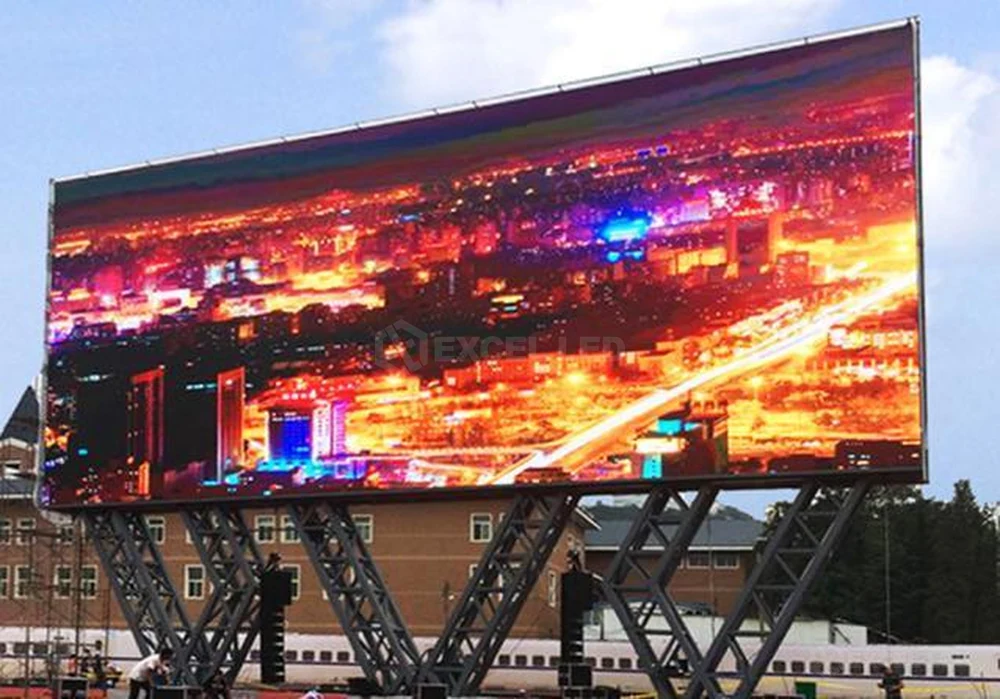
Five formats carry most of the volume in this market.
- Roadside LED billboard — large-format digital board, typically P6 to P10 pitch.
- Mall and retail screens — longer dwell time, lower ambient light.
- Transit and airport screens — repeat exposure from daily commuters.
- Mobile billboard trucks — screens that carry the placement to the audience.
- Stadium and venue ribbons — perimeter displays tied to live events.
Scale keeps rising too: coverage of a New York LED installation above 1,000 square metres shows how far the format has moved from a single roadside panel. Buyers now ask which pitch, brightness and control system, not whether digital works.
DOOH Advertising vs Traditional OOH: What Actually Changes for Advertisers
The difference is not print versus light. It is static versus addressable.
A printed panel serves one message to everyone who passes. A digital screen can run a coffee brand at 07:00, a lunch offer at 12:00 and an evening promotion at 19:00 on the same structure.
| Factor | Printed OOH | DOOH advertising |
|---|---|---|
| Creative change | Reprint and site visit, days of lead time | Upload to the CMS, live in minutes |
| Advertisers per structure | One | Often 10 to 20 sharing the day |
| Dayparting | Not possible | Scheduling by hour and weekday |
| Measured delivery | Estimated traffic only | Play logs plus counted impressions |
| Failure mode | Fades, tears, peels | Dark modules, power or signal faults |
| Cost shape | Low capital, repeating print cost | Higher capital, low cost per message |
One thing does not change: location still decides most of the result. A weak site with a bright screen remains a weak buy.
The second difference is operational: a digital board is electronics with a service life, so it needs power, data and someone able to diagnose it. That is why diagnosing a dark or partly dead LED screen matters in a way it never did with vinyl.
How an LED Billboard Advertising Screen Works, From File to Glass
An LED billboard advertising screen has no moving parts in the image path. A player decodes the file, a sending card splits each frame across cabinets, and driver ICs pulse the LEDs at a controlled current.
- Creative is produced to the screen’s exact aspect ratio and pixel resolution.
- The player or CMS schedules the file by daypart.
- The sending card encodes each frame and splits it across cabinets.
- Receiving cards drive their module rows at the scan rate.
- Driver ICs switch individual LEDs thousands of times per second.
- Your eye integrates those pulses into a steady image.
Three specs decide whether the result looks clean on camera. A refresh rate of 3840Hz stops the dark banding phones and broadcast cameras create on cheaper screens. Brightness of 5,000 to 8,000 nits holds up in direct sun, and an IP65 rating on both faces keeps rain and dust out.
Brightness is also the spec most often oversold. Chinese display industry guidance on LED brightness selection makes the point plainly: the nit target should follow the ambient light of the site, because a screen far brighter than it needs only burns power and ages its LEDs faster.
The control layer is where projects quietly fail. NovaStar and Colorlight are the systems we ship most, and our walkthrough of how an LED control system is architected explains how sending cards, receiving cards and backup signal paths fit together.
How to Choose an Outdoor LED Display for DOOH Advertising Campaigns
Selection is a four-variable problem: viewing distance, ambient light, content type and how often content changes. Pixel pitch is the first variable to fix, because it sets both the visual result and much of the price.
| Pixel pitch | Realistic viewing distance | Typical DOOH advertising use |
|---|---|---|
| P4 | 4 to 8 m | Mall atrium, retail entrance, foot traffic |
| P6 | 8 to 15 m | Roadside board on a slow, dense street |
| P8 | 15 to 25 m | Arterial roads and urban junctions |
| P10 | 25 to 50 m | Highway boards and rooftop screens |
| P16 | 50 m and beyond | Landmark facades seen across a plaza |
Once the pitch is fixed, confirm the build rather than the headline number.
- Pixel pitch matched to the nearest realistic viewing distance, not the theoretical maximum.
- Brightness of 5,000 to 8,000 nits for sites in direct sun.
- Refresh rate of 3840Hz if phones or broadcast cameras will point at the screen.
- IP65 cabinet rating front and back for permanent outdoor installation.
- NovaStar or Colorlight control, with a spare receiving card held on site.
- Certification documents on file: UL, CE, FCC and RoHS.
- Written warranty terms — we standardise on 2 years, with LED and power supply coverage stated separately.
Physical size drives steel and structure cost more than pitch does, so settle screen size and aspect ratio before negotiating price. Our outdoor LED display range lists the pitch and cabinet combinations we build most.
What Does DOOH Advertising Cost in 2026? A Real Budget Breakdown
Buyers conflate two budgets: the one-time cost of putting a screen on a wall, and the recurring cost of running it. Only the first is a capital decision.
| Cost line | What drives it | Weight in year one |
|---|---|---|
| Cabinets, modules, power and control | Total square metres and pixel pitch | Largest single line |
| Steel or aluminium structure | Wind load, height, wall condition | Often 15 to 30 percent of hardware |
| Installation and commissioning | Site access, crane needs, power runs | Varies widely by city |
| Content production | Number of creative variants | Recurring, per campaign |
| Power and connectivity | Brightness setting, hours, fibre or 5G | Fastest-growing recurring line |
| Maintenance and spares | Climate and spare kit held on site | Small if planned, large if not |
| Media rental or site lease | Footfall, city, sightline quality | Advertiser’s dominant cost |
For a media owner running their own board, hardware plus structure is the majority of the first-year figure. By year two the balance flips: power, connectivity and maintenance dominate.
Advertisers who rent rather than own never see the screen cost; they pay for exposure. Temporary deployments price differently again, and our breakdown of LED screen rental pricing sets out what changes once a screen has to travel and be rigged.
How to Measure Whether Your Digital Out-of-Home Spend Is Working
Digital out-of-home is measurable, but not the way search advertising is. You are measuring exposure and lift, and no single metric proves a campaign.
- Play logs — proof the creative ran when scheduled.
- Camera-based impression counts — vehicle and pedestrian passes, aggregated for privacy.
- QR scans and short codes — the closest practical equivalent to a click.
- Promo code redemptions — links one site to one sale.
- Footfall change — store traffic before, during and after the flight.
- Brand lift surveys — recall measured against a control area.
The right mix depends on whether the site is a pass-through or a destination. Mall campaigns shift the maths because dwell time and repeat exposure rise, and our notes on shopping mall LED display solutions explain how placement changes what you can measure.
Common Mistakes That Waste DOOH Advertising Budget
Most wasted DOOH advertising spend is not a hardware failure. It is a planning failure locked in before the purchase order was signed.
- Buying on pixel pitch alone. A fine pitch at 60 metres is money spent where no eye can see it.
- Running a 30-second TV cut. Traffic viewers get a few seconds, not half a minute.
- Ignoring ambient light. Over-specifying brightness raises power bills for no visible gain.
- No spare parts on site. One receiving card can darken a cabinet for weeks.
- Skipping the site survey. Structure, wind load and power runs get quoted wrong.
- A supplier who cannot service the control system. We walk buyers through control system and signal path options before quoting.
- No maintenance plan. Our guide to checking an LED display that stopped working covers the first things to test.
The costliest item is content built for the wrong medium. A driver in moving traffic may give you 3 to 6 seconds; a shopper waiting for coffee may give you 20.
Request Factory-Direct Pricing
Mobile Billboard and Mall Screens: Two Formats Worth Testing
Not every campaign justifies a permanent structure. A mobile billboard LED truck carries the placement to the audience: a launch, a stadium exit, a festival or a detour.
The trade-off is power and vibration. Truck-mounted screens run from generators or battery banks, and the cabinet mounting must survive road shock, so we specify reinforced locking and lower brightness than a fixed board.
Fixed indoor and semi-outdoor work is the more common entry point. This collection of outdoor display solution cases from China’s digital signage industry shows how varied those deployments have become. If your first site is inside a centre, review the mall LED display placements we build most often.
What to Verify Before You Buy a DOOH LED Screen
A spec sheet can overstate what the site actually needs. One number worth checking is brightness: a roadside board that faces away from the sun often only needs about 6,500 nits, not the 10,000 nits many specs default to. Quoting the lower brightness and moving the saving into a better power supply and spare parts is usually the smarter spend.
Also confirm the real cost of ownership, not the panel price. Receiving cards, power supplies and the steel structure are the lines that decide whether a board stays on air, and the deciding factor for an advertising screen is rarely peak brightness — it is uptime and remote control.
Capacity is not the constraint any more. Reporting on a high-end LED display project above 2 billion RMB in output value shows how much manufacturing depth sits behind an ordinary outdoor order. Compare the screen build types and finished screen dimensions line by line, not just price per square metre.
FAQ About DOOH Advertising
What is DOOH advertising in simple terms?
DOOH advertising is out-of-home advertising delivered on digital screens rather than printed panels. The screen can be a roadside billboard, a mall wall, a transit display or a truck-mounted unit, and the creative changes remotely.
How much does DOOH advertising cost?
Hardware, structure and installation dominate year one and scale with square metres and pixel pitch. From year two, power, connectivity, content and maintenance dominate; advertisers renting space pay for exposure instead.
Is DOOH advertising better than a traditional billboard?
Digital wins where you need flexible timing, several advertisers per structure or measured play delivery. Printed panels still win on very low budgets, on sites without power or data, and where one long-run message is enough.
How long should one DOOH ad be?
Six to ten seconds is the practical range for traffic-facing screens, where viewers are moving. Screens in malls and waiting areas can carry twenty to thirty seconds, because dwell time is genuinely longer.
What is the difference between DOOH and digital signage?
Digital signage is the hardware and software category. DOOH advertising is the commercial use of that category when a screen serves as paid inventory in public space, so a hospital wayfinding screen is not DOOH.
How bright should an outdoor LED advertising screen be?
Most permanent roadside screens land between 5,000 and 8,000 nits, depending on ambient light and whether the screen faces the sun. Higher brightness raises power consumption and accelerates LED ageing.
How long do outdoor LED advertising screens last?
A well-built outdoor screen typically runs for many years of continuous operation, with LEDs and power supplies ageing first. Real service life depends more on brightness settings, climate and maintenance than on purchase price.
Can DOOH advertising be measured like online ads?
Not identically, and any supplier claiming otherwise is overselling. Digital out-of-home gives you play logs, counted impressions, QR scans, promo redemptions and brand lift studies — none of which is a click.
DOOH Advertising: Start With One Screen and Real Numbers
The brands and media owners who get the most from DOOH advertising are rarely the ones with the largest first order. They matched pixel pitch to a real viewing distance, brightness to a real site, and kept a spare card on the shelf.
Start with one screen, measure it for a full quarter, and let play logs and footfall data decide the second one. Send us your dimensions, viewing distance and a site photo, and we will quote the build directly from our factory.


