
500×500 vs 500×1000 LED Floor Tiles: Choosing the Right Cabinet Size
0.25 m² vs 0.5 m² · 11 kg vs 22.5 kg · 2,000 kg/m² both · Front maintenance
Two footprints, one load rating, a different installation day. This page compares the 500×500 and 500×1000 LED floor tile formats on area, seams, load path, crew size, truck space, curves and spares — so the cabinet size is fixed before the pit is poured.

500×500 vs 500×1000 LED Floor Tiles: The Short Answer
500×500 LED floor tiles win on handling, curves and rental logistics. At 11 kg per 0.25 m² cabinet one technician carries a tile into a service lift, and the finer grid follows an arc or a cut-out more closely.
500×1000 LED floor tiles win on build speed and joint count. One 22.5 kg cabinet covers 0.5 m², so the same venue needs half the units, half the levelling operations and half the cabinets to store.
Cabinet size changes the build, not the image or the load rating. Both are rated 2,000 kg/m², both use 250×250 mm modules, and at equal pitch the pixel density per square metre is identical.
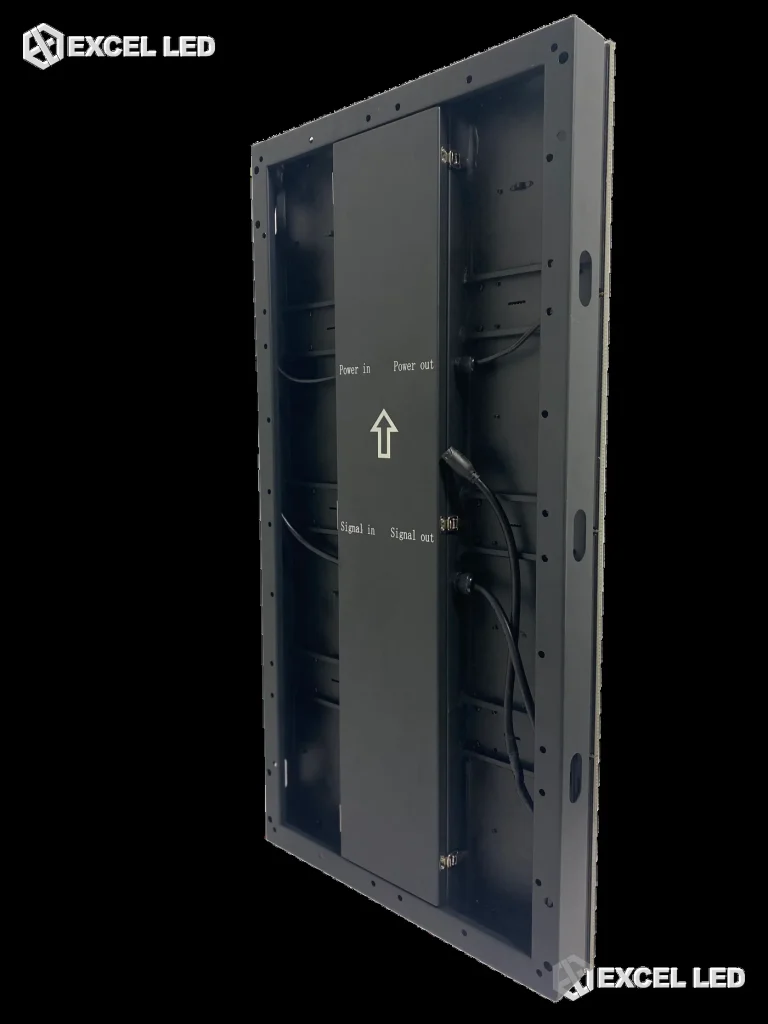
The footprints are not interchangeable on every platform: 500×1000 belongs to the 500x1000mm iron cabinet floor screen (P2.97–P6.25, permanent install), while 500×500 serves the 500x500mm COD floor tiles (P1.5–P2.6) and the 500x500mm die-cast rental dance floor (P1.5–P6.25). Pitch and IP follow the platform, not the footprint.
| Item | 500×500 LED Floor Tile | 500×1000 LED Floor Tile |
|---|---|---|
| Area / weight per cabinet | 0.25 m² / 11 kg | 0.5 m² / 22.5 kg |
| Cabinet dimensions | 500×500×73 mm (COD) or 500×500×82 mm (die-cast) | 500×1000×77 mm (iron cabinet) |
| Pitch range offered | P1.5–P2.6 (COD) / P1.5–P6.25 (die-cast, no P5.2) | P2.97–P6.25 (iron cabinet) |
| IP rating front / back | IP31 (COD, indoor) / IP65 front IP54 back (die-cast, manufacturer-stated) | IP54 front / IP53 back |
| Load rating | 2,000 kg/m² | 2,000 kg/m² |
| Best fit | Curves, cut-outs, rental fleets, fine pitch | Large regular areas, permanent venues |
500×500 vs 500×1000 LED Floor Tile Maths: Area, Seam Count and Pixel Grid
A 500×500 cabinet covers 0.25 m², a 500×1000 cabinet covers 0.5 m². On the same 10 m² floor that is 40 tiles against 20 cabinets — twice the units, each one another lift, another alignment, another line on the packing list (illustrative).
Seams follow the same arithmetic. On a 4.0 × 2.5 m floor a 500 mm grid gives 8 × 5 = 40 tiles and 11 internal seam lines (7 vertical, 4 horizontal), about 33.5 m; long-side 500×1000 gives 4 × 5 = 20 cabinets and 7 lines, about 23.5 m (illustrative).
| Metric on a 10 m² floor | 500×500 LED Floor Tile | 500×1000 LED Floor Tile |
|---|---|---|
| Units to level | 40 | 20 |
| Internal seam lines (4.0 × 2.5 m) | 11 | 7 |
| Internal seam length | ~33.5 m | ~23.5 m |
| Pixels per m² at P3.91 (illustrative) | 65,536 | 65,536 |
The pixel count does not move: at P3.91 a 500×500 tile carries 128 × 128 pixels and a 500×1000 cabinet 128 × 256 — both 65,536 per m². What changes is pitch availability: P1.5–P2.6 exists only in the 500×500 COD format.
Load Path and Structural Behaviour in 500×500 and 500×1000 LED Floor Tiles
Both footprints are rated 2,000 kg/m², and on both the load runs from module to cabinet frame to rails or feet to the site structure — the display components carry no weight. Per cabinet that is roughly 500 kg on a 500×500 and 1,000 kg on a 500×1000 (derived from the same rating).
The real divergence is span: a 1 m cabinet bridges further between feet, so a 3–4 mm slab dip a 500 mm tile absorbs locally becomes a rock or lip across a metre. Long cabinets need a levelled structure; short tiles forgive an uneven slab. Both sit in a 300–650 mm pit per the installation drawings.
Two rules hold for both sizes: the rating covers crowds and trolleys, while a car wheel, forklift or stage leg is a point load needing written factory confirmation; and 2,000 kg/m² is about 45× the cabinet’s own 44–45 kg/m², so the structure beneath the floor is usually the limit (illustrative).

Build Speed and Crew Size: 500×500 vs 500×1000 LED Floor Tiles
Weight decides the build. An 11 kg 500×500 tile is a one-person carry; a 22.5 kg 500×1000 iron cabinet is a two-person lift with its rail or feet base set first.
Counter-intuitively, the long cabinet is usually faster per square metre when access is good — half the units means half the lifts, alignments and seam work. That advantage dies at a narrow service lift, a spiral stair or a 900 mm door.
| Build stage (10 m²) | 500×500 LED Floor Tile | 500×1000 LED Floor Tile |
|---|---|---|
| Units to move and set | 40 | 20 |
| Heaviest single lift | 11 kg | 22.5 kg |
| Minimum crew | 1–2 people | 2 people |
| Alignment points | 40 | 20 |
| Typical lay time, 2 crew (illustrative) | ~2 hours | ~1.5 hours |
A two-person crew taking whatever load-in the venue offers means 500×500; a fixed venue with a dock and a flat slab converts the same labour into a cleaner grid with 500×1000.
Logistics: Truck Space, Flight Cases and Storage for Both LED Floor Tiles
Volume follows the envelope: about 0.018 m³ for a 500×500×73 mm COD cabinet, 0.021 m³ for the 82 mm die-cast and 0.039 m³ for the 500×1000×77 mm iron cabinet — roughly 0.073 / 0.082 / 0.077 m³ per m², within 10% (illustrative, cabinet envelope only).
Item count does scale. A 40 m² floor is 160 tiles or 80 cabinets: same area, same cube, twice as many items to scan and handle at load-in (illustrative). Cabinet mass is identical at 44–45 kg/m² before cases, and case hardware adds substantially (industry practice).
Storage favours the small tile: a 500×500 inventory can ship exactly 12 m² without opening a second crate and split across two vans, while a 1 m crate needs wider access and forklift tines set for a metre. Confirm case dimensions and pallet plan before booking freight.
Curves, Cut-Outs and Creative Layouts with 500×500 and 500×1000 LED Floor Tiles
A curved floor is built from straight cabinets, so the question is how much angle each joint absorbs before faceting shows. On a 6 m circle a 500 mm chord subtends about 9.6° and a 1 m chord 19.2° (illustrative) — hence 500×500 is the curve format: more joints, smaller angles, a smoother arc. The die-cast platform adds hang and curve capability.
Cut-outs follow the same logic. Logos, circular features, tree pits and column surrounds are infill work, and a 500×500 closes a shape with less waste. Cutting a 500×1000 in half yields a nominal 500×500 piece, but a cut cabinet loses its sealed edge — a perimeter compromise, not an option (industry practice).
Service Access and Spare Strategy for Each LED Floor Tile Size
Both formats are front maintenance: the faulty cabinet comes out through the walking surface with no pit access. The difference is the hole — a failed 500×500 blanks 0.25 m², a failed 500×1000 blanks 0.5 m², a patch content hides versus a visible dark rectangle.
Spares split into two numbers. Module spares scale with area: 250×250 mm modules give 16 per m², so 1,600 per 100 m² either way, and 2–4 spares per 100 m² on site is a working start (industry practice). Cabinet spares scale with unit count: 400 tiles or 200 cabinets per 100 m².
Order spares with the original production batch so colour and brightness binning still match a year later. Every floor ships after factory aging testing under a 2-year warranty, and certification is per model: quote CE / FCC / RoHS / CCC certified models against your exact configuration.

When 500×500 Wins, When 500×1000 Wins: LED Floor Tile Decision Checklist
Work through these in order; the first hard constraint decides the format.
- Anything curved, angled or cut out? Yes → 500×500, for the finer joint grid.
- Does the floor travel? Yes → 500×500 die-cast at 11 kg with quick locks; 500×1000 iron is permanent-install.
- Is P2.6 or finer required? Yes → 500×500 COD, the only format reaching P1.5–P2.6.
- Is access restricted? Stairs, a narrow lift, a 900 mm door → 500×500, on handling alone.
- Large, regular, flat area with a dock? Yes → 500×1000: half the units, half the seams.
- Substrate flatness surveyed? If slab tolerance is unknown, prefer the shorter span and confirm with your contractor.
| Scenario | Size that wins | Why |
|---|---|---|
| Rental fleet, weekly load-in | 500×500 die-cast | 11 kg units, quick locks, cased packing |
| Fixed nightclub floor, 60–100 m² | 500×1000 iron cabinet | Half the units and seams; P2.97–P6.25 for 3–8 m viewing |
| Flagship retail, arm’s-length viewing | 500×500 COD | P1.5–P2.6 fine pitch, matte surface |
| Curved runway or circular feature | 500×500 | Smaller chord angle per joint, less faceting |
| Mall atrium, large rectangle, trolleys | 500×1000 iron cabinet | Fewer seams to level; IP54 front for spills |
Either way the platform shares one interactive foundation: 2,000 kg/m² load paths, front maintenance, 800 W/m² maximum and 270 W/m² average power, 1,920/3,840 Hz refresh, ≥14-bit grey scale, 120° viewing and ≥100,000 h rated life. See the LED floor screen collection or the LED floor display buying guide.
LED Floor Tile Size FAQ
Q1Is 500×500 or 500×1000 better for an LED floor tile?
Neither is better in the abstract: 500×500 wins on handling, curves and cut-outs, 500×1000 on build speed and seam count. Settle the constraint that cannot change first.
Q2Does cabinet size change pixel pitch or resolution?
No. At equal pitch both formats use 250×250 mm modules, so pixel density per square metre is identical. The platform changes which pitches exist — P1.5 to P2.6 in the 500×500 COD.
Q3Is the 500×1000 cabinet available in the rental platform?
No. The 500x1000x77 mm format is the iron cabinet platform for permanent install with rails or feet; the die-cast rental platform is 500x500x82 mm at 11 kg.
Q4How many cabinets do I need per square metre?
Four 500×500 cabinets per square metre at 0.25 m², or two 500×1000 at 0.5 m² — 40 tiles or 20 cabinets for 10 m², plus trim and cut tiles.
Q5Can a 500×1000 cabinet be used on a curved floor?
Only with visible faceting: on a 6 m circle a 1 m chord turns about 19 degrees per joint against 9.6 degrees for 500 mm. For curves, specify 500×500.
Q6How heavy is each cabinet, and how many people are needed?
A 500×500 cabinet is 11 kg in both COD and die-cast formats; a 500×1000 iron cabinet is 22.5 kg and a two-person lift.
Q7Do both sizes carry the same load rating?
Yes, 2,000 kg/m² for both, with load through the cabinet structure. The die-cast platform offers a manufacturer-stated 3,000 kg/m² option.
Q8Which size should a rental fleet standardise on?
500×500: the die-cast rental format at 11 kg with quick locks, magnetic front maintenance and cases small enough for a service lift.
Related guides: LED floor screen weight capacity explained and LED floor screen installation guide.
LED Floor Tile Size: One Decision, Three Platforms
Cabinet size decides how the floor is built, packed, curved and serviced; pitch decides what it looks like; the platform decides what is possible. Get that order right and the floor meets its install window, load case and spare plan without a redesign on site.
Related reading: LED floor screen collection · LED floor display buying guide · 500x1000mm iron cabinet floor · 500x500mm COD floor tiles · 500x500mm die-cast rental floor